
RevenueCat
A subscription infrastructure platform with analytics, paywalls, experiments and web funnels for app developers.
RevenueCat powers purchases for over 100,000 apps and publishes an annual State of Subscription Apps report. Its data says hard paywalls convert five times better than freemium, about 80% of payers convert on day one, and nearly a third of Google Play cancellations are involuntary billing failures. Lesson: use these benchmarks to test paywalls and fix billing recovery, but read them as correlations.
From RevenueCat State of Subscription Apps 2026
What was said about RevenueCat
1The State of Subscription Apps report: a winner-take-most market
RevenueCat turned its customer data into the benchmark operators lacked. Teams stare at their own dashboards and can't tell if their numbers are good, so RevenueCat publishes an annual State of Subscription Apps report from what Rik Haandrikman calls the biggest cross-platform monetization data set. It powers purchases for over 100,000 apps across Apple, Google, web and Amazon.
The 2026 edition is the fourth, runs about 300 pages and took four months to write; it isn't capped, so it grows each year. Data is anonymized and aggregated, which is why it shows distributions rather than scatter plots, and only apps with active subscription revenue above install and revenue thresholds are included.
Growth concentrates at the top while new app supply explodes. The top 10% of apps grew 306% year over year while the median grew 5.3%, and the top 25% grew 80%. New subscription apps per month rose from 2,000 in January 2022 to 14,700 in January 2026, about 7x, most of it in the last six months.
iOS now takes 77% of new launches, up from 67% in 2023. RevenueCat sees daily app submissions roughly triple, with about 7x more new users a month but roughly the same support ticket volume, because new customers talk to an AI agent that sets up their account. Jacob Eiting: "These markets are just sorting machines."
Old apps still earn most of the money because winners compound. 69% of store revenue comes from apps released before 2020; apps from 2020 to 2021 earn 9% and apps from 2022 to 2023 earn 14%.
Strava, ClassDojo, Duolingo and the big media apps are named as compounding winners. Eiting says this chart is where disruption would show first if newer cohorts start taking share.
With polish now table stakes, niche focus and community decide winners. In the Shipyard hackathon, 15% as many participants delivered twice as many finished products at a much higher quality bar, so a finished-looking app no longer stands out. Cal AI won users who wanted speed over perfect macros and was acquired by My Fitness Pal; Shotsy started as a tool for its founder's GLP-1 Reddit group.
Rik says niche apps can now reach $10 to 20 million ARR and that building in public only works inside the community you serve, such as Studyfetch on TikTok where students look for study help. "You could probably make something that looks and feels like Duolingo for the first 30 minutes, but then it'll be done."
Subscription retention makes paid acquisition a sound bet. With about 30% annual retention, a $1M ad spend in March 2026 yields about $300K of free cash flow in March 2027, assuming the spend pays back within the first year.
Churned customers also stay on a list that can be marketed to for years. Eiting still sees venture capital as a rare fit for apps.
Read report benchmarks as correlations and test them on your app. The figures mix selection effects, such as who chooses long trials, and the median 5.3% growth includes apps owners have abandoned. Run the test on your own business before adopting a benchmark.
The data covers only apps using RevenueCat's SDK, and which apps count as AI is a subjective call. Eiting treats a 33% drop as the sign to rethink strategy. "You should never take one of these single data points and treat it as gospel."
2Hard paywalls, trials and the first session
- 10.7% download-to-paid by day 35
- 26.8% median year-one retention
- 2.1% download-to-paid by day 35
- 27.7% median year-one retention
About 5x conversion, retention nearly the same
From RevenueCat State of Subscription Apps data
Hard paywalls convert about five times better than freemium without hurting retention. Download-to-paid by day 35 is 10.7% for hard paywalls against 2.1% for freemium (cited as 2.7% in another talk), while median year-one retention is 26.8% versus 27.7%.
Phil Carter saw one client's shift to freemium cut subscriber conversion by more than 50%, so it was pulled after a couple of weeks. Freemium suits apps chasing a huge top of funnel like Spotify, Duolingo and Strava, and only works if free users bring value through upsells, ads or organic growth. The hard paywall figure ignores users who never reach a paywall.
Most users decide on day zero, so onboarding and paywall carry the business. 80 to 90% of trial starts and half of conversions happen on day 0, and 55% of 3-day trial cancellations happen on day zero. About 80% of payers across the industry convert on day one.
34% of annual subscribers who churn cancel in the first month, and only 11% cancel right at renewal. Mojo gets about 50% of payers on day one and reads that lower share as a sign of good retention and a base of existing users still to monetize.
Longer trials often convert better, yet the industry keeps shortening them. RevenueCat's data shows 14 to 30 day trials often convert better, while most companies trend toward shorter trials. Carter suspects AI apps drive the trend because free usage burns compute.
The hosts admit longer trials may look better only because of selection bias.
Turn on grace periods and billing retry on Android. Nearly a third of all subscription cancellations on Google Play are involuntary billing failures, from causes like prepaid cards running out and no auto-recovery path like iOS.
Enable grace periods and retry features and tell users about payment problems, especially once Android is more than experimental revenue.
3AI apps: more revenue per payer, faster churn
AI apps earn more per payer but lose users faster. AI apps make 41% more revenue per payer but churn 30% faster, with year-one retention of 21% against 31% for other apps.
Users hop between AI tools like streaming services and return when a better model launches, so reactivation is strong. Rik argues only products built on a bond beyond being a tool hold users.
Compute costs push AI apps to short trials, credits and paid tiers. Serving each user costs real compute, so AI apps use very short trials or none, metered credits and extra paid tiers. A 30-day free trial lets heavy users rack up costs and churn without paying.
Tolen started with a 7-day trial and adjusted trial length and freemium over time. "You have whales racking up massive compute costs without paying you a dime and then they churn."
4Building AI into RevenueCat's own product
Check whether an AI feature is affordable for every user every day. RevenueCat builds on a frontier Claude model and estimated one LLM call per app per day would cost tens of thousands of dollars a month. Opus pricing had not come down in six months.
Cheaper models often fail on trivial tasks once you have used the best one, so routing is not a free fix. Eiting's view is that venture money fits products with viral growth and high inference costs, betting costs fall in time. "Can we afford to do this for every user every day?"
It uses top models for its data chatbot, expecting costs to fall. RevenueCat is building Rico, an agent that answers questions about revenue data, plus agentic paywall creation for vibe-coded apps.
Carter argues model choice should match the customer, planning 6 to 12 months out as prices fall; David Barnard pushed back that premature cost optimization can cost you the best experience.
5How the team works
A judgment-free Slack channel for dumb ideas produced major initiatives. The default assumption in the channel is that an idea is bad, so people share without fear. The AppGrowth conference, planned in three months, and App Store rejection socks both came from it.
Staff spend one to two hours a day tinkering with AI tools. Rik tells his team to pause regular work daily to try tools like Perplexity, computer use and OpenClaw, and the company moved everyone onto Manus for complex projects, making the team much faster.
Rik runs an OpenClaw setup on a Mac Mini that builds niche apps around the clock. "Whatever you invest now is almost certainly going to pay dividends."
CEO involvement signals priority, and a clear line prevents product drift. Jacob Eiting gets involved in priorities, which signals importance and brings his knowledge. He also recalled mascot characters creeping onto every dashboard page until the product looked like a McDonald's.
6How app teams use RevenueCat data
Mojo used new-cohort 7-day ARPU as its single monetization metric. Mojo picked a 7-day window to cover its 3-day trial and confirmed paywall and pricing lifts in RevenueCat Charts, which offered 7-day ARPU as a view.
RevenueCat's blog first published Mojo's yearly-only default paywall test.
Overlay revenue spikes on posting dates to see which content converts. Sideshift lays RevenueCat and Stripe revenue, plus App Store installs, over creator video performance to see which organic videos drive revenue, connecting Superwall too.
Attribution stays imperfect since you only feel the million-view hits; checking creator audience geography helps detect view botting. "It's always the attribution piece that is so foggy."
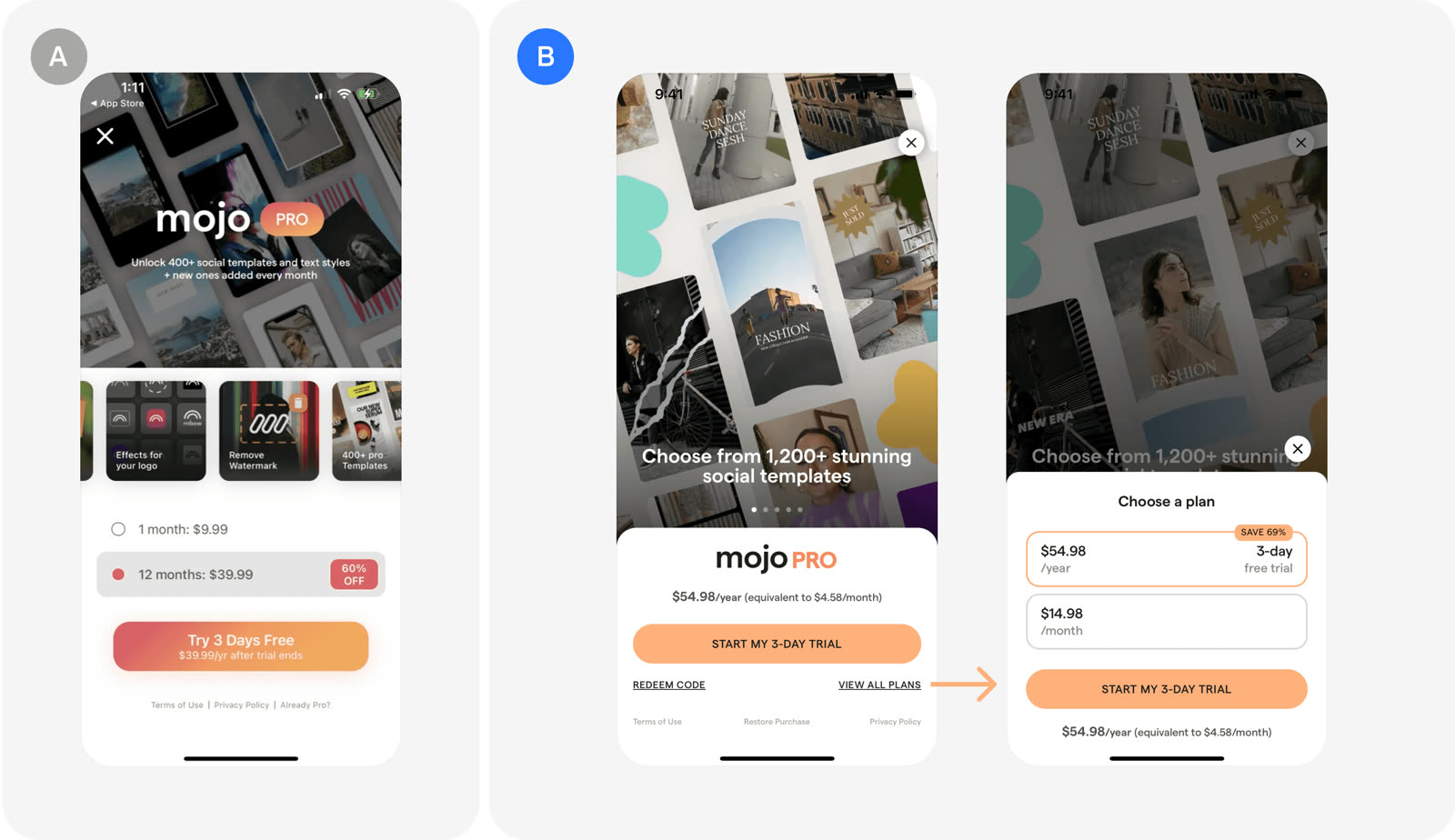
Version A and version B as Mojo tested them. Longer lookbacks and combined views help teams judge matured cohorts. RevenueCat widened its experiment lookback window to over a year, which BoldVoice finds easier than homemade analytics. Ryan Thorpe pulled RevenueCat, App Store Connect, Google Play and ad data into spreadsheets before building Flo to combine them.
Coconote's Zack Hargett watched the RevenueCat chart from day one, treating paying customers as a stronger signal than usage events.
Payments integrations open new revenue, like HSA billing. Natal added HSA billing through the RevenueCat and Flex integration and saw tens of thousands of dollars come through in two weeks with no announcement.
Pre-tax money acts like a 30 to 40% discount, and RevenueCat's Daily Payouts is a factoring product that could extend to loans against run rate.

Are You Ignoring These RevenueCat Features? (Stop Losing Money)
Its charts on revenue mix, trial conversion and LTV show whether a subscription app is healthy. Steve runs A/B paywall experiments on a custom paywall, finds the built-in builder basic, and plans to test its web-to-app funnels and API.
Mojo used new-cohort 7-day ARPU as its single monetization metric. Mojo picked a 7-day window to cover its 3-day trial and confirmed paywall and pricing lifts in RevenueCat Charts, which offered 7-day ARPU as a view.
RevenueCat's blog first published Mojo's yearly-only default paywall test.

Insights from RevenueCat’s 2026 State of Subscription Apps Report
Powers in-app purchases for over 100,000 apps and publishes a roughly 300-page annual State of Subscription Apps report that takes four months to write. Its Slack channel for dumb ideas produced the AppGrowth conference and App Store rejection socks, and the team moved onto Manus for complex projects.
CEO involvement signals priority, and a clear line prevents product drift. Jacob Eiting gets involved in priorities, which signals importance and brings his knowledge. He also recalled mascot characters creeping onto every dashboard page until the product looked like a McDonald's.

The Top 10% of Apps Grew 306%. Everyone Else? Barely Beat Inflation | SOSA 2026
Publishes the annual State of Subscription Apps report from its anonymized customer data. It is building Rico, an agent that answers questions about revenue data, and agentic paywall creation for vibe-coded apps.
Overlay revenue spikes on posting dates to see which content converts. Sideshift lays RevenueCat and Stripe revenue, plus App Store installs, over creator video performance to see which organic videos drive revenue, connecting Superwall too.
Attribution stays imperfect since you only feel the million-view hits; checking creator audience geography helps detect view botting. "It's always the attribution piece that is so foggy."
Version A and version B as Mojo tested them.
Insights from RevenueCat’s 2025 State of Subscription Apps Report
Founded in 2017 after Elevate's in-house billing pain, it now handles roughly the whole app store subscription revenue it originally targeted, a market that grew 20x. Product-market fit came from infrastructure, charts and just-in-time integrations, and a too-early 2021 Series B led to slow growth through 2023.
Longer lookbacks and combined views help teams judge matured cohorts. RevenueCat widened its experiment lookback window to over a year, which BoldVoice finds easier than homemade analytics. Ryan Thorpe pulled RevenueCat, App Store Connect, Google Play and ad data into spreadsheets before building Flo to combine them.
Coconote's Zack Hargett watched the RevenueCat chart from day one, treating paying customers as a stronger signal than usage events.

Yearly plan as the default: Mojo's A/B test
Its blog first published the write-up of Mojo's yearly-only paywall test.
Overlay revenue spikes on posting dates to see which content converts. Sideshift lays RevenueCat and Stripe revenue, plus App Store installs, over creator video performance to see which organic videos drive revenue, connecting Superwall too.
Attribution stays imperfect since you only feel the million-view hits; checking creator audience geography helps detect view botting. "It's always the attribution piece that is so foggy."
Version A and version B as Mojo tested them.
How Praktika built a profitable $50M ARR AI business — Adam Turaev, Praktika
CEO Jacob Eiting shared that its mascot characters crept onto every dashboard page until the product looked like a McDonald's, as an example of product drift without a clear line.
CEO involvement signals priority, and a clear line prevents product drift. Jacob Eiting gets involved in priorities, which signals importance and brings his knowledge. He also recalled mascot characters creeping onto every dashboard page until the product looked like a McDonald's.
Before You Spend $1 on Meta Ads, Watch This
Its State of Subscription Apps report gives a median iOS download-to-paid of 2.6% by day 35 and about 33% median iOS trial-to-paid. It is also a place to check LTV per install.
Check whether an AI feature is affordable for every user every day. RevenueCat builds on a frontier Claude model and estimated one LLM call per app per day would cost tens of thousands of dollars a month. Opus pricing had not come down in six months.
Cheaper models often fail on trivial tasks once you have used the best one, so routing is not a free fix. Eiting's view is that venture money fits products with viral growth and high inference costs, betting costs fall in time. "Can we afford to do this for every user every day?"
Payments integrations open new revenue, like HSA billing. Natal added HSA billing through the RevenueCat and Flex integration and saw tens of thousands of dollars come through in two weeks with no announcement.
Pre-tax money acts like a 30 to 40% discount, and RevenueCat's Daily Payouts is a factoring product that could extend to loans against run rate.

How To Grow Your App 23x Faster Than The Competition
Sideshift overlays RevenueCat revenue spikes on video performance to show which creator content drives revenue, though the attribution is imperfect.
Payments integrations open new revenue, like HSA billing. Natal added HSA billing through the RevenueCat and Flex integration and saw tens of thousands of dollars come through in two weeks with no announcement.
Pre-tax money acts like a 30 to 40% discount, and RevenueCat's Daily Payouts is a factoring product that could extend to loans against run rate.
Why BoldVoice charged from day 1 and ignored the Duolingo freemium playbook — Anada Lakra
It has widened its experiment lookback window to over a year, which makes checking back on matured cohorts easier than with homemade analytics.
Hard paywalls convert about five times better than freemium without hurting retention. Download-to-paid by day 35 is 10.7% for hard paywalls against 2.1% for freemium (cited as 2.7% in another talk), while median year-one retention is 26.8% versus 27.7%.
Phil Carter saw one client's shift to freemium cut subscriber conversion by more than 50%, so it was pulled after a couple of weeks. Freemium suits apps chasing a huge top of funnel like Spotify, Duolingo and Strava, and only works if free users bring value through upsells, ads or organic growth. The hard paywall figure ignores users who never reach a paywall.
Longer trials often convert better, yet the industry keeps shortening them. RevenueCat's data shows 14 to 30 day trials often convert better, while most companies trend toward shorter trials. Carter suspects AI apps drive the trend because free usage burns compute.
The hosts admit longer trials may look better only because of selection bias.
Compute costs push AI apps to short trials, credits and paid tiers. Serving each user costs real compute, so AI apps use very short trials or none, metered credits and extra paid tiers. A 30-day free trial lets heavy users rack up costs and churn without paying.
Tolen started with a 7-day trial and adjusted trial length and freemium over time. "You have whales racking up massive compute costs without paying you a dime and then they churn."
It uses top models for its data chatbot, expecting costs to fall. RevenueCat is building Rico, an agent that answers questions about revenue data, plus agentic paywall creation for vibe-coded apps.
Carter argues model choice should match the customer, planning 6 to 12 months out as prices fall; David Barnard pushed back that premature cost optimization can cost you the best experience.
We’ve Tested 100s of Paywalls. Here’s What Actually Converts.
Its State of Subscription report finds nearly all trial starts happen on day zero, and users who don't try immediately rarely try at all.
RevenueCat turned its customer data into the benchmark operators lacked. Teams stare at their own dashboards and can't tell if their numbers are good, so RevenueCat publishes an annual State of Subscription Apps report from what Rik Haandrikman calls the biggest cross-platform monetization data set. It powers purchases for over 100,000 apps across Apple, Google, web and Amazon.
The 2026 edition is the fourth, runs about 300 pages and took four months to write; it isn't capped, so it grows each year. Data is anonymized and aggregated, which is why it shows distributions rather than scatter plots, and only apps with active subscription revenue above install and revenue thresholds are included.
Growth concentrates at the top while new app supply explodes. The top 10% of apps grew 306% year over year while the median grew 5.3%, and the top 25% grew 80%. New subscription apps per month rose from 2,000 in January 2022 to 14,700 in January 2026, about 7x, most of it in the last six months.
iOS now takes 77% of new launches, up from 67% in 2023. RevenueCat sees daily app submissions roughly triple, with about 7x more new users a month but roughly the same support ticket volume, because new customers talk to an AI agent that sets up their account. Jacob Eiting: "These markets are just sorting machines."
Old apps still earn most of the money because winners compound. 69% of store revenue comes from apps released before 2020; apps from 2020 to 2021 earn 9% and apps from 2022 to 2023 earn 14%.
Strava, ClassDojo, Duolingo and the big media apps are named as compounding winners. Eiting says this chart is where disruption would show first if newer cohorts start taking share.
With polish now table stakes, niche focus and community decide winners. In the Shipyard hackathon, 15% as many participants delivered twice as many finished products at a much higher quality bar, so a finished-looking app no longer stands out. Cal AI won users who wanted speed over perfect macros and was acquired by My Fitness Pal; Shotsy started as a tool for its founder's GLP-1 Reddit group.
Rik says niche apps can now reach $10 to 20 million ARR and that building in public only works inside the community you serve, such as Studyfetch on TikTok where students look for study help. "You could probably make something that looks and feels like Duolingo for the first 30 minutes, but then it'll be done."
Read report benchmarks as correlations and test them on your app. The figures mix selection effects, such as who chooses long trials, and the median 5.3% growth includes apps owners have abandoned. Run the test on your own business before adopting a benchmark.
The data covers only apps using RevenueCat's SDK, and which apps count as AI is a subjective call. Eiting treats a 33% drop as the sign to rethink strategy. "You should never take one of these single data points and treat it as gospel."
Hard paywalls convert about five times better than freemium without hurting retention. Download-to-paid by day 35 is 10.7% for hard paywalls against 2.1% for freemium (cited as 2.7% in another talk), while median year-one retention is 26.8% versus 27.7%.
Phil Carter saw one client's shift to freemium cut subscriber conversion by more than 50%, so it was pulled after a couple of weeks. Freemium suits apps chasing a huge top of funnel like Spotify, Duolingo and Strava, and only works if free users bring value through upsells, ads or organic growth. The hard paywall figure ignores users who never reach a paywall.
Most users decide on day zero, so onboarding and paywall carry the business. 80 to 90% of trial starts and half of conversions happen on day 0, and 55% of 3-day trial cancellations happen on day zero. About 80% of payers across the industry convert on day one.
34% of annual subscribers who churn cancel in the first month, and only 11% cancel right at renewal. Mojo gets about 50% of payers on day one and reads that lower share as a sign of good retention and a base of existing users still to monetize.
AI apps earn more per payer but lose users faster. AI apps make 41% more revenue per payer but churn 30% faster, with year-one retention of 21% against 31% for other apps.
Users hop between AI tools like streaming services and return when a better model launches, so reactivation is strong. Rik argues only products built on a bond beyond being a tool hold users.
Compute costs push AI apps to short trials, credits and paid tiers. Serving each user costs real compute, so AI apps use very short trials or none, metered credits and extra paid tiers. A 30-day free trial lets heavy users rack up costs and churn without paying.
Tolen started with a 7-day trial and adjusted trial length and freemium over time. "You have whales racking up massive compute costs without paying you a dime and then they churn."
A judgment-free Slack channel for dumb ideas produced major initiatives. The default assumption in the channel is that an idea is bad, so people share without fear. The AppGrowth conference, planned in three months, and App Store rejection socks both came from it.
Staff spend one to two hours a day tinkering with AI tools. Rik tells his team to pause regular work daily to try tools like Perplexity, computer use and OpenClaw, and the company moved everyone onto Manus for complex projects, making the team much faster.
Rik runs an OpenClaw setup on a Mac Mini that builds niche apps around the clock. "Whatever you invest now is almost certainly going to pay dividends."
App Ideas That People Are Already Searching For (Steal This Strategy)
Its report shows apps launched before 2020 earn about 69% of subscription revenue while apps from 2025 on earn just 3%. It also shows a steep rise in new iOS apps in 2026 and ranks categories by revenue per install, which stays stable from day 14 to day 60.
Longer lookbacks and combined views help teams judge matured cohorts. RevenueCat widened its experiment lookback window to over a year, which BoldVoice finds easier than homemade analytics. Ryan Thorpe pulled RevenueCat, App Store Connect, Google Play and ad data into spreadsheets before building Flo to combine them.
Coconote's Zack Hargett watched the RevenueCat chart from day one, treating paying customers as a stronger signal than usage events.
#1 UGC EXPERT Reveals How To Market Consumer Apps
SideShift connects it, along with Superwall and Stripe, to show which organic videos drive revenue rather than just correlation spikes.
RevenueCat turned its customer data into the benchmark operators lacked. Teams stare at their own dashboards and can't tell if their numbers are good, so RevenueCat publishes an annual State of Subscription Apps report from what Rik Haandrikman calls the biggest cross-platform monetization data set. It powers purchases for over 100,000 apps across Apple, Google, web and Amazon.
The 2026 edition is the fourth, runs about 300 pages and took four months to write; it isn't capped, so it grows each year. Data is anonymized and aggregated, which is why it shows distributions rather than scatter plots, and only apps with active subscription revenue above install and revenue thresholds are included.
Growth concentrates at the top while new app supply explodes. The top 10% of apps grew 306% year over year while the median grew 5.3%, and the top 25% grew 80%. New subscription apps per month rose from 2,000 in January 2022 to 14,700 in January 2026, about 7x, most of it in the last six months.
iOS now takes 77% of new launches, up from 67% in 2023. RevenueCat sees daily app submissions roughly triple, with about 7x more new users a month but roughly the same support ticket volume, because new customers talk to an AI agent that sets up their account. Jacob Eiting: "These markets are just sorting machines."
Old apps still earn most of the money because winners compound. 69% of store revenue comes from apps released before 2020; apps from 2020 to 2021 earn 9% and apps from 2022 to 2023 earn 14%.
Strava, ClassDojo, Duolingo and the big media apps are named as compounding winners. Eiting says this chart is where disruption would show first if newer cohorts start taking share.
Subscription retention makes paid acquisition a sound bet. With about 30% annual retention, a $1M ad spend in March 2026 yields about $300K of free cash flow in March 2027, assuming the spend pays back within the first year.
Churned customers also stay on a list that can be marketed to for years. Eiting still sees venture capital as a rare fit for apps.
Read report benchmarks as correlations and test them on your app. The figures mix selection effects, such as who chooses long trials, and the median 5.3% growth includes apps owners have abandoned. Run the test on your own business before adopting a benchmark.
The data covers only apps using RevenueCat's SDK, and which apps count as AI is a subjective call. Eiting treats a 33% drop as the sign to rethink strategy. "You should never take one of these single data points and treat it as gospel."
Hard paywalls convert about five times better than freemium without hurting retention. Download-to-paid by day 35 is 10.7% for hard paywalls against 2.1% for freemium (cited as 2.7% in another talk), while median year-one retention is 26.8% versus 27.7%.
Phil Carter saw one client's shift to freemium cut subscriber conversion by more than 50%, so it was pulled after a couple of weeks. Freemium suits apps chasing a huge top of funnel like Spotify, Duolingo and Strava, and only works if free users bring value through upsells, ads or organic growth. The hard paywall figure ignores users who never reach a paywall.
Most users decide on day zero, so onboarding and paywall carry the business. 80 to 90% of trial starts and half of conversions happen on day 0, and 55% of 3-day trial cancellations happen on day zero. About 80% of payers across the industry convert on day one.
34% of annual subscribers who churn cancel in the first month, and only 11% cancel right at renewal. Mojo gets about 50% of payers on day one and reads that lower share as a sign of good retention and a base of existing users still to monetize.
Longer trials often convert better, yet the industry keeps shortening them. RevenueCat's data shows 14 to 30 day trials often convert better, while most companies trend toward shorter trials. Carter suspects AI apps drive the trend because free usage burns compute.
The hosts admit longer trials may look better only because of selection bias.
Turn on grace periods and billing retry on Android. Nearly a third of all subscription cancellations on Google Play are involuntary billing failures, from causes like prepaid cards running out and no auto-recovery path like iOS.
Enable grace periods and retry features and tell users about payment problems, especially once Android is more than experimental revenue.
AI apps earn more per payer but lose users faster. AI apps make 41% more revenue per payer but churn 30% faster, with year-one retention of 21% against 31% for other apps.
Users hop between AI tools like streaming services and return when a better model launches, so reactivation is strong. Rik argues only products built on a bond beyond being a tool hold users.
It uses top models for its data chatbot, expecting costs to fall. RevenueCat is building Rico, an agent that answers questions about revenue data, plus agentic paywall creation for vibe-coded apps.
Carter argues model choice should match the customer, planning 6 to 12 months out as prices fall; David Barnard pushed back that premature cost optimization can cost you the best experience.
Make Ugly Ads to Grow Your App – Yuliya Lennox (Solid Starts)
Its CEO, Jacob, gets involved in priorities, which signals importance and brings his knowledge and passion.
Most users decide on day zero, so onboarding and paywall carry the business. 80 to 90% of trial starts and half of conversions happen on day 0, and 55% of 3-day trial cancellations happen on day zero. About 80% of payers across the industry convert on day one.
34% of annual subscribers who churn cancel in the first month, and only 11% cancel right at renewal. Mojo gets about 50% of payers on day one and reads that lower share as a sign of good retention and a base of existing users still to monetize.
Mojo used new-cohort 7-day ARPU as its single monetization metric. Mojo picked a 7-day window to cover its 3-day trial and confirmed paywall and pricing lifts in RevenueCat Charts, which offered 7-day ARPU as a view.
RevenueCat's blog first published Mojo's yearly-only default paywall test.
The Bootstrapper's Path to $10M ARR Without Venture Capital – Andrew Maguire, Volo Ventures
Its Daily Payouts product is a factoring product that could extend to loans against run rate. It builds on a frontier Claude model, and one LLM call per app per day would cost tens of thousands of dollars a month.
Longer lookbacks and combined views help teams judge matured cohorts. RevenueCat widened its experiment lookback window to over a year, which BoldVoice finds easier than homemade analytics. Ryan Thorpe pulled RevenueCat, App Store Connect, Google Play and ad data into spreadsheets before building Flo to combine them.
Coconote's Zack Hargett watched the RevenueCat chart from day one, treating paying customers as a stronger signal than usage events.
The Paywall Strategy That Increased Conversions by 56%
Says longer trials convert better, but Young argues the result depends on when the trial is shown.
Copy Our $85,000/Month Apple Ads Strategy
Used to measure revenue without an MMP, including for an app spending about $7,000 a month on Apple Ads that makes about $40,000 MRR.
How Removing the Free Trial Grew Monthly Subs 2000% – Nancy Anderson, Natal
Natal added HSA billing through the RevenueCat and Flex integration, after clients had long been submitting receipts to insurers.
Live App Store Optimization Tutorial (ASO)
Sick Days was built for RevenueCat's first Shipaton, when Flo had little time for a project.
The AI Growth Playbook for Subscription Apps – Phil Carter, Elemental Growth
Its data shows hard paywalls convert five times better than freemium and that 14 to 30 day trials often convert better, though most companies shorten trials. It uses top models for its data chatbot, expecting costs to fall.
$6.7M ARR, No Paid Ads, and an Exit to Quizlet in 2 Years – Brett Bauman & Zack Hargett, Coconote
Zack watched the RevenueCat chart from day one, treating paying customers as a stronger signal of value than usage events, until his wife staged an intervention.
How Mojo Increased ARPU 60% In Just Five Months – Michal Parizek, Mojo
Its Charts showed the new-cohort 7-day ARPU that Mojo used to confirm lifts, and its data shows about 80% of payers across the industry convert on day one. The talk is part of a series for its State of Subscription Apps report.
App Marketing 101: How to Grow in a Crowded App Market
Its data shows only 17% of apps make at least $1,000 a month, which is why distribution matters more than building.
Meet The Guy Dominating The App Store
One of the data sources, alongside App Store Connect, Google Play and ad managers, that had to be pulled into spreadsheets to run the portfolio before Flow.
How Best-In-Class Retention Propelled Flo to a $1B Valuation
Its data show over 80% of trial starts happen in the first 24 hours, which challenges optimizing day-eight ROAS.
The Beginner's Guide to Meta Ads for Web2App Campaigns (Part 1/2)
After a web purchase, RevenueCat syncs the subscription into the app so the user's status is restored. The web user ID reaches the app through a deferred deep link.
How onX Built a Portfolio of Apps to Grow ARR by 10x
Its report finds over 80% of premium app trial starts happen in the first 24 hours, which supports focusing on a new user's first moments.
7 Counterintuitive App Growth Strategies That Actually Work | Steve P. Young at MAU 2025
Its data is cited as showing that AI apps 'print money' and that three plans is the most common paywall setup.
How Runna’s Laser Focus Led to Its Successful Acquisition by Strava
Its published test results on the Dipsy app's app-to-web flow shaped Runna's plan, which was to let others test first. Engineering is now trying a plain link-out and an iframe approach.
My Secret App Monetization Strategies
Hosted the webinar where the Curio email case was shared. Its tooling can tie a web payer to the app user in web-to-app subscription campaigns.
The 5 Biggest Mistakes First-Time App Founders Make
Its data shows only 17% of apps make at least $1,000 a month, so most apps sit in an app store graveyard.
Breaking the Money Taboo: Real Talk on App Store Revenue
Its State of Subscription Apps data shows only 17% of tracked apps reach $1,000 in monthly revenue. Its dashboard shows install, trial and paid rates in one place, like ChartMogul or Google Analytics for app subscriptions.
2 Secret Retention & Monetization Strategies (Stolen From 7-Figure Apps) #retentionstrategies
It offers dynamic paywall functionality too, so LiveOps offers can be shipped fast. The guest says the industry is aligning toward dynamic paywalls.
(Part 3/3 - 6 Figure App Exit) Strategies to sell your cash-generating app
In-app purchase SDK data such as RevenueCat feeds the seller's spreadsheet and shared Google Drive so a buyer can see everything from day one.
Mastering App Monetization: CRM & Discounting Strategies Revealed
Its podcast featured a crossword app CEO who credits community for many premium users, supporting the case for locked content.
Early Stage Strategies to Drive App Subscriptions
Mindful Mamas added it in Q2 of last year across native Android, native iOS and web. It supplies price test graphs, but each new price still needs development work and paywall logic, so they started with only two products.
App Store Connect: iOS Conversion Analysis
Steve prefers pulling data straight from App Store Connect over RevenueCat, because the data comes directly from Apple.
More in Payments & subscriptions
 Payments & subscriptions
Stripe
A payments infrastructure company that lets businesses accept payments and run operations online.
 28 sources · 47 tips
 Payments & subscriptions
Superwall
A paywall builder and testing platform that lets apps design and A/B test subscription paywalls.
13 sources · 27 tips Payments & subscriptions
Adapty
A paywall and subscription management platform for mobile apps.
9 sources · 12 tips Payments & subscriptions
Patreon
A membership platform where creators earn recurring income from their fans.
4 sources · 10 tips Payments & subscriptions
Cash App
A mobile payments app for sending money, spending with a card, and trading stocks and Bitcoin.
 3 sources · 9 tips
 Payments & subscriptions
PayPal
An online payments company Musk co-founded, with no separate engineering department.
 6 sources · 7 tips
 Payments & subscriptions
Paddle
A merchant of record payments platform that handles checkout, tax and compliance for software and app companies.
4 sources · 7 tips Payments & subscriptions
Square
A payments and point-of-sale company for merchants.
6 sources · 10 tips