Pingo
An AI language learning app where users hold spoken conversations with an AI in many languages.
Pingo reached nearly $500k a month 14 months after launching from a dorm, with 350 to 370 million views in 30 days from about 100 creators. What worked: every creator video shows the app, a roast and crying format hit 52 million views, and a trial-timeline paywall beat older versions. Lesson: tie creators to the real product, cull weak ones, and check viewer geography (200k Russian users brought no revenue).
- Launched from college dormSpoken AI conversation chosen as viral hook
- Founders post every videoFirst viral ~100K; Chinese hook ~1M
- Creators take overEvery video must show Pingo on screen
- Mean roast formatOne roast video hit 52M views
- Nearly $500K a month350–370M views in 30 days, ~100 creators
From Pingo co-founders, self-reported interview figures
What was said about Pingo
1Growth from videos that show the app
Pingo was designed so that talking to an AI is the viral hook. Co-founder Michael's earlier food app did poorly, so before building Pingo he asked which AI feature would be inherently viral and chose a spoken conversation with an AI. That conversation became the base of all early UGC.
The visual is four colored sound-wave lines, with no avatar, because the team dislikes the "fake Disney avatar" style. Morrie guesses a minimal look may stand out more as characters become common. Quote: "there's kind of not a point in building a consumer app that won't go viral".
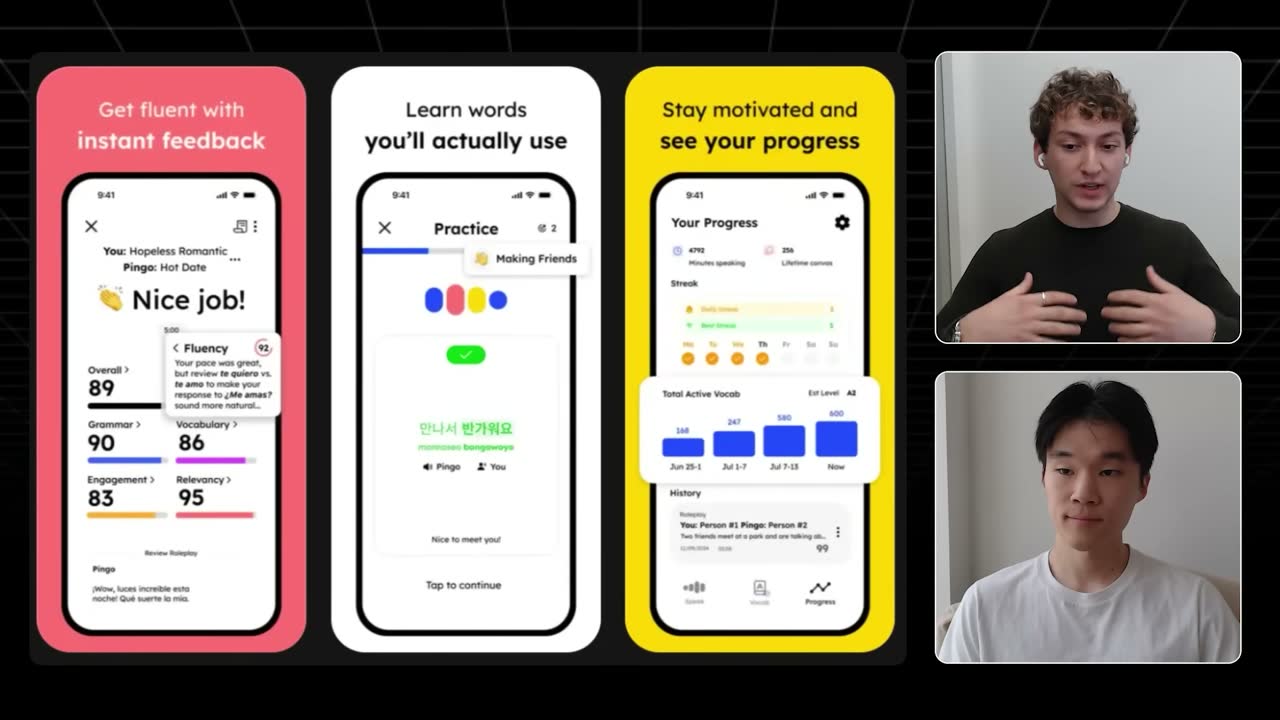
Pingo's app screens: roleplay feedback scores (Fluency 92), vocabulary practice, and progress tracking showing vocab growth to 600. Only videos that show the app itself convert into paying users. Every creator video must feature someone talking to Pingo on screen. Everything that went viral since August used the app, while one creator's videos without it went viral but did not convert.
Slideshows could hit 1 million views, but accounts burned out fast and their conversion versus Pingo videos was "night and day". Learning-tip and demo hooks that did not use Pingo never went viral. Quote: "virality that converts shows and doesn't tell".
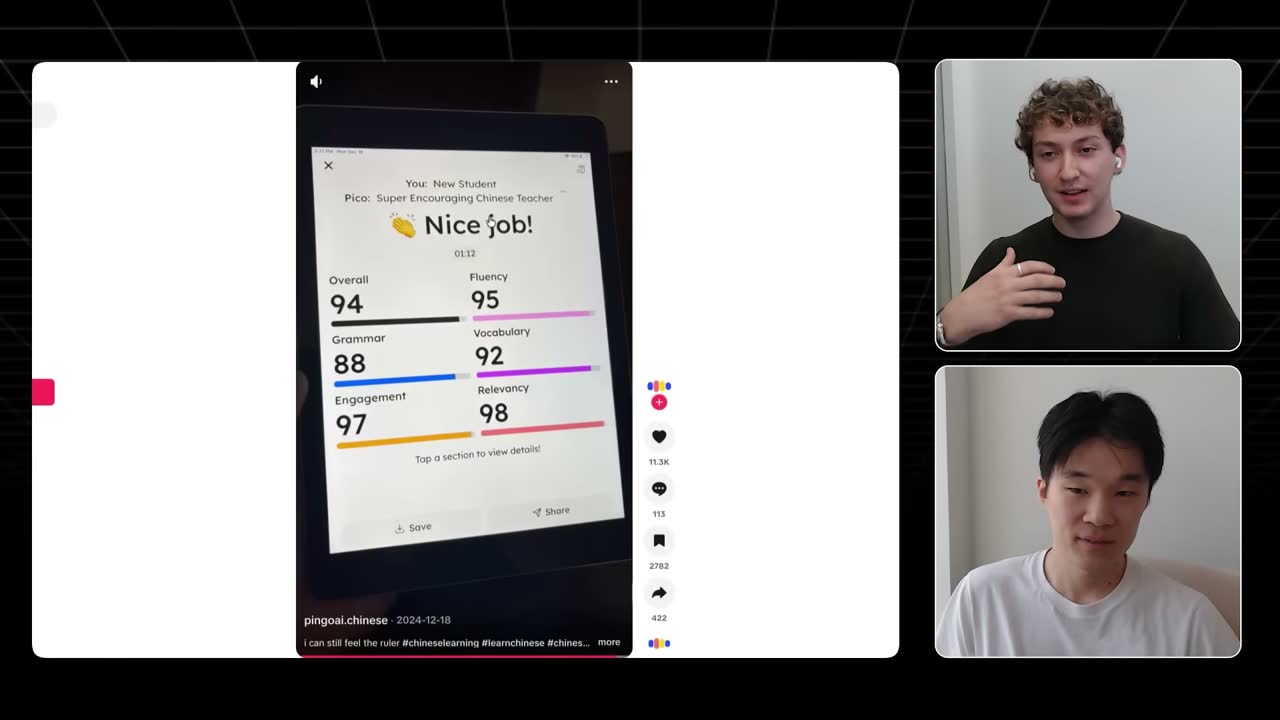
Pingo's first viral TikTok showed its feedback screen: Overall 94, Fluency 95, Engagement 97. The founders made every video themselves until about $20k MRR. For the first three months the two founders posted videos of themselves talking to Pingo on an iPad, using beginner quizzes and cultural hooks. The first viral video got about 100k views; a Chinese hook tied to the TikTok ban and RedNote got about 1 million.
A basic Korean quiz got 77,000 views, and the Korean account beat the Chinese one. With only two creators, any user spike could be traced to one video. Humor layered on culture and learning then went more viral than either alone, and the same concept worked in French.
Repeated virality across languages compounds into about $500k a month. Pingo reached nearly $500k a month 14 months after launching from a college dorm, with 350 to 370 million views in 30 days from about 100 creators.
Korean, German, French, Arabic and Japanese content all hit, with a similar conversion rate. All figures are self-reported and rounded, and no creator cost or CAC is given.
2The mean Pingo roast and crying format
A flexible custom scenario feature let creators invent the roast format. Custom scenarios existed since day one and were never built for marketing. Creators prompted Pingo to be mean, and one roast video hit 52 million views; the format has kept working since September.
The first version had a creator mispronounce a word, Pingo roast them, and the creator cry after a Snapchat-style hook. Variations add props or drop the crying, and sometimes need prompt tricks like calling the chat a play. Users now ask for a built-in "mean" or "18+" toggle, which is on the roadmap.
Scale a winning format by sending creators the example and why it worked. When a format goes viral with one creator, the team sends others the video, why it likely went viral, and the key steps, asking them to "recreate this as close as possible in your target language". A variation of the crying meme was scaled this way.
For a brand new format, the team makes an example video themselves first. They are also considering having about 20 core creators post the same new format on one day to engineer a spike, and Morrie says he has no idea if it will work.
3Running about 100 creators like a VC portfolio
Cut the bottom creators, coach the middle, keep recruiting. The top 20 to 30% of creators drive most views and the bottom adds almost nothing. Pingo cut 30 to 50 creators and now sits near 100.
Each new creator gets an internal deadline before a keep-or-cut decision. Quote: "We cut the bottom of the portfolio. Kept the top, working on the mid-range."
Recruit micro creators in the language niche with one breakout video. Targets are creators under 10k followers, up to about 30k, who post about learning the target language and have gone viral at least once. Some under 2,000 followers blew up.
VAs search keywords like "learning German", then "German major", with native speakers last, and send a simple DM naming the app and its user count; that count grew from tens of thousands to three million without changing the message. Interested creators move to email so a CRM tracks follow-ups.
Pay a base fee plus non-stacking view milestone bonuses. Creators get base pay per video plus bonus tiers at 50k, 100k, 200k, 500k and 1M views, earning only the highest tier reached. A creator at 200,000 views gets the $100 tier, not $150.
A past breakout makes the bonus feel reachable; someone who never went viral may find 50,000 views unthinkable.
Coach execution like lighting and audio before changing ideas. Many flopped videos had good ideas but bad lighting, odd angles, awkward framing or weak audio, so Pingo started content coaching about a week before the interview. A Discord lets creators share what went viral.
About 30 of roughly 100 creators come up with their own ideas; 20 are good and 10 standout. Coaching results are not yet known.
4Going viral in Russia, where users could not pay
Check which country views come from before scaling a language. Russian content brought about 200 thousand users in February who could not pay, since Apple and Google block payments there under sanctions. About 5,000 of 12,000 new Android users in one month were Russian.
Viewer country does not follow creator location: a UK-based creator had 90-something percent Russian viewership. The team now tracks where each video goes viral and kills formats that pull unmonetizable geos. The cause of the Russian viewership is a guess.
5The paywall and trial tests
- Single page offer
- Testimonial and value variants also tested
- Today, day 5, day 7 billing
- Reminder 2 days before trial ends
- Cancel-anytime messaging
Low-risk trial framing won; became the control
From Pingo co-founders on paywall tests
A trial timeline paywall won by making the trial feel low risk. The winner spells out today, day 5 and day 7 when billing starts, with a reminder 2 days before the trial ends and cancel-anytime messaging. It beat the older one-page paywall and testimonial and value-focused variants, and became the control.
Quote: "reinforcing the low risk nature of this trial like really helped with conversion".
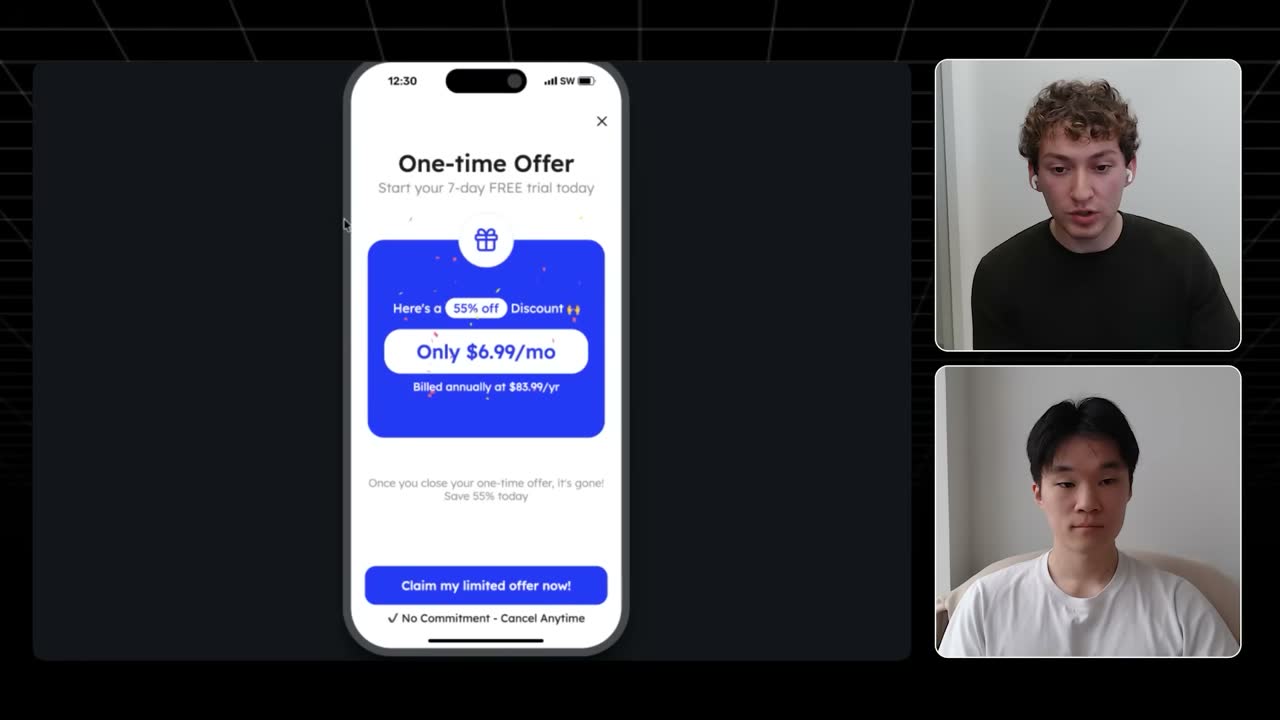
Pingo's original one-time offer paywall: 55% off, $6.99/mo billed annually at $83.99/yr. Offer a 7-day trial to users who abandon the 3-day offer. Users who abandon a 3-day trial see a second paywall with 7 days, which converts higher. Internationally a 7-day trial converted about 2% higher than 3-day; in the US the gap was about 0.3 to 0.7 percent.
Pingo splits paywall tests between the US and other countries, partly to move US billing to Stripe web checkout for better margins, which is not possible internationally. A 10 or 14 day abandon trial is planned. The trial data was incomplete when discussed.
Weigh trial length against voice AI usage costs, not just conversion. Longer trials cost more for an app with per-use AI costs. In the US, 7-day versus 3-day showed about a 20 cent ARPU difference, with 3-day cancel rates 5 to 7% higher.
Users use Pingo heavily in the first 3 days, so the team compares usage in days 1 to 3 against days 4 to 7, along with CAC, to decide.
Put the trial only on the annual plan and hide monthly. The trial comes only with the annual plan, and the monthly plan sits behind a "view all plans" link with no trial.
Because $99.99 a year feels daunting, they test showing the weekly or monthly equivalent next to it. Quote: "You don't get a trial on the monthly plan. And we don't even show it."
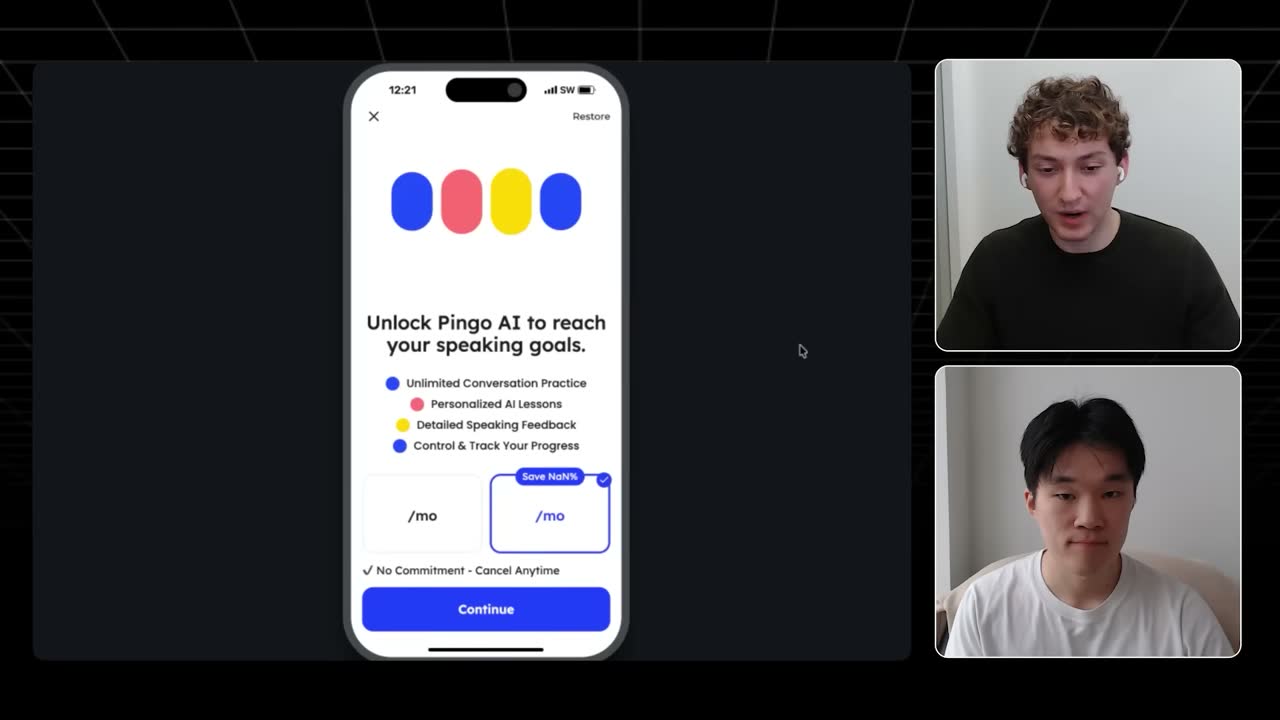
Pingo's original one-page paywall listing four AI features, two plan buttons and a Continue button.

How I built a $500k/mo ai app (so you can just copy me)
Reached nearly $500k a month 14 months after launching from a college dorm, with 350 to 370 million views in 30 days from about 100 creators. Growth comes from videos that show the app, the viral roast and crying format (one video hit 52 million views), and a paywall with a trial timeline.
Pingo was designed so that talking to an AI is the viral hook. Co-founder Michael's earlier food app did poorly, so before building Pingo he asked which AI feature would be inherently viral and chose a spoken conversation with an AI. That conversation became the base of all early UGC.
The visual is four colored sound-wave lines, with no avatar, because the team dislikes the "fake Disney avatar" style. Morrie guesses a minimal look may stand out more as characters become common. Quote: "there's kind of not a point in building a consumer app that won't go viral".
Pingo's app screens: roleplay feedback scores (Fluency 92), vocabulary practice, and progress tracking showing vocab growth to 600. Only videos that show the app itself convert into paying users. Every creator video must feature someone talking to Pingo on screen. Everything that went viral since August used the app, while one creator's videos without it went viral but did not convert.
Slideshows could hit 1 million views, but accounts burned out fast and their conversion versus Pingo videos was "night and day". Learning-tip and demo hooks that did not use Pingo never went viral. Quote: "virality that converts shows and doesn't tell".
Pingo's first viral TikTok showed its feedback screen: Overall 94, Fluency 95, Engagement 97. The founders made every video themselves until about $20k MRR. For the first three months the two founders posted videos of themselves talking to Pingo on an iPad, using beginner quizzes and cultural hooks. The first viral video got about 100k views; a Chinese hook tied to the TikTok ban and RedNote got about 1 million.
A basic Korean quiz got 77,000 views, and the Korean account beat the Chinese one. With only two creators, any user spike could be traced to one video. Humor layered on culture and learning then went more viral than either alone, and the same concept worked in French.
Repeated virality across languages compounds into about $500k a month. Pingo reached nearly $500k a month 14 months after launching from a college dorm, with 350 to 370 million views in 30 days from about 100 creators.
Korean, German, French, Arabic and Japanese content all hit, with a similar conversion rate. All figures are self-reported and rounded, and no creator cost or CAC is given.
A flexible custom scenario feature let creators invent the roast format. Custom scenarios existed since day one and were never built for marketing. Creators prompted Pingo to be mean, and one roast video hit 52 million views; the format has kept working since September.
The first version had a creator mispronounce a word, Pingo roast them, and the creator cry after a Snapchat-style hook. Variations add props or drop the crying, and sometimes need prompt tricks like calling the chat a play. Users now ask for a built-in "mean" or "18+" toggle, which is on the roadmap.
Scale a winning format by sending creators the example and why it worked. When a format goes viral with one creator, the team sends others the video, why it likely went viral, and the key steps, asking them to "recreate this as close as possible in your target language". A variation of the crying meme was scaled this way.
For a brand new format, the team makes an example video themselves first. They are also considering having about 20 core creators post the same new format on one day to engineer a spike, and Morrie says he has no idea if it will work.
Cut the bottom creators, coach the middle, keep recruiting. The top 20 to 30% of creators drive most views and the bottom adds almost nothing. Pingo cut 30 to 50 creators and now sits near 100.
Each new creator gets an internal deadline before a keep-or-cut decision. Quote: "We cut the bottom of the portfolio. Kept the top, working on the mid-range."
Recruit micro creators in the language niche with one breakout video. Targets are creators under 10k followers, up to about 30k, who post about learning the target language and have gone viral at least once. Some under 2,000 followers blew up.
VAs search keywords like "learning German", then "German major", with native speakers last, and send a simple DM naming the app and its user count; that count grew from tens of thousands to three million without changing the message. Interested creators move to email so a CRM tracks follow-ups.
Pay a base fee plus non-stacking view milestone bonuses. Creators get base pay per video plus bonus tiers at 50k, 100k, 200k, 500k and 1M views, earning only the highest tier reached. A creator at 200,000 views gets the $100 tier, not $150.
A past breakout makes the bonus feel reachable; someone who never went viral may find 50,000 views unthinkable.
Coach execution like lighting and audio before changing ideas. Many flopped videos had good ideas but bad lighting, odd angles, awkward framing or weak audio, so Pingo started content coaching about a week before the interview. A Discord lets creators share what went viral.
About 30 of roughly 100 creators come up with their own ideas; 20 are good and 10 standout. Coaching results are not yet known.
Check which country views come from before scaling a language. Russian content brought about 200 thousand users in February who could not pay, since Apple and Google block payments there under sanctions. About 5,000 of 12,000 new Android users in one month were Russian.
Viewer country does not follow creator location: a UK-based creator had 90-something percent Russian viewership. The team now tracks where each video goes viral and kills formats that pull unmonetizable geos. The cause of the Russian viewership is a guess.
A trial timeline paywall won by making the trial feel low risk. The winner spells out today, day 5 and day 7 when billing starts, with a reminder 2 days before the trial ends and cancel-anytime messaging. It beat the older one-page paywall and testimonial and value-focused variants, and became the control.
Quote: "reinforcing the low risk nature of this trial like really helped with conversion".
Pingo's original one-time offer paywall: 55% off, $6.99/mo billed annually at $83.99/yr. Offer a 7-day trial to users who abandon the 3-day offer. Users who abandon a 3-day trial see a second paywall with 7 days, which converts higher. Internationally a 7-day trial converted about 2% higher than 3-day; in the US the gap was about 0.3 to 0.7 percent.
Pingo splits paywall tests between the US and other countries, partly to move US billing to Stripe web checkout for better margins, which is not possible internationally. A 10 or 14 day abandon trial is planned. The trial data was incomplete when discussed.
Weigh trial length against voice AI usage costs, not just conversion. Longer trials cost more for an app with per-use AI costs. In the US, 7-day versus 3-day showed about a 20 cent ARPU difference, with 3-day cancel rates 5 to 7% higher.
Users use Pingo heavily in the first 3 days, so the team compares usage in days 1 to 3 against days 4 to 7, along with CAC, to decide.
Put the trial only on the annual plan and hide monthly. The trial comes only with the annual plan, and the monthly plan sits behind a "view all plans" link with no trial.
Because $99.99 a year feels daunting, they test showing the weekly or monthly equivalent next to it. Quote: "You don't get a trial on the monthly plan. And we don't even show it."
Pingo's original one-page paywall listing four AI features, two plan buttons and a Continue button.
More in Education
 Education
Duolingo
A language learning app built around daily streaks and short lessons.



 47 sources · 132 tips
 Education
Headway
A book summary and self-growth app that sells subscriptions through a long web quiz funnel.
 10 sources · 36 tips
 Education
Blinkist
A nonfiction book summary app that turns books into short audio and text reads.
16 sources · 17 tips Education
StudyFetch
An AI study platform that turns course materials into practice tests, flashcards and tutoring sessions.
4 sources · 31 tips Education
Coconote
An AI study app that records and transcribes lectures and creates notes, summaries and flashcards.
3 sources · 30 tips Education
Reforge
A company offering courses on product and growth, now also building AI products like Reforge Insights.
10 sources · 13 tips Education
Coursiv
An AI learning app that teaches beginners practical AI tools through short lessons and challenges.
2 sources · 17 tips Education
Unacademy
An Indian online learning platform offering courses for exam preparation and other subjects.
2 sources · 6 tips