
MyFitnessPal
A long-established calorie and nutrition tracking app.
MyFitnessPal sold for $475M in 2015 while growing, then for over $100M less in 2020 after growth slowed. It later bought Cal AI, which reached $50M+ ARR in two years at $30 a year versus its roughly $70, and kept it separate for a different audience. Lesson: sell while growth is strong, and a niche, cheaper challenger can build distribution an incumbent then buys.
- Fast photo logging
- About $30 a year
- Younger, price-sensitive users
- Accuracy and more features
- About $70 a year
- Serious users accepting friction
Cal AI won mind share, then MyFitnessPal bought it
From Blake Anderson and MyFitnessPal's CEO
What was said about MyFitnessPal
1How Cal AI counter-positioned against MyFitnessPal
Cal AI won a different audience by trading accuracy for speed. MyFitnessPal serves serious users who accept friction for more features, and its CEO says its users want accuracy. Cal AI targeted a younger, price-sensitive audience that wanted fast photo logging.
Simplicity also opened the category to people who had never tracked calories and track nutrition without a goal: "it opened up a lot of people who had never really done calorie tracking before." Cal AI later added barcode scanning and a food database to improve accuracy. Phil Carter ties the result to Brian Balfour's four fits (product, market, channel, model) behind $50M+ ARR in two years.
A much lower price than the incumbent bought Cal AI mind share. Cal AI stayed at $30 a year while MyFitnessPal charged about $70 a year (another account puts MyFitnessPal at roughly $80 to $120). Co-founder Blake Anderson insisted on optimizing for mind share over profit despite many price tests.
The reasoning: the easiest app to buy becomes the most popular, and a young audience with little disposable income, who had suffered the problem for less time, would pay less. "We're not optimizing for profit. We're optimizing for mind share." Price should fit your own market and pain point, not copy Cal AI.
A big incumbent proves the market; attack it with a novel angle. MyFitnessPal showed calorie tracking is a large market, so Cal AI only had to test one new variable: photo calorie counting that was easy to show in marketing videos.
Daniel Heintzman's criteria are an idea easy to understand in videos, a novel angle and a big market; starting from a blank slate means "you're solving too many variables at that point." The Cal AI team had once seen MyFitnessPal as untouchable.
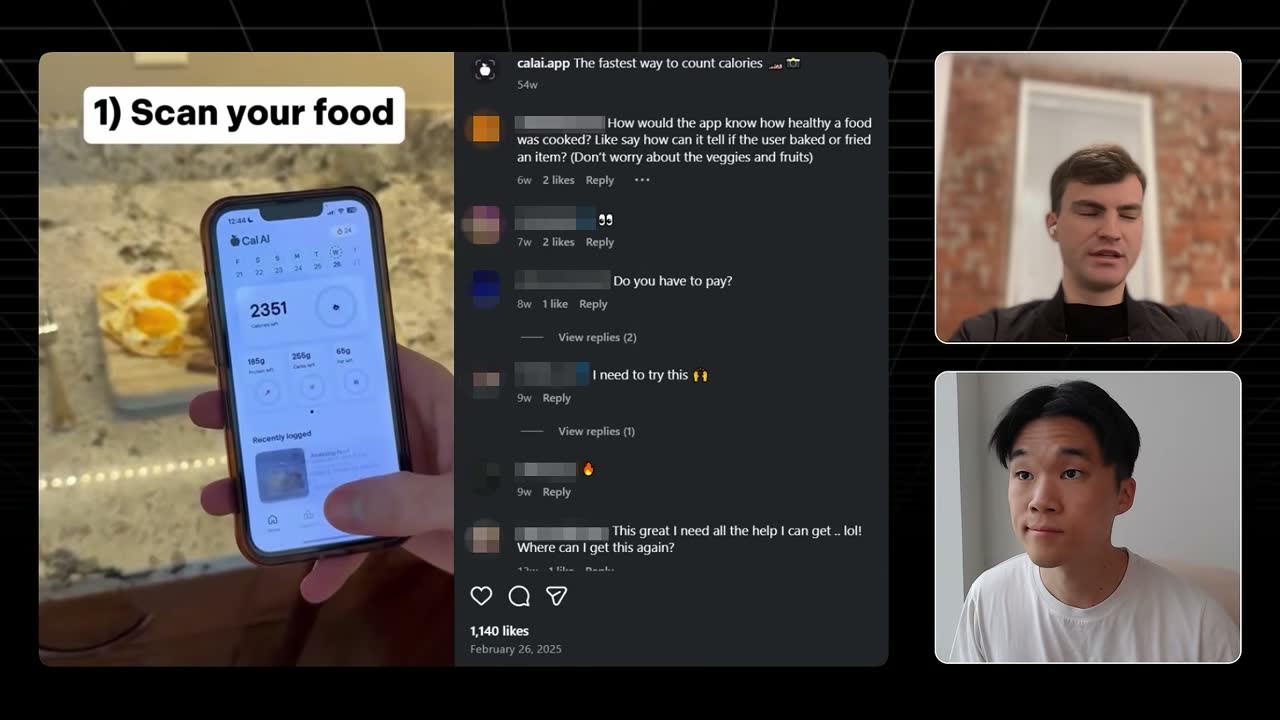
Cal AI influencer post showing the scan step and home screen with 2,351 calories left. Cheap AI software makes underserved niches next to incumbents viable. Cal AI succeeded by serving a tightly defined segment MyFitnessPal was not built for, the same pattern as Runna winning serious race trainers that Strava ignored.
As software costs approach zero, niches that were not viable before now are; Phil Carter claims small niche apps can reach 10 to 20 million in ARR. "I don't think that we're running out of niches to cater to anytime soon."
2Why MyFitnessPal bought Cal AI
The incumbent bought the challenger for its distribution and kept it separate. MyFitnessPal acquired Cal AI in late 2025, likely for the team's top-of-funnel distribution skill, and both apps stay separate products because they serve different audiences.
Cal AI keeps its own identity while MyFitnessPal shares institutional knowledge with its founders, who started the app at 17. Phil Carter cites it as an incumbent absorbing the AI challenger to its own product.
Know what a likely buyer lacks and build your story around it. MyFitnessPal likely bought Cal AI's distribution skill, as Strava bought Runna to reach beginner runners it was losing. Read a buyer's last five deals to learn why they buy, then build the metric story they want.
The four buyer types are aggregators or platforms, strategics (who pay the highest multiples for synergies), private equity and acqui-hire or IP buyers. Start the relationship 6 to 12 months ahead. "Do a little bit of Sherlock Holmes on it."
3Two sales: $475M growing, over $100M less slowing
Sell while growing; buyers pay for future growth, not past. Under Armour paid $475M for MyFitnessPal in 2015 while it was growing. Francisco Partners paid over $100M less in 2020 after growth slowed.
Fast-growing, profitable apps (30 to 50% EBITDA margin) are valued on future run rate at up to 6x, slower ones on the last 12 months. Don't try to time the peak; let the buyer pay for the peak still ahead and have other options so you are not forced to sell. "Sell before you need to."
4MyFitnessPal's scale in search and analytics
Copy keywords from small apps outranking MyFitnessPal, not from MyFitnessPal. In calorie tracker search, MyFitnessPal has 2.1 million ratings, yet Calorie AI with about 4,000 still outranks it for some terms.
Lose It had 700,000 and Cal AI 200,000. A small app beating giants is probably doing something different with keywords, and its keyword set is more realistic to copy.
MyFitnessPal pulls external data sources into one dashboard. Mike Rollins of Flurry favors MyFitnessPal for combining external sources in a single dashboard and says he envies its position.

How Cal AI turned creators into a growth machine — Jake Castillo, Cal AI
It acquired Cal AI, lets the app keep its identity, and shares institutional knowledge with the founders. It charged about $70 a year versus Cal AI's $30.
A much lower price than the incumbent bought Cal AI mind share. Cal AI stayed at $30 a year while MyFitnessPal charged about $70 a year (another account puts MyFitnessPal at roughly $80 to $120). Co-founder Blake Anderson insisted on optimizing for mind share over profit despite many price tests.
The reasoning: the easiest app to buy becomes the most popular, and a young audience with little disposable income, who had suffered the problem for less time, would pay less. "We're not optimizing for profit. We're optimizing for mind share." Price should fit your own market and pain point, not copy Cal AI.
The incumbent bought the challenger for its distribution and kept it separate. MyFitnessPal acquired Cal AI in late 2025, likely for the team's top-of-funnel distribution skill, and both apps stay separate products because they serve different audiences.
Cal AI keeps its own identity while MyFitnessPal shares institutional knowledge with its founders, who started the app at 17. Phil Carter cites it as an incumbent absorbing the AI challenger to its own product.

$172M of App Building Advice in 50 Minutes
Under Armour paid $475M for it in 2015 while it was growing. Francisco Partners paid over $100M less in 2020 after growth slowed, and it later bought Cal AI's team for its top-of-funnel distribution skill.
The incumbent bought the challenger for its distribution and kept it separate. MyFitnessPal acquired Cal AI in late 2025, likely for the team's top-of-funnel distribution skill, and both apps stay separate products because they serve different audiences.
Cal AI keeps its own identity while MyFitnessPal shares institutional knowledge with its founders, who started the app at 17. Phil Carter cites it as an incumbent absorbing the AI challenger to its own product.
Know what a likely buyer lacks and build your story around it. MyFitnessPal likely bought Cal AI's distribution skill, as Strava bought Runna to reach beginner runners it was losing. Read a buyer's last five deals to learn why they buy, then build the metric story they want.
The four buyer types are aggregators or platforms, strategics (who pay the highest multiples for synergies), private equity and acqui-hire or IP buyers. Start the relationship 6 to 12 months ahead. "Do a little bit of Sherlock Holmes on it."
Sell while growing; buyers pay for future growth, not past. Under Armour paid $475M for MyFitnessPal in 2015 while it was growing. Francisco Partners paid over $100M less in 2020 after growth slowed.
Fast-growing, profitable apps (30 to 50% EBITDA margin) are valued on future run rate at up to 6x, slower ones on the last 12 months. Don't try to time the peak; let the buyer pay for the peak still ahead and have other options so you are not forced to sell. "Sell before you need to."

How Cal AI Hit $50M ARR in 2 Years by Nailing Product/Channel Fit on TikTok
Serves serious users who accept more friction, at roughly $80 to $120 a year. It acquired Cal AI in late 2025, since the two apps serve different audiences.
Cal AI won a different audience by trading accuracy for speed. MyFitnessPal serves serious users who accept friction for more features, and its CEO says its users want accuracy. Cal AI targeted a younger, price-sensitive audience that wanted fast photo logging.
Simplicity also opened the category to people who had never tracked calories and track nutrition without a goal: "it opened up a lot of people who had never really done calorie tracking before." Cal AI later added barcode scanning and a food database to improve accuracy. Phil Carter ties the result to Brian Balfour's four fits (product, market, channel, model) behind $50M+ ARR in two years.
A much lower price than the incumbent bought Cal AI mind share. Cal AI stayed at $30 a year while MyFitnessPal charged about $70 a year (another account puts MyFitnessPal at roughly $80 to $120). Co-founder Blake Anderson insisted on optimizing for mind share over profit despite many price tests.
The reasoning: the easiest app to buy becomes the most popular, and a young audience with little disposable income, who had suffered the problem for less time, would pay less. "We're not optimizing for profit. We're optimizing for mind share." Price should fit your own market and pain point, not copy Cal AI.
The incumbent bought the challenger for its distribution and kept it separate. MyFitnessPal acquired Cal AI in late 2025, likely for the team's top-of-funnel distribution skill, and both apps stay separate products because they serve different audiences.
Cal AI keeps its own identity while MyFitnessPal shares institutional knowledge with its founders, who started the app at 17. Phil Carter cites it as an incumbent absorbing the AI challenger to its own product.
I speedran a new app from 0 to $2m/year in 6 months (here's how)
Proved calorie tracking is a large market, and it acquired Cal AI, which was started by 17-year-olds, with both apps staying separate products. The Cal AI team had once seen it as untouchable.
A big incumbent proves the market; attack it with a novel angle. MyFitnessPal showed calorie tracking is a large market, so Cal AI only had to test one new variable: photo calorie counting that was easy to show in marketing videos.
Daniel Heintzman's criteria are an idea easy to understand in videos, a novel angle and a big market; starting from a blank slate means "you're solving too many variables at that point." The Cal AI team had once seen MyFitnessPal as untouchable.
Cal AI influencer post showing the scan step and home screen with 2,351 calories left. The incumbent bought the challenger for its distribution and kept it separate. MyFitnessPal acquired Cal AI in late 2025, likely for the team's top-of-funnel distribution skill, and both apps stay separate products because they serve different audiences.
Cal AI keeps its own identity while MyFitnessPal shares institutional knowledge with its founders, who started the app at 17. Phil Carter cites it as an incumbent absorbing the AI challenger to its own product.
The AI Growth Playbook for Subscription Apps – Phil Carter, Elemental Growth
Bought Calorie AI, an example of an incumbent absorbing the AI challenger to its own product.
Cheap AI software makes underserved niches next to incumbents viable. Cal AI succeeded by serving a tightly defined segment MyFitnessPal was not built for, the same pattern as Runna winning serious race trainers that Strava ignored.
As software costs approach zero, niches that were not viable before now are; Phil Carter claims small niche apps can reach 10 to 20 million in ARR. "I don't think that we're running out of niches to cater to anytime soon."
The incumbent bought the challenger for its distribution and kept it separate. MyFitnessPal acquired Cal AI in late 2025, likely for the team's top-of-funnel distribution skill, and both apps stay separate products because they serve different audiences.
Cal AI keeps its own identity while MyFitnessPal shares institutional knowledge with its founders, who started the app at 17. Phil Carter cites it as an incumbent absorbing the AI challenger to its own product.
Insights from RevenueCat’s 2026 State of Subscription Apps Report
Its CEO says users want accuracy, a different audience from Cal AI's speed-focused users. It acquired Cal AI.
Cal AI won a different audience by trading accuracy for speed. MyFitnessPal serves serious users who accept friction for more features, and its CEO says its users want accuracy. Cal AI targeted a younger, price-sensitive audience that wanted fast photo logging.
Simplicity also opened the category to people who had never tracked calories and track nutrition without a goal: "it opened up a lot of people who had never really done calorie tracking before." Cal AI later added barcode scanning and a food database to improve accuracy. Phil Carter ties the result to Brian Balfour's four fits (product, market, channel, model) behind $50M+ ARR in two years.
Cheap AI software makes underserved niches next to incumbents viable. Cal AI succeeded by serving a tightly defined segment MyFitnessPal was not built for, the same pattern as Runna winning serious race trainers that Strava ignored.
As software costs approach zero, niches that were not viable before now are; Phil Carter claims small niche apps can reach 10 to 20 million in ARR. "I don't think that we're running out of niches to cater to anytime soon."

The Most Important Element of App Store Optimization (ASO Keyword Research)
Has 2.1 million ratings in the calorie tracker results, far more than small apps like Calorie AI that still outrank it for some terms.
Copy keywords from small apps outranking MyFitnessPal, not from MyFitnessPal. In calorie tracker search, MyFitnessPal has 2.1 million ratings, yet Calorie AI with about 4,000 still outranks it for some terms.
Lose It had 700,000 and Cal AI 200,000. A small app beating giants is probably doing something different with keywords, and its keyword set is more realistic to copy.
Flurry: The Key Metrics You Should Be Tracking in Your Mobile App
Mike favors it for pulling external sources into one dashboard and says he envies its position.
MyFitnessPal pulls external data sources into one dashboard. Mike Rollins of Flurry favors MyFitnessPal for combining external sources in a single dashboard and says he envies its position.
More in Health & Fitness
 Health & Fitness
Calm
A meditation and sleep app with guided sessions and celebrity-narrated Sleep Stories.
45 sources · 102 tips Health & Fitness
Cal AI
A calorie tracking app that logs meals from photos, grown largely through influencer and UGC videos.
28 sources · 104 tips Health & Fitness
Headspace
A meditation and mental wellness app with guided sessions and subscriptions.
 27 sources · 50 tips
 Health & Fitness
Flo
A data tool that combines app analytics into one view and is adding AI agents.
 10 sources · 31 tips
 Health & Fitness
Ladder
A strength training app with human coaches, a workout journal and a nutrition feature.
12 sources · 39 tips Health & Fitness
Zero
An intermittent fasting tracker app that teaches fasting and builds habits toward metabolic health.
6 sources · 21 tips Health & Fitness
Rise
A sleep and energy app that helps people track and pay down their sleep debt.
3 sources · 29 tips Health & Fitness
Runna
A personalized running coach app that builds adaptive training plans around a runner's race goals.
6 sources · 28 tips