Sunflower
A sobriety app with a day counter, community and an AI sponsor for people quitting addictions.
Sunflower went from near zero to $1M annualized revenue and over 10,000 paying subscribers in about 10 months, on roughly $6.5M raised. It grew through one anchor influencer, an AI sponsor wrapped in a full product, and paywall tuning: trial reminders lifted revenue 48%. Lesson: ship a simple core fast, default to annual plans, and add monetization before token costs force it.
- 1Eric posts high volume50 to 100 million views a month
- 2Viewers click Sunflower link50 to 100k link clicks monthly
- 3Users hit primed paywallTold they'll be reminded before trial ends
- 4Users subscribeOver 10,000 paying subscribers
- 5$1M annualized revenueIn roughly 10 months
From Koby Conrad, Sunflower founder
What was said about Sunflower
1How Sunflower reached $1M a year in 10 months
One anchor creator, an AI sponsor and paywall tuning drove the growth. Sunflower went from about zero to $1M annualized revenue in roughly 10 months and passed 10,000 paying subscribers. It had raised about $6.5M.
The app helps people quit any addiction, including alcohol, cannabis, methamphetamines, cocaine and gambling. No churn or retention figures, and no data on the app's effect on actual sobriety, were given.
2Hiring the top sobriety influencer as VP of Sobriety
Hire the biggest creator in your niche instead of paying many per post. Eric (Mr. Impulsive) gets 50 to 100 million views a month and sends 50 to 100k link clicks monthly. He joined as VP of Sobriety before the app had any revenue.
Koby Conrad, who says he has spent $10 to 20 million on influencer marketing, rejects running 30 influencers with complicated deal structures. He did the same at Reddit and points to Replicate and Function Health, which made Mark Hyman its face. The claim that this deal is 10 times more effective rests on anecdote, and Eric's salary and equity were not disclosed.
Pay creators with salary, equity and a mission, not per post. Koby treats an employee creator as buying reach wholesale, and being the creator's biggest sponsor earns better treatment. Eric is pitched by other apps constantly, but seeing the roadmap makes him less likely to switch.
The pitch was an invitation to change the world from a go-to-market role. Eric posts high volume, links Sunflower in all of it, and learned over a year to drive far more clicks. Sunflower pairs him with a few smaller influencers and ads, and Koby says Facebook is underrated: "You want to be the biggest sponsor this person has."
Put the creator in the team chat so he sees user impact. Eric sits in Sunflower's Slack channel where user feedback, like people saying the app saved their life, is posted constantly. That gives a paid partner a mission to care about.
Koby says this helps team building generally, not only with influencers.
Bootstrappers can offer creators a revenue split instead of equity. Without venture money, Koby would pitch a creator: you have the audience, I build the app, we split 50/50. He also suggests building your own audience first, as he did with a Facebook page at 19.
Creators hear similar pitches about 20 times and some clients ghost them on payment for 60 days, so being reliable and having a product they care about matters.
3Sam, the AI sponsor wrapped in a full product
A bare AI chatbot failed; bundling it into a product made it work. The AI sponsor alone had horrible engagement and retention and nobody would pay for it. Sunflower bundled it with community, courses, content and tools, and Sam has handled over 4 million messages in a year.
"If you take our app and you only do the AI companion, the whole thing is horrible."
Turn the chatbot into an agent with memory, actions and safety. Sam went from a ChatGPT wrapper to prompt tuning to an agent that follows up on payday, replies to community posts, runs prompted sessions, pulls context from across the app and escalates scary cases to a clinical team.
Because some users have abusive partners, the app has biometric lock and data erasure. The team can read conversations while staying HIPAA compliant.
Build AI where model labs lack outcome data. OpenAI and Anthropic don't know whether users stay sober or feel less depressed, and they carry liability. A startup tracking relapse, days sober and loneliness can optimize the whole system without training a model.
Koby says OpenAI people told him in a YC talk that liability and not knowing what to optimize for kept them out of behavioral health. He sees addiction as the smallest segment of behavioral health, behind depression and anxiety.
Real usage proved the founder's doubts about the AI sponsor wrong. Koby, seven years sober, didn't think he would use it himself, but usage blew him away. One super user, Patty, a 60-year-old who had been an alcoholic for 30 years, went thousands of messages deep and is over a year sober.
Claims that the AI talks users out of suicide and drug use rest on anecdotes, not comparison data.
4Starting from a sobriety timer
Build around the one thing users do every day, and launch ugly. The core feature is the sobriety timer, not the AI. Koby's V1, coded himself after a bootcamp in 2020 to 2021, had three features: a timer, Fiverr sunflower graphics and a CRUD journal.
His rule: find what people do daily, segment your ICP and build everything around it. "Just build the smallest thing you freaking can. It can be ugly as hell and just launch it."
With cheap building, ship many features and trim what fails. AI lowered the opportunity cost of choosing a direction, so Sunflower builds everything, watches the data and cuts the rest.
Previously a team picked one or two directions. Sunflower now has five engineers Koby calls S-tier.
5The paywall and pricing changes
From Koby Conrad, Sunflower founder
Priming users with a trial reminder lifted revenue 48%. Before the paywall, users see a message like "we'll remind you before your trial ends." Revenue rose 48%, trial conversions 46%, trial starts 30% and annual revenue 70%.
Koby says trial anxiety is bigger than most teams assume. Sunflower is A/B testing a couple of versions of the priming screen.
Make the plan you want users to buy the default. Sunflower moved from monthly only, to adding annual, to annual as default, to upfront annual with a toggle to switch it off. Each step brought more annual revenue.
No single number was given for these steps. It currently shows $9 a month and $35 a year, and Koby favors offering weekly, monthly and annual so users self-select.
Lowering price earned more for a price-sensitive audience. Users struggling with addiction often have little money, and Sunflower gained more by cutting its price than by raising it.
"We made a lot of gains by actually lowering our price than like increasing our price."
Add a paywall before token costs and investors force it. Koby copied Duolingo's free-first approach, but AI token costs were scaling to hundreds of thousands of dollars and investors wanted revenue, so Sunflower added a monthly paywall.
"Turns out investors want to see money."
6Raising $6.5M and what comes after subscriptions
Venture money paid for hiring the creator before revenue. Sunflower raised about $6.5M, with Flybridge leading the seed, and Koby says it could not have hired Eric without that capital.
The first deck leaned on Koby's Rupa background and usage numbers and mostly failed. The one that worked after YC described where the market is going, positioned Sunflower in AI, showed revenue growth and included letters of intent from pilots.
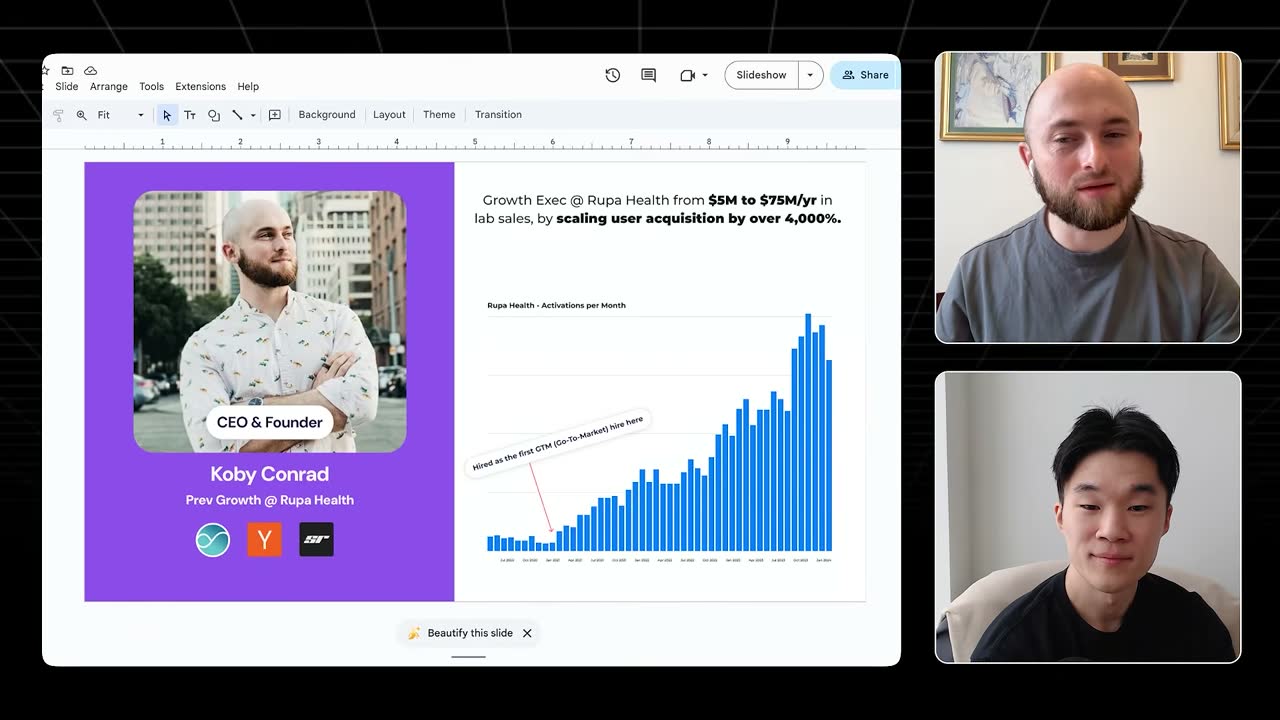
Sunflower pitch deck founder slide: Koby grew Rupa Health from $5M to $75M/yr, acquisition up 4,000%. Expect cheap apps to become lead magnets for goods and services. Koby expects paid subscriptions to fade as software gets cheap, with apps selling physical goods, services and ads, such as 1-day, 7-day and 1-month milestone pins.
He notes most addiction spending goes to therapy, not apps, and Sunflower is launching a teletherapy clinic.

I speedran an ai app from 0 to $1m/yr in 10 months
Went from about zero to $1M annualized revenue in roughly 10 months and passed 10,000 paying subscribers, on about $6.5M raised. Growth came from one anchor influencer, an AI sponsor wrapped in a full product, and paywall tuning where trial reminders lifted revenue 48%.
One anchor creator, an AI sponsor and paywall tuning drove the growth. Sunflower went from about zero to $1M annualized revenue in roughly 10 months and passed 10,000 paying subscribers. It had raised about $6.5M.
The app helps people quit any addiction, including alcohol, cannabis, methamphetamines, cocaine and gambling. No churn or retention figures, and no data on the app's effect on actual sobriety, were given.
Hire the biggest creator in your niche instead of paying many per post. Eric (Mr. Impulsive) gets 50 to 100 million views a month and sends 50 to 100k link clicks monthly. He joined as VP of Sobriety before the app had any revenue.
Koby Conrad, who says he has spent $10 to 20 million on influencer marketing, rejects running 30 influencers with complicated deal structures. He did the same at Reddit and points to Replicate and Function Health, which made Mark Hyman its face. The claim that this deal is 10 times more effective rests on anecdote, and Eric's salary and equity were not disclosed.
Pay creators with salary, equity and a mission, not per post. Koby treats an employee creator as buying reach wholesale, and being the creator's biggest sponsor earns better treatment. Eric is pitched by other apps constantly, but seeing the roadmap makes him less likely to switch.
The pitch was an invitation to change the world from a go-to-market role. Eric posts high volume, links Sunflower in all of it, and learned over a year to drive far more clicks. Sunflower pairs him with a few smaller influencers and ads, and Koby says Facebook is underrated: "You want to be the biggest sponsor this person has."
Put the creator in the team chat so he sees user impact. Eric sits in Sunflower's Slack channel where user feedback, like people saying the app saved their life, is posted constantly. That gives a paid partner a mission to care about.
Koby says this helps team building generally, not only with influencers.
Bootstrappers can offer creators a revenue split instead of equity. Without venture money, Koby would pitch a creator: you have the audience, I build the app, we split 50/50. He also suggests building your own audience first, as he did with a Facebook page at 19.
Creators hear similar pitches about 20 times and some clients ghost them on payment for 60 days, so being reliable and having a product they care about matters.
A bare AI chatbot failed; bundling it into a product made it work. The AI sponsor alone had horrible engagement and retention and nobody would pay for it. Sunflower bundled it with community, courses, content and tools, and Sam has handled over 4 million messages in a year.
"If you take our app and you only do the AI companion, the whole thing is horrible."
Turn the chatbot into an agent with memory, actions and safety. Sam went from a ChatGPT wrapper to prompt tuning to an agent that follows up on payday, replies to community posts, runs prompted sessions, pulls context from across the app and escalates scary cases to a clinical team.
Because some users have abusive partners, the app has biometric lock and data erasure. The team can read conversations while staying HIPAA compliant.
Build AI where model labs lack outcome data. OpenAI and Anthropic don't know whether users stay sober or feel less depressed, and they carry liability. A startup tracking relapse, days sober and loneliness can optimize the whole system without training a model.
Koby says OpenAI people told him in a YC talk that liability and not knowing what to optimize for kept them out of behavioral health. He sees addiction as the smallest segment of behavioral health, behind depression and anxiety.
Real usage proved the founder's doubts about the AI sponsor wrong. Koby, seven years sober, didn't think he would use it himself, but usage blew him away. One super user, Patty, a 60-year-old who had been an alcoholic for 30 years, went thousands of messages deep and is over a year sober.
Claims that the AI talks users out of suicide and drug use rest on anecdotes, not comparison data.
Build around the one thing users do every day, and launch ugly. The core feature is the sobriety timer, not the AI. Koby's V1, coded himself after a bootcamp in 2020 to 2021, had three features: a timer, Fiverr sunflower graphics and a CRUD journal.
His rule: find what people do daily, segment your ICP and build everything around it. "Just build the smallest thing you freaking can. It can be ugly as hell and just launch it."
With cheap building, ship many features and trim what fails. AI lowered the opportunity cost of choosing a direction, so Sunflower builds everything, watches the data and cuts the rest.
Previously a team picked one or two directions. Sunflower now has five engineers Koby calls S-tier.
Priming users with a trial reminder lifted revenue 48%. Before the paywall, users see a message like "we'll remind you before your trial ends." Revenue rose 48%, trial conversions 46%, trial starts 30% and annual revenue 70%.
Koby says trial anxiety is bigger than most teams assume. Sunflower is A/B testing a couple of versions of the priming screen.
Make the plan you want users to buy the default. Sunflower moved from monthly only, to adding annual, to annual as default, to upfront annual with a toggle to switch it off. Each step brought more annual revenue.
No single number was given for these steps. It currently shows $9 a month and $35 a year, and Koby favors offering weekly, monthly and annual so users self-select.
Lowering price earned more for a price-sensitive audience. Users struggling with addiction often have little money, and Sunflower gained more by cutting its price than by raising it.
"We made a lot of gains by actually lowering our price than like increasing our price."
Add a paywall before token costs and investors force it. Koby copied Duolingo's free-first approach, but AI token costs were scaling to hundreds of thousands of dollars and investors wanted revenue, so Sunflower added a monthly paywall.
"Turns out investors want to see money."
Venture money paid for hiring the creator before revenue. Sunflower raised about $6.5M, with Flybridge leading the seed, and Koby says it could not have hired Eric without that capital.
The first deck leaned on Koby's Rupa background and usage numbers and mostly failed. The one that worked after YC described where the market is going, positioned Sunflower in AI, showed revenue growth and included letters of intent from pilots.
Sunflower pitch deck founder slide: Koby grew Rupa Health from $5M to $75M/yr, acquisition up 4,000%. Expect cheap apps to become lead magnets for goods and services. Koby expects paid subscriptions to fade as software gets cheap, with apps selling physical goods, services and ads, such as 1-day, 7-day and 1-month milestone pins.
He notes most addiction spending goes to therapy, not apps, and Sunflower is launching a teletherapy clinic.
More in Health & Fitness
 Health & Fitness
Calm
A meditation and sleep app with guided sessions and celebrity-narrated Sleep Stories.


 45 sources · 102 tips
 Health & Fitness
Cal AI
A calorie tracking app that logs meals from photos, grown largely through influencer and UGC videos.
28 sources · 104 tips Health & Fitness
Headspace
A meditation and mental wellness app with guided sessions and subscriptions.
 27 sources · 50 tips
 Health & Fitness
Flo
A data tool that combines app analytics into one view and is adding AI agents.
 10 sources · 31 tips
 Health & Fitness
Ladder
A strength training app with human coaches, a workout journal and a nutrition feature.
12 sources · 39 tips Health & Fitness
Zero
An intermittent fasting tracker app that teaches fasting and builds habits toward metabolic health.
6 sources · 21 tips Health & Fitness
Rise
A sleep and energy app that helps people track and pay down their sleep debt.
3 sources · 29 tips Health & Fitness
Runna
A personalized running coach app that builds adaptive training plans around a runner's race goals.
6 sources · 28 tips