A photo and video sharing social app built around creators, Stories, Reels and feeds.
Instagram won by protecting its main feed (about 80% of use), cloning Snap's Stories and making them better, and fixing forward after IGTV flopped, as Reels followed. Missteps: Reels launched on a low-read-through surface cost timing against TikTok, and a 4% iOS feed test snowballed into backlash. For builders: guard the core surface, copy and improve, and plan for leaks.
From Adam Mosseri on Instagram's feed
What was said about Instagram
1From IGTV's flop to Reels built on Stories
IGTV failed on wrong assumptions, then Reels succeeded once those were dropped. IGTV was a big flop because it baked in wrong assumptions and held onto some constraints. The team changed those assumptions and redid the idea as Reels, which became very successful.
Ian Silber, who spent eight years at Instagram, frames it as a lesson in reacting and listening to users: "Not what you shipped one time but how you fix forward."
Building the first Reels on Stories cost Instagram its timing against TikTok. The 2019 Reels was built on top of Stories to reuse existing primitives, but Stories have low read-through, so most Reels went unseen and then disappeared. Instagram was out of position when TikTok surged during the 2020 pandemic.
Adam Mosseri calls it a big fork in the road for the business. The lesson: do not launch a new format on a surface people rarely read through.
2How Instagram ranks the feed
The main feed carries most usage, so protect it and resist extra tabs. Instagram's main feed drew about 80% of use, and a better Explore tab might only move Explore from 10% to 15%. Surface usage follows a power law, so make the main experience great and use it as the entry point to others.
Fold in successful experiments once proven without killing them too early. "Half of the job is saying no to another thing in the sidebar or another tab."
A chronological default lowered usage and satisfaction, so Instagram ranks instead. When chronological was made the default, usage went down and large-scale surveys showed satisfaction dropping over months. Pure recency rewards posting volume, so publishers like the New York Times crowd out a friend who posts weekly.
Mosseri treats recency as one input to relevance and says designing these systems is "almost like designing a city": ask what incentives the mechanics create.
Exploration ranking gives small and niche creators a path to an audience. Exploitation ranking shows what many people already like and moves engagement easily. Exploration tests content on people who might like something they don't yet know, such as showing Afrojack to a Bieber fan.
Inspired by TikTok, Instagram invested in originality, breakout content and recency, and believes it is ahead of TikTok in a couple of these areas.
"Your algorithm" uses an LLM to describe embeddings so users can edit them. Recommenders run on embedding vectors humans cannot read. Instagram has an LLM describe a region of a user's embedding map in words, such as "deep pourover coffee snobbery", then lets users add or remove those topics.
Mosseri says the algorithm knew less about people than they assumed, and LLMs are closing that gap. Next steps include non-topical controls like more fun content or fewer photos in a row.
3Betting on authentic creators as AI content floods feeds
Instagram bets AI abundance pushes people toward real creators. Mosseri expects people to seek out creativity, point of view and the person behind content "more, not less", which favors the largest creator platform. Instagram counts creators broadly, including journalists, artists and shop owners.
This rests on belief about what people will want: no usage data is shown, and Mosseri admits Instagram is not yet good at ranking AI content.
Label AI content and show account context rather than filtering it. Mosseri would tell users whether content is AI and show more about the poster, such as profile age and name changes, so they can decide whom to trust.
Since AI detection may weaken as models improve, labeling camera-captured content may be more practical long term, and platforms should be honest about their confidence.
4Small pods and the product staff role
Meta replaced 13-person teams with pods of four to six engineers. The old shape had 2 to 3 each of Android, iOS and server engineers plus PM, designer, data scientist and researcher. Pods now have four to six engineers and a product staff lead, with core teams of about six or seven.
Specialists join only when the work needs them, such as a senior data scientist for pricing or a senior designer for a novel experience. Fewer people means "a little bit less design by committee." No results comparing pods to old teams are given.
Product staff is an evolved PM who also does design, data and research. A pod can run with four engineers and one product staff and no dedicated specialists. A Reels creation drop-off waterfall that needed a data scientist a year earlier can now be pulled by product staff with internal tools.
Strong designers often make strong product staff because they already hold views on strategy, business and go-to-market; senior Instagram designer Nate just transferred into the role.
With building cheap, the leverage is deciding what to build. Mosseri says taste is hard to automate, so he stays long on designers even as roles blur. Strategy must be controversial enough that a reasonable person could disagree, or you only compete on execution.
An AI asked lazily for strategy gives the predictable answer competitors expect; it needs steering on constraints like talent, regulation and brand.
5Copying Snapchat
Instagram copied Snap's features, and made Stories better than the original. Instagram launched an Instagram Plus subscription right after Snapchat Plus passed 25 million subscribers. Peter Sellis credits Stories' success to great design and Mosseri's taste, while features like the map fit Instagram less well.
Evan Spiegel's response is to assume any software feature gets cloned and build hard-to-copy ecosystems: creator relationships, an AR platform with millions of developer-built lenses, and vertically integrated hardware.
6Changing a product used by three billion people
Plan what to say when a controversial test leaks, because it will. A video-viewer feed redesign test shown to 4% of iOS users was conflated with Reels, recommendations and creator reach complaints, and snowballed through creators and press.
The team now decides before testing what to say and whether to speak proactively or reactively: "not if it leaks, when it leaks, what are we saying?"
Explain trade-offs publicly for onlookers, not to convert critics. Mosseri engages in public debates because they happen with or without the company, laying out what is being done, why, and the trade-offs. He started this with the 2009 News Feed redesign.
He puts criticism in perspective by comparing a redesign to rearranging someone's desk without warning.
7Instagram's culture and leadership habits
Instagram was design-led and slow on purpose: do the simple thing first. Under Kevin Systrom, Instagram kept a simple product for billions of users and changed it less than peers. That pace worked for most of its stages but would not suit OpenAI's current stage.
Ian Silber's advice is to carry useful habits across companies but work with each company's DNA instead of trying to change it.
Lead as a curator and build leadership teams on trust. Mosseri sees strong product leaders building an environment where good ideas bubble up and get chosen. When forming a leadership group across engineering, product, data science, design and research, check complementary skills plus trust and rapport.
Sometimes two great people cannot work together and should be split.
New managers at Meta started by shipping as ICs. Fiona Fung spent her first quarter on each Meta team shipping and learning the code before managing, across infrastructure, growth, integrity and safety teams.
Teammates said they appreciated her using what they built.
8Using Reels as a UGC channel for apps
Judge a format by the share watching past 3 seconds. Jay checks Instagram's 3-second retention stat with engagement; a format that consistently holds 75 to 80% past 3 seconds will go viral eventually, with average watch time of 6 to 10 seconds.
All his good formats hold at least 70%. Before launching, Nick Lawton searches TikTok and Instagram competitor accounts for formats to remix by 10 to 20%, since exact copies from warmed-up accounts often fail on a new account.
Reels views often fail to convert, from clickbait or foreign audiences. Instagram mostly rewards watch time, so a clickbait hook like "a girl in my hostel showed me this" pulled 300k views but only 174 likes and 8 comments. StudyFetch had Reels go viral that converted close to nothing.
Reels push videos to countries with lower conversion or where TikTok is banned. Kieran says TikTok is higher intent because Instagram is where people relax; aim for over 80% US viewers, and non-US creators should prefer TikTok.
9The automated Instagram comment campaign
- 1Warm up accountHarmless comments, no CTA first
- 2Comment earlyRising videos with engaged threads
- 3Hook, soft mentionFits video, admits founder ties
- 4Visit branded profileBio and clip sell the app
- 5Click the link15% profile-to-link is good
From Nick and Ivan's comment campaign
About 300,000 automated comments produced roughly 7,000 clicks. Nick and Ivan's campaign posted comments across many accounts; about 5,000 profile activities led to about 750 link clicks, and they project a 4x return. They treat 15% profile-to-link clickthrough as a good benchmark.
Bad campaigns land near 3% and the best reach 50 to 60%. Only a tiny share of comments get enough exposure to matter, so early on change angles completely, not slightly.
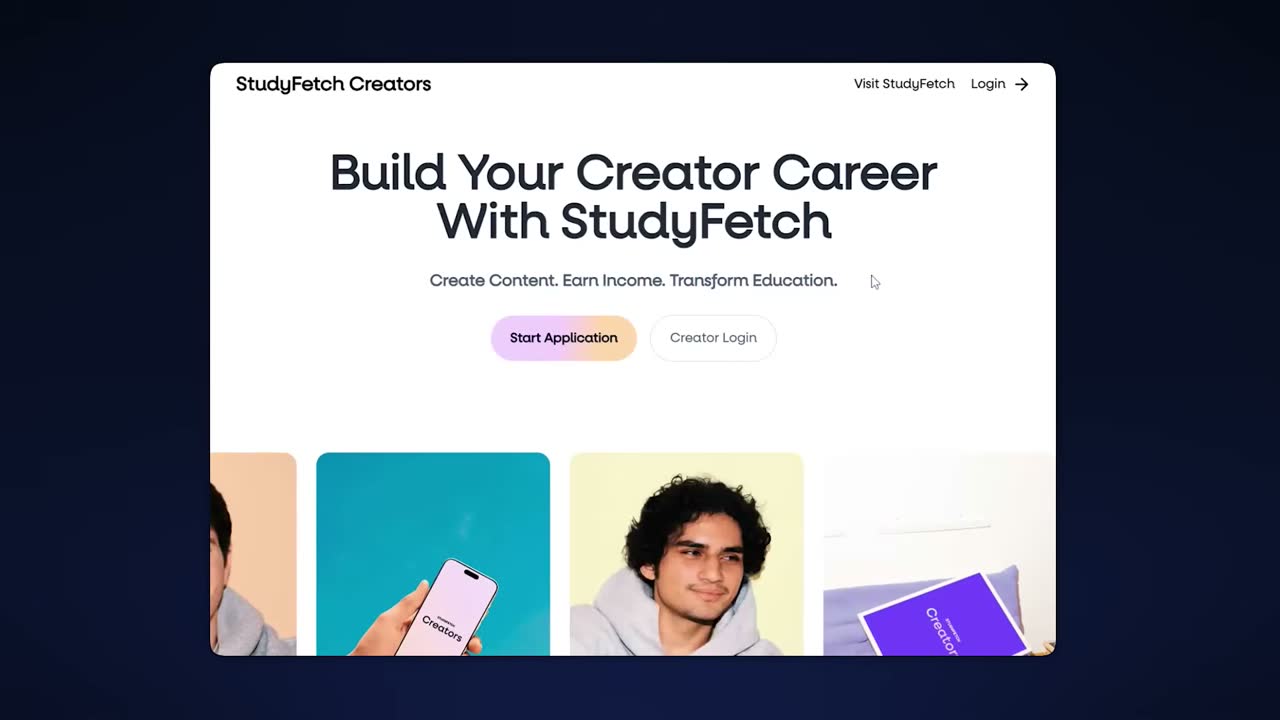
StudyFetch Creators site, the inbound application page paired with outbound creator recruiting. Comments that fit the video and admit founder ties converted best. Comments respond to the video and the thread, open with a story or hook, and end with a soft mention like "Now I use an app for my exercises." A calorie comment saying the app was built by "my friends and me" reached 800 likes.
They run parallel angles: answer then add a CTA, ask and name-drop, story with no CTA, or point to a clip on the profile, since many people will watch one more video before installing. Profiles are branded for the app with test bios like "fitness and tech" vs "I founded this app."
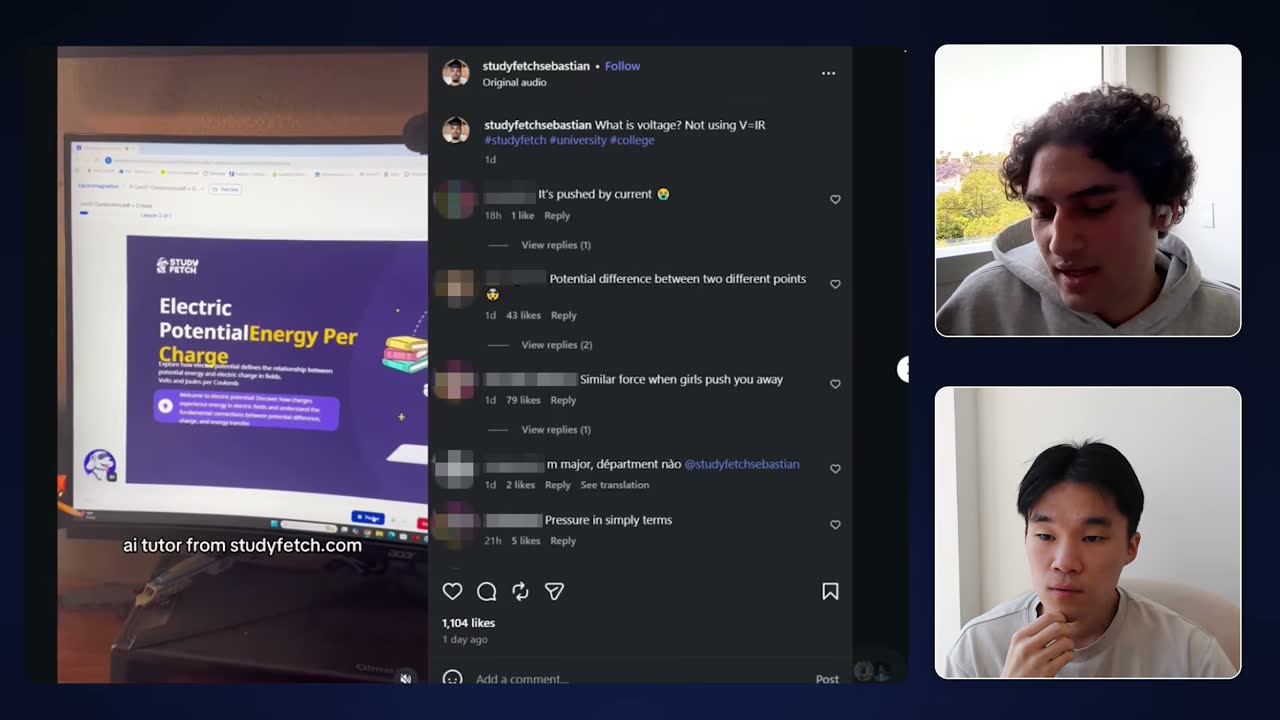
Study Fetch creator's Instagram Reel 'What is voltage?' with 1,104 likes and comments, showing the AI tutor. Comment early on rising videos with engaged threads, filtered by AI. Being among the first comments on a trending video lets a comment sit on top; old videos are skipped. AI prompts analyze each video and comment section, targeting people who ask questions or state opinions.
One phone identity per account plus warm-up comments avoids detection. A custom Android loads and unloads the whole ROM so each account looks like its own phone, running 12 to 24 accounts per phone per day, each posting up to 60 comments. Harmless comments with no CTA warm accounts up, like cold email inboxes.
One angle worked for two weeks, then Instagram began blocking it with no change on their side; rotating angles and prompts fixed it. They run 60 devices, though 1,000 would yield about 21 million comments a month.
10Passing mentions
Quitting Instagram flips how people feel about it. Mark Pincus says people now talk about getting off Instagram like quitting smoking, with NPS falling from plus 35 to minus 35 for those who quit Facebook and Instagram.
He also cites Instagram's camera as a best-of-breed benchmark to learn from.

The rise of taste, human authenticity and judgment in an AI world | Adam Mosseri (Head of IG)
Over three billion people use it monthly. It is shifting to small generalist pods, lets users view and edit their inferred topics with a "your algorithm" feature, and bets that AI content flooding feeds favors authentic creators. A feed redesign test shown to 4% of iOS users snowballed into a backlash, and Reels built on Stories in 2019 cost it timing against TikTok.
The main feed carries most usage, so protect it and resist extra tabs. Instagram's main feed drew about 80% of use, and a better Explore tab might only move Explore from 10% to 15%. Surface usage follows a power law, so make the main experience great and use it as the entry point to others.
Fold in successful experiments once proven without killing them too early. "Half of the job is saying no to another thing in the sidebar or another tab."
From ChatGPT to Instagram to Uber: The quiet architect behind the world’s most popular products
Deng was first Head of Product. Usage quadrupled in two years thanks to systems built along the way, the team had no idea how many users it had until a growth team came in, and it won through craft on a simple idea.
Instagram copied Snap's features, and made Stories better than the original. Instagram launched an Instagram Plus subscription right after Snapchat Plus passed 25 million subscribers. Peter Sellis credits Stories' success to great design and Mosseri's taste, while features like the map fit Instagram less well.
Evan Spiegel's response is to assume any software feature gets cloned and build hard-to-copy ecosystems: creator relationships, an AR platform with millions of developer-built lenses, and vertically integrated hardware.
Unorthodox frameworks for growing your product, career, and impact | Bangaly Kaba (YT, IG, FB)
Bangaly led growth there. 15 teams each ran 12 to 20 experiments a quarter with 60 to 70% shippable. It grew 47% in 2016, retention doubled after the 2017 connections pivot, and an easier login fix added 15 to 20 million monthly actives a year.
IGTV failed on wrong assumptions, then Reels succeeded once those were dropped. IGTV was a big flop because it baked in wrong assumptions and held onto some constraints. The team changed those assumptions and redid the idea as Reels, which became very successful.
Ian Silber, who spent eight years at Instagram, frames it as a lesson in reacting and listening to users: "Not what you shipped one time but how you fix forward."
Instagram was design-led and slow on purpose: do the simple thing first. Under Kevin Systrom, Instagram kept a simple product for billions of users and changed it less than peers. That pace worked for most of its stages but would not suit OpenAI's current stage.
Ian Silber's advice is to carry useful habits across companies but work with each company's DNA instead of trying to change it.
Why Claude can’t be your PM (yet) | Anthropic CPO Panel
Its main feed drew about 80% of use, so the main tab must stay great and extra tabs must earn their place. A better Explore tab might move from 10% to 15% of use.
Judge a format by the share watching past 3 seconds. Jay checks Instagram's 3-second retention stat with engagement; a format that consistently holds 75 to 80% past 3 seconds will go viral eventually, with average watch time of 6 to 10 seconds.
All his good formats hold at least 70%. Before launching, Nick Lawton searches TikTok and Instagram competitor accounts for formats to remix by 10 to 20%, since exact copies from warmed-up accounts often fail on a new account.
90 minutes of unfiltered product advice from Snap and Discord’s product chief | Peter Sellis
It copied Snap eagerly, launching an 'Instagram plus' right after Snapchat Plus, and made Stories better than the original thanks to great design and Adam Mosseri's taste. Features like the map fit it less well.
Building the first Reels on Stories cost Instagram its timing against TikTok. The 2019 Reels was built on top of Stories to reuse existing primitives, but Stories have low read-through, so most Reels went unseen and then disappeared. Instagram was out of position when TikTok surged during the 2020 pandemic.
Adam Mosseri calls it a big fork in the road for the business. The lesson: do not launch a new format on a surface people rarely read through.
A chronological default lowered usage and satisfaction, so Instagram ranks instead. When chronological was made the default, usage went down and large-scale surveys showed satisfaction dropping over months. Pure recency rewards posting volume, so publishers like the New York Times crowd out a friend who posts weekly.
Mosseri treats recency as one input to relevance and says designing these systems is "almost like designing a city": ask what incentives the mechanics create.
Exploration ranking gives small and niche creators a path to an audience. Exploitation ranking shows what many people already like and moves engagement easily. Exploration tests content on people who might like something they don't yet know, such as showing Afrojack to a Bieber fan.
Inspired by TikTok, Instagram invested in originality, breakout content and recency, and believes it is ahead of TikTok in a couple of these areas.
"Your algorithm" uses an LLM to describe embeddings so users can edit them. Recommenders run on embedding vectors humans cannot read. Instagram has an LLM describe a region of a user's embedding map in words, such as "deep pourover coffee snobbery", then lets users add or remove those topics.
Mosseri says the algorithm knew less about people than they assumed, and LLMs are closing that gap. Next steps include non-topical controls like more fun content or fewer photos in a row.
Instagram bets AI abundance pushes people toward real creators. Mosseri expects people to seek out creativity, point of view and the person behind content "more, not less", which favors the largest creator platform. Instagram counts creators broadly, including journalists, artists and shop owners.
This rests on belief about what people will want: no usage data is shown, and Mosseri admits Instagram is not yet good at ranking AI content.
Label AI content and show account context rather than filtering it. Mosseri would tell users whether content is AI and show more about the poster, such as profile age and name changes, so they can decide whom to trust.
Since AI detection may weaken as models improve, labeling camera-captured content may be more practical long term, and platforms should be honest about their confidence.
Meta replaced 13-person teams with pods of four to six engineers. The old shape had 2 to 3 each of Android, iOS and server engineers plus PM, designer, data scientist and researcher. Pods now have four to six engineers and a product staff lead, with core teams of about six or seven.
Specialists join only when the work needs them, such as a senior data scientist for pricing or a senior designer for a novel experience. Fewer people means "a little bit less design by committee." No results comparing pods to old teams are given.
Product staff is an evolved PM who also does design, data and research. A pod can run with four engineers and one product staff and no dedicated specialists. A Reels creation drop-off waterfall that needed a data scientist a year earlier can now be pulled by product staff with internal tools.
Strong designers often make strong product staff because they already hold views on strategy, business and go-to-market; senior Instagram designer Nate just transferred into the role.
With building cheap, the leverage is deciding what to build. Mosseri says taste is hard to automate, so he stays long on designers even as roles blur. Strategy must be controversial enough that a reasonable person could disagree, or you only compete on execution.
An AI asked lazily for strategy gives the predictable answer competitors expect; it needs steering on constraints like talent, regulation and brand.
Plan what to say when a controversial test leaks, because it will. A video-viewer feed redesign test shown to 4% of iOS users was conflated with Reels, recommendations and creator reach complaints, and snowballed through creators and press.
The team now decides before testing what to say and whether to speak proactively or reactively: "not if it leaks, when it leaks, what are we saying?"
Explain trade-offs publicly for onlookers, not to convert critics. Mosseri engages in public debates because they happen with or without the company, laying out what is being done, why, and the trade-offs. He started this with the 2009 News Feed redesign.
He puts criticism in perspective by comparing a redesign to rearranging someone's desk without warning.
Lead as a curator and build leadership teams on trust. Mosseri sees strong product leaders building an environment where good ideas bubble up and get chosen. When forming a leadership group across engineering, product, data science, design and research, check complementary skills plus trust and rapport.
Sometimes two great people cannot work together and should be split.

How to Dominate for Decades | Doug Leone, Sequoia Capital
Sequoia closed its investment on a Thursday and it sold on a Sunday, so it made little money. Leone argues that without Instagram, Meta might be gone.
New managers at Meta started by shipping as ICs. Fiona Fung spent her first quarter on each Meta team shipping and learning the code before managing, across infrastructure, growth, integrity and safety teams.
Teammates said they appreciated her using what they built.
Chatbots are not the final interface: OpenAI’s Head of Design on what’s next | Ian Silber
Ian spent eight years there. It had billions of users but a simple product, was design-led under Kevin Systrom, and moved slower under the motto 'do the simple thing first.' IGTV flopped, then Reels followed once wrong assumptions were dropped. It succeeded after the team dropped IGTV's wrong assumptions and constraints and redid the idea.
Quitting Instagram flips how people feel about it. Mark Pincus says people now talk about getting off Instagram like quitting smoking, with NPS falling from plus 35 to minus 35 for those who quit Facebook and Instagram.
He also cites Instagram's camera as a best-of-breed benchmark to learn from.

#1 UGC EXPERT Reveals How To Market Consumer Apps
Along with TikTok, it is where you search competitor accounts to find formats to remix before launching a UGC campaign.
Reels views often fail to convert, from clickbait or foreign audiences. Instagram mostly rewards watch time, so a clickbait hook like "a girl in my hostel showed me this" pulled 300k views but only 174 likes and 8 comments. StudyFetch had Reels go viral that converted close to nothing.
Reels push videos to countries with lower conversion or where TikTok is banned. Kieran says TikTok is higher intent because Instagram is where people relax; aim for over 80% US viewers, and non-US creators should prefer TikTok.
What happens after coding is solved? | Fiona Fung (Claude Code & Cowork)
Fiona led infrastructure, growth, integrity and safety teams there, and teammates said they liked that she used what they built.
Instagram copied Snap's features, and made Stories better than the original. Instagram launched an Instagram Plus subscription right after Snapchat Plus passed 25 million subscribers. Peter Sellis credits Stories' success to great design and Mosseri's taste, while features like the map fit Instagram less well.
Evan Spiegel's response is to assume any software feature gets cloned and build hard-to-copy ecosystems: creator relationships, an AR platform with millions of developer-built lenses, and vertically integrated hardware.
The hidden pattern behind successful products | Mark Pincus (FarmVille, Words with Friends, & more)
Its camera is cited as a best-of-breed benchmark to learn from. People now say they are off it as if they quit smoking, and NPS fell from plus 35 to minus 35 for quitters.
Judge a format by the share watching past 3 seconds. Jay checks Instagram's 3-second retention stat with engagement; a format that consistently holds 75 to 80% past 3 seconds will go viral eventually, with average watch time of 6 to 10 seconds.
All his good formats hold at least 70%. Before launching, Nick Lawton searches TikTok and Instagram competitor accounts for formats to remix by 10 to 20%, since exact copies from warmed-up accounts often fail on a new account.
Reels views often fail to convert, from clickbait or foreign audiences. Instagram mostly rewards watch time, so a clickbait hook like "a girl in my hostel showed me this" pulled 300k views but only 174 likes and 8 comments. StudyFetch had Reels go viral that converted close to nothing.
Reels push videos to countries with lower conversion or where TikTok is banned. Kieran says TikTok is higher intent because Instagram is where people relax; aim for over 80% US viewers, and non-US creators should prefer TikTok.
The EXACT System to Go From 0-$10M+ With Your App
Some Reels went viral for StudyFetch but converted close to nothing, since audiences often come from countries where conversion is lower or TikTok is banned.
About 300,000 automated comments produced roughly 7,000 clicks. Nick and Ivan's campaign posted comments across many accounts; about 5,000 profile activities led to about 750 link clicks, and they project a 4x return. They treat 15% profile-to-link clickthrough as a good benchmark.
Bad campaigns land near 3% and the best reach 50 to 60%. Only a tiny share of comments get enough exposure to matter, so early on change angles completely, not slightly.
StudyFetch Creators site, the inbound application page paired with outbound creator recruiting. Comments that fit the video and admit founder ties converted best. Comments respond to the video and the thread, open with a story or hook, and end with a soft mention like "Now I use an app for my exercises." A calorie comment saying the app was built by "my friends and me" reached 800 likes.
They run parallel angles: answer then add a CTA, ask and name-drop, story with no CTA, or point to a clip on the profile, since many people will watch one more video before installing. Profiles are branded for the app with test bios like "fitness and tech" vs "I founded this app."
Study Fetch creator's Instagram Reel 'What is voltage?' with 1,104 likes and comments, showing the AI tutor. Comment early on rising videos with engaged threads, filtered by AI. Being among the first comments on a trending video lets a comment sit on top; old videos are skipped. AI prompts analyze each video and comment section, targeting people who ask questions or state opinions.
One phone identity per account plus warm-up comments avoids detection. A custom Android loads and unloads the whole ROM so each account looks like its own phone, running 12 to 24 accounts per phone per day, each posting up to 60 comments. Harmless comments with no CTA warm accounts up, like cold email inboxes.
One angle worked for two weeks, then Instagram began blocking it with no change on their side; rotating angles and prompts fixed it. They run 60 devices, though 1,000 would yield about 21 million comments a month.

Why Most Apps Are Failing in 2026: 7 Mistakes Killing Your App Success
Its filters and social features were stacked up over time after a stripped-down first version solved one problem. Used as an iceberg example of years of hidden work.
How to win when software is not a moat | Evan Spiegel (Snapchat CEO)
Started about a year before Snapchat and launched Instagram Plus after Snapchat Plus passed 25 million subscribers, an example of Snap's features being copied.
Copy This UGC Strategy, It'll Make Your App Go Viral
Its algorithm mostly rewards watch time, so a clickbait hook pulled 300k views with only 174 likes and 8 comments. Jay uses its 3-second retention stat to judge formats, and one of his accounts lost reach, which he suspects was a shadow ban.
Jimmy Iovine: Building Interscope Records & Beats by Dre
Instagram and TikTok own the relationship with the end user, which the music industry never had.
The App Marketing Strategy No One Talks About
The channel for the campaign: about 300,000 automated comments produced roughly 7,000 clicks. Each phone runs 12 to 24 accounts a day, and Instagram began blocking one comment angle after two weeks.
Inside Google's AI turnaround: AI Mode, AI Overviews, and vision for AI-powered search | Robby Stein
It grew to half a billion daily actives during Stein's time. Stories worked as a distinct but coherent format with its own tools, while sharing shifted from public feed posts to Stories and DMs. It took two to three years and failed at first because it spanned too many surfaces, was named favorites, and was mistranslated as best friend in many markets, so people added one person. The fix was a Stories-only redesign, larger lists (20 to 30 people got a couple of replies) and a green ring.
Anthropic's CPO on what comes next | Mike Krieger (co-founder of Instagram)
Spread because people posted photos elsewhere and friends asked how it was done. Time spent was its north star, later refined into healthy time spent, and it had two people early on.
OpenAI’s CPO on how AI changes must-have skills, moats, coding, startup playbooks, more | Kevin Weil
Stories exploded internally, with colleagues knowing each other's weekends from what they posted, which signaled it would work outside.

How Ladder Nailed Product/Channel Fit on TikTok and Meta to Grow 2,000%
Now sends Ladder leads on about every other day, more than TikTok. It works like TikTok, so the same creators and strategy carried over.
How Tinder's Monetization Strategy Propelled it to $1B+ in Revenue
As dating apps raise prices and add paid products, users turn to Instagram for social discovery, which weakens Tinder's engagement.
Making and Leading Products People Love (Scott Belsky) | Lenny & Friends Summit 2024
Engagement rises after a user posts, which suggests people return to see who saw their content, an example of vanity-driven use.
Simplify To Win | Lenny & Friends Summit 2024
It began as Burbn, then dropped everything except photo sharing, an example of winning through simplicity.
A conversation with OpenAI's CPO Kevin Weil, Anthropic's CPO Mike Krieger, and Sarah Guo
Krieger's past company had almost no UI tests because they were brittle and broke whenever a button moved, which makes it a first fit for computer use. Waiting on Apple's WWDC announcements there is like waiting on research now.
Meta’s head of product on working with Mark Zuckerberg, early growth tactics, and more | Naomi Gleit
It launched Teen Accounts, which put teens in the safest settings by default, with parental permission needed for under-16s to change them. Tens of millions of public teen accounts moved to private unless a parent approves.

Meta
Bought for $1B in 2012 with 27M users and no revenue, during the IPO quiet period. Zuckerberg framed it as buying time to build rivals' social mechanics, and it later copied Snapchat's stories.
Pattern Breakers: How to find a breakthrough startup idea | Mike Maples, Jr. (Partner at Floodgate)
Rode better phone cameras, Wi-Fi and upload speeds as smartphones crossed about 10 million units.
Hard-won lessons building 0 to 1 inside Atlassian | Tanguy Crusson (Head of Jira Product Discovery)
Used as the example for incubate, iterate, integrate: a side popular tab became the explore tab and then the main feed.
Be fundamentally different, not incrementally better | Jag Duggal (Nubank, Facebook, Google)
Kevin Systrom's line from early Instagram, "We may not be right, but at least we are clear", illustrates how a clear strategy shows when you drift off course.
Twitter’s ex-Head of Product on Elon, consumer products, culture, more | Kayvon Beykpour
It is an asynchronous product with live added on top, which Kayvon cites as why live works there. It has also struggled with optimizing metrics and tiptoed toward giving people more control.
Lessons from 1,000+ YC startups: Resilience, tar pit ideas, pivoting, more | Dalton Caldwell (YC)
It came from Burbn, a check-in style app that pivoted by copying Hipstamatic, the top paid app, with a social graph attached. That pivot beat PicPlz.
The Anatomy of a High-Performing UGC Ad
Partnership ads let an ad run from a creator's page instead of the app's page, making it look less like an ad. Posting from the app account versus a creator account made little difference in tests.
Cracking the Code: App Store Optimization for Apps Struggling with Downloads
Competing with Instagram for its own top keyword is a fight a new app never wins.
Amazon Web Services
Started on AWS as one of the early startups that used pay-as-you-go infrastructure.
Product Market Fit: The Simple Way to Find It
Camera filters began as a throwaway feature but proved the most used and became the core product, showing fit can emerge later. It is also cited as a daily-use app, so its healthy DAU to MAU ratio differs from a monthly travel app.
This Meme Maker App Makes $60K a Month [How to Make Memes]
The number three meme app earns about $30K a month using Instagram ads, roughly three times the number two app's $10K.
Video Ads Example for Facebook & Mobile Advertising
Polished creative that works on Instagram fails on TikTok. The same TikTok-style video still works in Instagram feeds and stories, where people know it is an ad and swipe up on their own.
Influencer Marketing: How to Decide Who is a Good or Bad Influencer
The top result of a general hashtag lists related tags, and each of those lists more specific ones, which makes it the tool for finding niche hashtag leaders. Outsiders get only a limited API, made even more limited recently by privacy issues, so metric tools have little data.
More in Social & Dating
 Social & Dating
A social network built around connecting people and sharing.
58 sources · 128 tips Social & Dating
TikTok
A short-form video app where creators post content and can earn through a revenue-sharing program.

 35 sources · 75 tips
 Social & Dating
A professional networking platform for jobs, hiring and career content.
15 sources · 55 tips Social & Dating
Tinder
A dating app with tiered subscriptions plus boosts, Super Likes and other in-app purchases.
11 sources · 47 tips Social & Dating
Snap
The company behind Snapchat, a camera-first messaging app popular with teens.
6 sources · 29 tips Social & Dating
Discord
A chat and voice platform for gaming friends and communities.
10 sources · 29 tips Social & Dating
Snapchat
A camera-first messaging and social app built around close friends, Stories and AR lenses.
10 sources · 23 tips Social & Dating
A social network for short public posts and real-time conversation.
11 sources · 29 tips