
Methods
A platform where creators earn money posting short-form videos, also used by companies to run UGC programs.
Methods, a short-form video platform for creators and UGC programs, drew few users as a UGC marketplace, then user count doubled every two weeks once pitched as a way to make money online. It has paid over $500,000 to about 50,000 creators, starting with $40 for a first video. Lesson: sell the outcome users want, not the category, and sign demand first; one AI lab client got 100 million views in 2 weeks.
- Pitched the category
- Drew few users
- Buyers heard 'we'll run your UGC'
- Pitched the outcome creators want
- Signups exploded
- Users double every two weeks
- Ranks first for 'make money online'
Companies also paid more for the money pitch
From Dris on Methods' framing
What was said about Methods
1Reframing Methods from UGC marketplace to 'make money online'
- 1See a Methods videoOn TikTok or Instagram
- 2Join MethodsPaid $40 for first video
- 3Post Methods videosLater move to paid company programs
From Dris on Methods' growth
Pitching the outcome creators want, not the category, made signups explode. Launched as a 'UGC marketplace app,' Methods drew few users. Reframed as the new way to 'make money online,' signups exploded, and users now double every two weeks.
Methods ranks first when you search 'make money online.' Dris: "The number one most important thing to company building is framing."
Companies pay more for a money pitch than for a UGC pitch. "We'll run your UGC program" confused some buyers. "We'll make you money and get you conversions" sold, and companies paid more for it.
Dris applies the same idea to creators. He wants UGC, drop shipping and crypto framed as a 'method,' not a gig or side hustle, and describes a 'method economy' where everyone works through the app.
Methods grows through a creator loop that posts about Methods. Someone sees a Methods video on TikTok or Instagram, joins, and posts more Methods videos. Creators later move on to paid company programs.
Companies use Methods to source creators for their own UGC programs. Scripts, payments and post reviews first ran on many separate tools and now sit in one self-service platform.
2The $40 first-video hook
Paying $40 for the first video turns content creation into a game. Every new creator gets $40 for their first post during onboarding. Methods has paid over $500,000 to about 50,000 creators.
Dris argues fear of a flop, not lack of skill, stops people from posting, and that people want rewards now rather than delayed gratification. He borrows the big early reward from casino and gambling apps. "We pay people on Methods $40 their first video. They're hella happy. They start making more videos." Payback on the $40 is not reported.
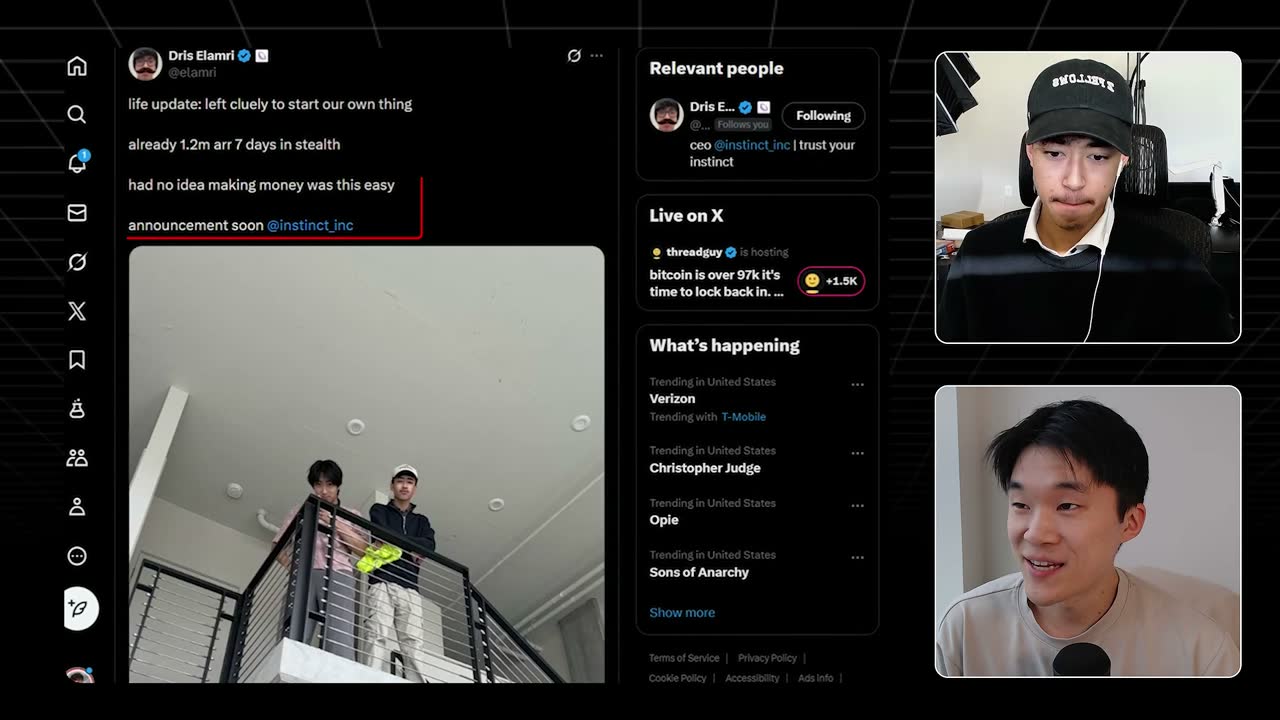
Dris Elamri's tweet announcing he left Cluely and hit $1.2M ARR seven days into stealth.
3Solving the marketplace cold start: companies first
Sign the demand side first, then pay creators to fill it. Methods signed companies first, then recruited creators by paying per video: $30 per video early on, later $40 for the first post.
A creator marketplace can't sign companies without creators or creators without companies. Dris judged that companies were the harder side and creators would follow once paid.
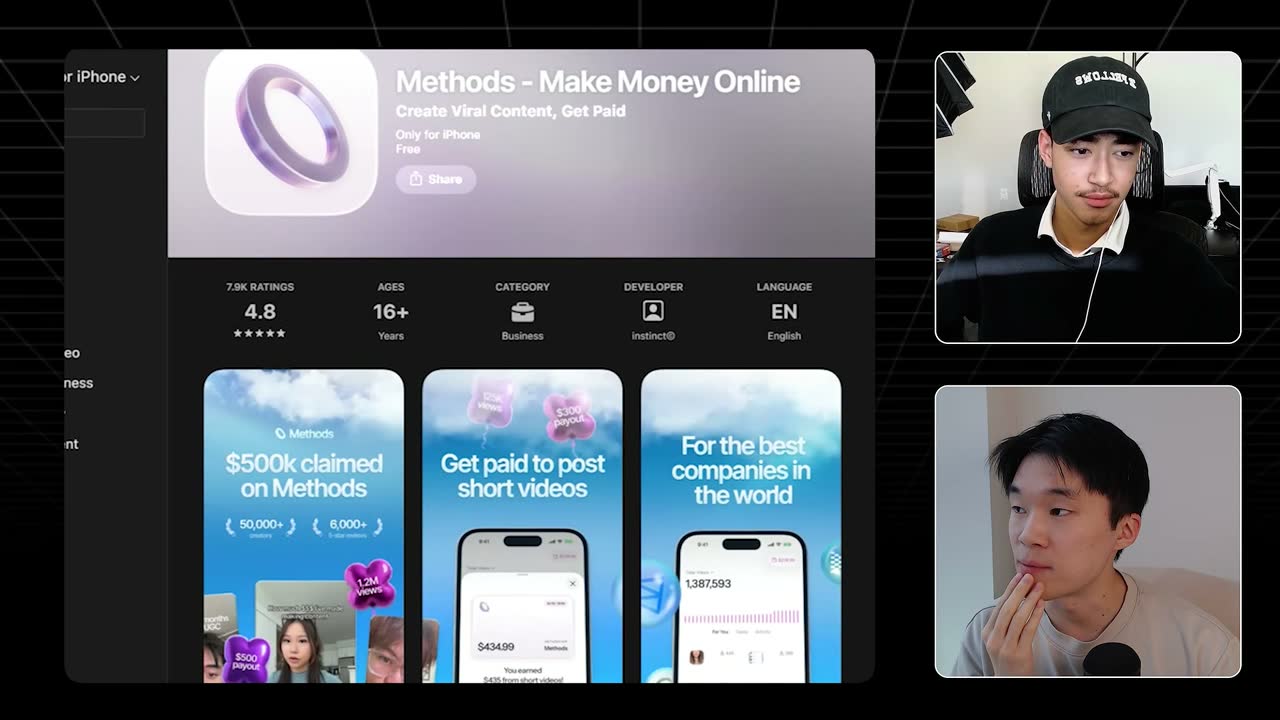
Methods app's App Store page: 4.8 rating from 7.9K reviews, "$500k claimed" by 50,000+ creators. Distribution sells before the product exists. After leaving Cluely, Dris took sales calls with no product, promising views, users and revenue, and reports reaching $1.2M ARR in 7 days.
He says the sales calls were the only thing the company had. The figure is his own, announced in a September 2025 tweet, with no independent data.
Deckard got 100 million views in two weeks at sub-30 cent CPM. Deckard, a billion-dollar AI lab with about 60 engineers and 2 marketers, used the program for a new AI photo and video app. It reached 100 million views in 2 weeks and a top 30 App Store spot.
The program has passed 400 million lifetime views. Dris's principle: work with winners and make them bigger winners.
Scripted onboarding lets anyone with a phone start posting. New creators get exact scripts, example videos, account warm-up, trial posts and lighting tips. Each post also gets personalized AI feedback on phone position, lighting and captions.
Keep creators posting through the low-view videos. The main churn is creators who quit when their second video gets about 100 views. Creators who stayed since the start are now the highest paid on Methods.
Dris says the gap between 100 views and going viral is small and that staying power, not talent, decides success. "If you keep trying, it is impossible to fail." How many creators quit is not reported.
4Dris's UGC playbook from Cluely
A few consistent creators beat a huge unmanaged roster. Cluely had fewer than 20 creators posting consistently. Another company with 2,000 creators got only 500,000 views in a month.
The top 1% or 0.1% of creators deliver about 90% of views. Dris says programs break when creators can't be managed at scale.
Borrow proven formats and keep testing new ones. Top formats are taken from other companies or solo creators and adapted to a new product. Programs fail when they stick with one format that isn't the most viral or converting.
With Ben, Dris scaled Cluely's UGC from zero to 100 million views at sub-$1 CPM in the first few weeks.
UGC is for conversion; launch videos are for reach. Dris says content is rarely both viral and converting. He claims UGC converts four times higher and costs 10 to 20 times less than other paid acquisition.
He calls launch videos the top-of-funnel move for tech, yet after Cluely's launch video many on Twitter still didn't know what it was. The conversion figures are his own.
Founders should post a 30-second video daily before hiring creators. Recording one video a day teaches what goes viral and what companies expect, before hiring for skills the founder lacks.
Dris built his own sense through volume: after 6 months at zero views, his Minecraft Shorts reached 200,000 subscribers and 180 million views in 9 months. Earlier he drop-shipped fake AirPods Max using recut unboxing clips. He says the sense fades on each new platform. "How hard is it to record one 30-second video every day?"

Meet The 18y/o Who Solved UGC Marketing (100M Views in 2 Weeks)
Framed as a UGC marketplace it drew few users, then exploded once pitched as a way to make money online, and users now double every two weeks. It pays $40 for a first video and has paid over $500,000 to about 50,000 creators.
Pitching the outcome creators want, not the category, made signups explode. Launched as a 'UGC marketplace app,' Methods drew few users. Reframed as the new way to 'make money online,' signups exploded, and users now double every two weeks.
Methods ranks first when you search 'make money online.' Dris: "The number one most important thing to company building is framing."
Companies pay more for a money pitch than for a UGC pitch. "We'll run your UGC program" confused some buyers. "We'll make you money and get you conversions" sold, and companies paid more for it.
Dris applies the same idea to creators. He wants UGC, drop shipping and crypto framed as a 'method,' not a gig or side hustle, and describes a 'method economy' where everyone works through the app.
Methods grows through a creator loop that posts about Methods. Someone sees a Methods video on TikTok or Instagram, joins, and posts more Methods videos. Creators later move on to paid company programs.
Companies use Methods to source creators for their own UGC programs. Scripts, payments and post reviews first ran on many separate tools and now sit in one self-service platform.
Paying $40 for the first video turns content creation into a game. Every new creator gets $40 for their first post during onboarding. Methods has paid over $500,000 to about 50,000 creators.
Dris argues fear of a flop, not lack of skill, stops people from posting, and that people want rewards now rather than delayed gratification. He borrows the big early reward from casino and gambling apps. "We pay people on Methods $40 their first video. They're hella happy. They start making more videos." Payback on the $40 is not reported.
Dris Elamri's tweet announcing he left Cluely and hit $1.2M ARR seven days into stealth. Sign the demand side first, then pay creators to fill it. Methods signed companies first, then recruited creators by paying per video: $30 per video early on, later $40 for the first post.
A creator marketplace can't sign companies without creators or creators without companies. Dris judged that companies were the harder side and creators would follow once paid.
Methods app's App Store page: 4.8 rating from 7.9K reviews, "$500k claimed" by 50,000+ creators. Distribution sells before the product exists. After leaving Cluely, Dris took sales calls with no product, promising views, users and revenue, and reports reaching $1.2M ARR in 7 days.
He says the sales calls were the only thing the company had. The figure is his own, announced in a September 2025 tweet, with no independent data.
Deckard got 100 million views in two weeks at sub-30 cent CPM. Deckard, a billion-dollar AI lab with about 60 engineers and 2 marketers, used the program for a new AI photo and video app. It reached 100 million views in 2 weeks and a top 30 App Store spot.
The program has passed 400 million lifetime views. Dris's principle: work with winners and make them bigger winners.
Scripted onboarding lets anyone with a phone start posting. New creators get exact scripts, example videos, account warm-up, trial posts and lighting tips. Each post also gets personalized AI feedback on phone position, lighting and captions.
Keep creators posting through the low-view videos. The main churn is creators who quit when their second video gets about 100 views. Creators who stayed since the start are now the highest paid on Methods.
Dris says the gap between 100 views and going viral is small and that staying power, not talent, decides success. "If you keep trying, it is impossible to fail." How many creators quit is not reported.
A few consistent creators beat a huge unmanaged roster. Cluely had fewer than 20 creators posting consistently. Another company with 2,000 creators got only 500,000 views in a month.
The top 1% or 0.1% of creators deliver about 90% of views. Dris says programs break when creators can't be managed at scale.
Borrow proven formats and keep testing new ones. Top formats are taken from other companies or solo creators and adapted to a new product. Programs fail when they stick with one format that isn't the most viral or converting.
With Ben, Dris scaled Cluely's UGC from zero to 100 million views at sub-$1 CPM in the first few weeks.
UGC is for conversion; launch videos are for reach. Dris says content is rarely both viral and converting. He claims UGC converts four times higher and costs 10 to 20 times less than other paid acquisition.
He calls launch videos the top-of-funnel move for tech, yet after Cluely's launch video many on Twitter still didn't know what it was. The conversion figures are his own.
Founders should post a 30-second video daily before hiring creators. Recording one video a day teaches what goes viral and what companies expect, before hiring for skills the founder lacks.
Dris built his own sense through volume: after 6 months at zero views, his Minecraft Shorts reached 200,000 subscribers and 180 million views in 9 months. Earlier he drop-shipped fake AirPods Max using recut unboxing clips. He says the sense fades on each new platform. "How hard is it to record one 30-second video every day?"
More in Marketing & growth tools
 Marketing & growth tools
App Masters
An app marketing and growth consultancy run by Steve P. Young, which also hosts a podcast.
 115 sources · 465 tips
Apple Search Ads
Apple's ad platform for promoting apps in the App Store.
 44 sources · 132 tips
 Marketing & growth tools
Meta
The parent company of Facebook, Instagram, WhatsApp and Threads, run by Mark Zuckerberg.


 42 sources · 106 tips
 Marketing & growth tools
Sensor Tower
An app intelligence and ASO platform with keyword rankings, competitor research and download estimates.
42 sources · 90 tips Marketing & growth tools
Mobile Action
An app store optimization and mobile marketing intelligence platform.
28 sources · 81 tips Marketing & growth tools
HubSpot
A CRM and marketing software platform built for small and medium businesses.
14 sources · 41 tips Marketing & growth tools
AdMob
Google's mobile ad monetization platform with mediation, open bidding and unified payments for app developers.
10 sources · 47 tips Marketing & growth tools
AppsFlyer
A mobile attribution and marketing analytics platform for app marketers.
17 sources · 30 tips