
GitHub Copilot
A code hosting and collaboration platform for software developers, with free and paid plans.
GitHub's pricing page redesign (more contrast between tiers, more features in higher tiers, the features customers value most emphasized, an outdated tier removed) lifted free and paid signups by over 20%. Its pull request shows the value of a tiny core, and about 10% of top contributors were designers. Lesson: sharpen tier differences, and prototype in code rather than writing specs.
- Features listed equally
- Less contrast between tiers
- Included an outdated tier
- Higher contrast between tiers
- More features in higher tiers
- Most-valued features emphasized
- Outdated tier removed
Free and paid signups both rose over 20%
From GitHub pricing page redesign test
What was said about GitHub Copilot
1The pricing page redesign test
A clearer, higher-contrast pricing page lifted free and paid signups by over 20%. GitHub redesigned its pricing page to increase visual contrast between tiers, showing more features in the higher tiers. It also emphasized the features customers value most, used vibrant colors and removed an outdated tier. Free and paid signups both rose by more than 20%.
The changes shipped together, so the gain is not split by change. Contrast made the value gap between plans visible at a glance. Features were chosen to match user priorities rather than listed equally. Dropping the outdated tier left fewer choices to weigh. The lift reached the free tier as well as the paid ones, so a clearer pricing page can help the whole funnel.
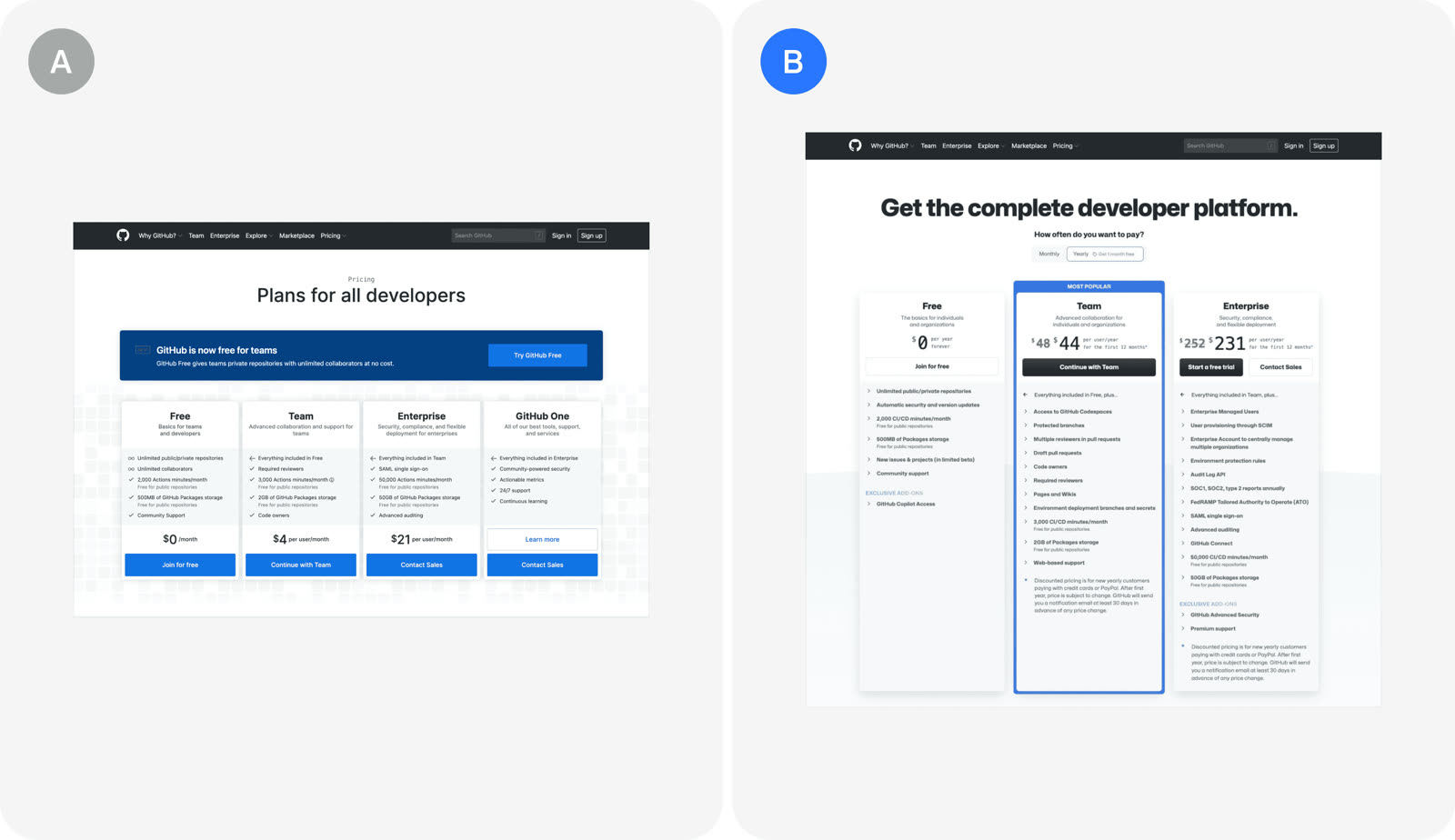
Version A and version B as Github tested them.
2How GitHub's product teams worked
GitHub product reviews ran on demos, not memos. Max Schoening says to build a janky demo instead of writing a PRD for the first 10% of a project. That first 10% is now nearly free, and a demo gives people something to react to early, the opposite of waterfall.
He suggests sending off 10 agents to explore 10 paths and seeing which was right. The caveat: the last 10% is still 90% of the work.
GitHub designers prototyped in code to master their material. Around 10% of the top contributors to GitHub's product were designers, even before LLMs. The aim was not production code but understanding the material, such as how an agent loop works.
Schoening would rather have a designer who understands agent loops than one who can only tweak styles. Production contributions tend to follow once people are awakened to the medium.
Mature-product teams should stop being precious about shipping. After a hit first act, teams worry about upsetting users. Schoening tells them users get more upset if you do not innovate than if you accidentally break something, and that the people who built act one can build act two.
He applied this at GitHub and at Notion, and argues cheaper experimentation now lets teams increase shots on goal.
3The pull request and GitHub Actions
The pull request is a tiny core that is exceptionally good. Schoening names the GitHub pull request among products built on one tiny superpower, alongside iPhone multitouch, Notion blocks, Heroku's git push and Dropbox's menu bar sync icon.
His advice is to find that core and push everything else back, since adding one more thing to finally make a product great never works.
Actions shipped without good package management, and the ecosystem paid for it. Schoening points to GitHub Actions as a case where a missing foundation has cost the ecosystem.
4Claude Code's share of GitHub commits
Claude Code accounts for 4% of public GitHub commits. Boris Cherny, head of Claude Code, cites this figure and calls it a floor because private repositories are not counted.

Visual contrast between pricing tiers: Github's A/B test
Its pricing page redesign increased visual contrast between tiers, highlighted more features in higher tiers, emphasized the features customers value most, used vibrant colors and removed an outdated tier. Free and paid signups both rose by more than 20%.
A clearer, higher-contrast pricing page lifted free and paid signups by over 20%. GitHub redesigned its pricing page to increase visual contrast between tiers, showing more features in the higher tiers. It also emphasized the features customers value most, used vibrant colors and removed an outdated tier. Free and paid signups both rose by more than 20%.
The changes shipped together, so the gain is not split by change. Contrast made the value gap between plans visible at a glance. Features were chosen to match user priorities rather than listed equally. Dropping the outdated tier left fewer choices to weigh. The lift reached the free tier as well as the paid ones, so a clearer pricing page can help the whole funnel.
Version A and version B as Github tested them.

The future of AI in software development | Inbal Shani (CPO of GitHub)
GitHub dogfoods every feature internally for months before release, with finance, legal and HR also using it. It started from a developer time problem, then added AI, and funds ideas from customers, open source and pitches. Surveys show code written 55% faster, 85% more confident in quality, 88% less frustrated and code reviews 15% faster. Over 37,000 organizations and 1.5 million developers use it, and it was designed to fade into the background with no friction. Its success is measured by how many secrets were stopped from leaking and how many code issues were fixed before shipping. It came from the same experiment-and-fail approach as Copilot.
GitHub product reviews ran on demos, not memos. Max Schoening says to build a janky demo instead of writing a PRD for the first 10% of a project. That first 10% is now nearly free, and a demo gives people something to react to early, the opposite of waterfall.
He suggests sending off 10 agents to explore 10 paths and seeing which was right. The caveat: the last 10% is still 90% of the work.
GitHub designers prototyped in code to master their material. Around 10% of the top contributors to GitHub's product were designers, even before LLMs. The aim was not production code but understanding the material, such as how an agent loop works.
Schoening would rather have a designer who understands agent loops than one who can only tweak styles. Production contributions tend to follow once people are awakened to the medium.
Mature-product teams should stop being precious about shipping. After a hit first act, teams worry about upsetting users. Schoening tells them users get more upset if you do not innovate than if you accidentally break something, and that the people who built act one can build act two.
He applied this at GitHub and at Notion, and argues cheaper experimentation now lets teams increase shots on goal.
The pull request is a tiny core that is exceptionally good. Schoening names the GitHub pull request among products built on one tiny superpower, alongside iPhone multitouch, Notion blocks, Heroku's git push and Dropbox's menu bar sync icon.
His advice is to find that core and push everything else back, since adding one more thing to finally make a product great never works.
Actions shipped without good package management, and the ecosystem paid for it. Schoening points to GitHub Actions as a case where a missing foundation has cost the ecosystem.
The role of AI in new product development | Ryan J. Salva (VP of Product at GitHub)
Grew out of the GitHub Next research team and reached general availability about a year and a half after initial product work. Suggestions write roughly 40% of code for Python developers and 27% to 40% across languages, with inline gray text and about 200 ms latency tuned to protect flow. Keeps a separate moonshot team, GitHub Next, apart from its engineering, product and design teams. Ryan splits large team capacity into 5-10% bold bets, about 60% incremental work and 25-30% operations.
Claude Code accounts for 4% of public GitHub commits. Boris Cherny, head of Claude Code, cites this figure and calls it a floor because private repositories are not counted.
AI era skills: Why cultivating agency matters more than job titles | Max Schoening (Notion)
Product reviews ran on demos not memos, and about 10% of top contributors were designers before LLMs. Its pull request is a tiny great core, while Actions shipped without good package management, which has cost the ecosystem.
Head of Claude Code: What happens after coding is solved | Boris Cherny
Claude Code reached 4% of public GitHub commits, which Cherny calls a floor because private repositories are not counted.
Inside OpenAI: 2026 is the year of agents, AI’s biggest bottleneck, and why compute isn’t the issue
The Codex name first powered GitHub Copilot years ago. Autocomplete is the model for mixed-initiative AI: cheap when wrong, a speedup when right.
Why AI is disrupting traditional product management | Tomer Cohen (LinkedIn CPO)
LinkedIn builds its own layer so Copilot, Cursor or Windsurf can work over its code base, and worked with vendors in alpha mode. Its knowledge agents run on Copilot Enterprise, heavily customized.
How we restructured Airtable's entire org for AI | Howie Liu (co-founder and CEO)
Cited as the example of early models that only supported autocomplete, before smarter models enabled agentic tools.
How 80,000 companies build with AI: Products as organisms and the death of org charts | Asha Sharma
Uses an ensemble of models fine-tuned across 30 countries and all their languages, iterating in a loop for next-edit suggestions and code completions. You can already assign a pull request to Copilot.
Pricing your AI product: Lessons from 400+ companies and 50 unicorns | Madhavan Ramanujam
GitHub began with seat pricing, and Cursor and others have since moved to hybrid pricing. The natural next step is an AI developer or AI QA person that is attributable and autonomous.
AI prompt engineering in 2025: What works and what doesn’t | Sander Schulhoff
It is listed among coding agents that can search the web and so be steered by a malicious page.
Microsoft CPO: If you aren’t prototyping with AI you’re doing it wrong | Aparna Chennapragada
GitHub competes as a full system of repo, context, autocomplete, chat and an agent board, which is one of its fastest loops with strong positive feedback. Chennapragada built her new-tab Chrome extension in it in about 10 minutes.
The rise of Cursor: The $300M ARR AI tool that engineers can’t stop using | Michael Truell
Its first beta was the first truly useful AI product the founders used, and it inspired Cursor. Truell says it stalled because this market does not favor incumbents, and most of the original team has moved on.
Building Lovable: $10M ARR in 60 days with 15 people | Anton Osika (CEO and co-founder)
Lovable created a new GitHub project per user, and at 15,000 projects a day an on-call engineer cut its access with only an email as notice. Lovable now syncs with GitHub, which Osika says no other tool does this way.
A conversation with OpenAI's CPO Kevin Weil, Anthropic's CPO Mike Krieger, and Sarah Guo
Launched on a small, imperfect model (GPT-2, as Krieger recalled) and was still valuable because it saved typing and users could edit the output. It is the example for human-in-the-loop design.
Inside OpenAI | Logan Kilpatrick (head of developer relations)
Its published studies are suggested as the likely analogy for the productivity gains ChatGPT users get on engineering work.
More in Developer tools
 Developer tools
Nvidia
A chip company whose GPUs and CUDA software power gaming, AI and accelerated computing.



 11 sources · 90 tips
 Developer tools
Claude Code
Anthropic's agentic coding tool that lets Claude work on code end to end.

 15 sources · 46 tips
 Developer tools
Cursor
An AI code editor that lets engineers build software with AI while staying in control.
 33 sources · 47 tips
 Developer tools
Lovable
An AI app builder that lets people create software by chatting with an agent.
11 sources · 48 tipsB7Dev
An app development company that builds apps for founders and clients.
5 sources · 28 tips Developer tools
Linear
A fast, well-designed project and issue tracking tool for software teams.
12 sources · 41 tips Developer tools
Firebase
Google's backend platform for building apps.
16 sources · 20 tips Developer tools
Vercel
A cloud platform for building, deploying and scaling front-end and AI web applications.
6 sources · 22 tips