
ChatPRD
An AI assistant that helps product managers write product requirement documents and other product docs.
ChatPRD's founder shipped far more with AI: PRs rose 3x and she rearchitected the product 70 times "because I could", yet she doubts any of it mattered. Her product graph was built nearly in one shot but matched competitors, so it stayed feature flagged off. Lesson: fast building makes parity easy, so test for differentiation and revenue impact before releasing.
- 1Built the product graphAlmost in one shot
- 2Customers reactedThey called it interesting
- 3Saw competitor parityMatched competitors feature for feature
- 4Kept it flagged offRebuilt repeatedly behind a feature flag
From Claire Vo on ChatPRD
What was said about ChatPRD
ChatPRD's product graph was easy to build but too close to competitors. Claire Vo built ChatPRD's product graph, which pulls everything a company knows about customers into a semantic graph and an auto wiki for agents, almost in one shot. Customers called it interesting, but she felt it matched competitors feature for feature and belonged in the trash.
She doubted the ROI, wondered whether the web interface should be agent first, and wanted something surprising that competitors could not imagine. Her diagnosis is the parity trap: competitors talk to the same customers and "they're all arriving at the same obvious conclusion and building the same obvious product."
Keep a feature flagged off until you have conviction it is right. Vo kept the working product graph behind a feature flag, rebuilding it repeatedly, because customers would build on it once they saw it and shipping the wrong thing would burn their trust.
She frames each ship as a probe (a small bet), an experiment (a durable test of a conviction) or a promise (something customers can build on), and the product graph sat in the promise category. Quote: "code is abundant customer trust is not."
ChatPRD's AI factory tripled output without proving any of it mattered. Vo's PRs are up 3x, she rearchitected ChatPRD 70 times "because I could", and customer fixes run automatically from intake through a bot to a fix, with issue tracking replaced by just shipping PRs. She calls the result "code to nowhere".
Her test for teams: ask "whose revenue is going up proportionate with the amount of PRs." She suggests measuring big swings taken per month instead of PRs or revenue per headcount, with the evidence that would prove or kill a conviction defined up front.
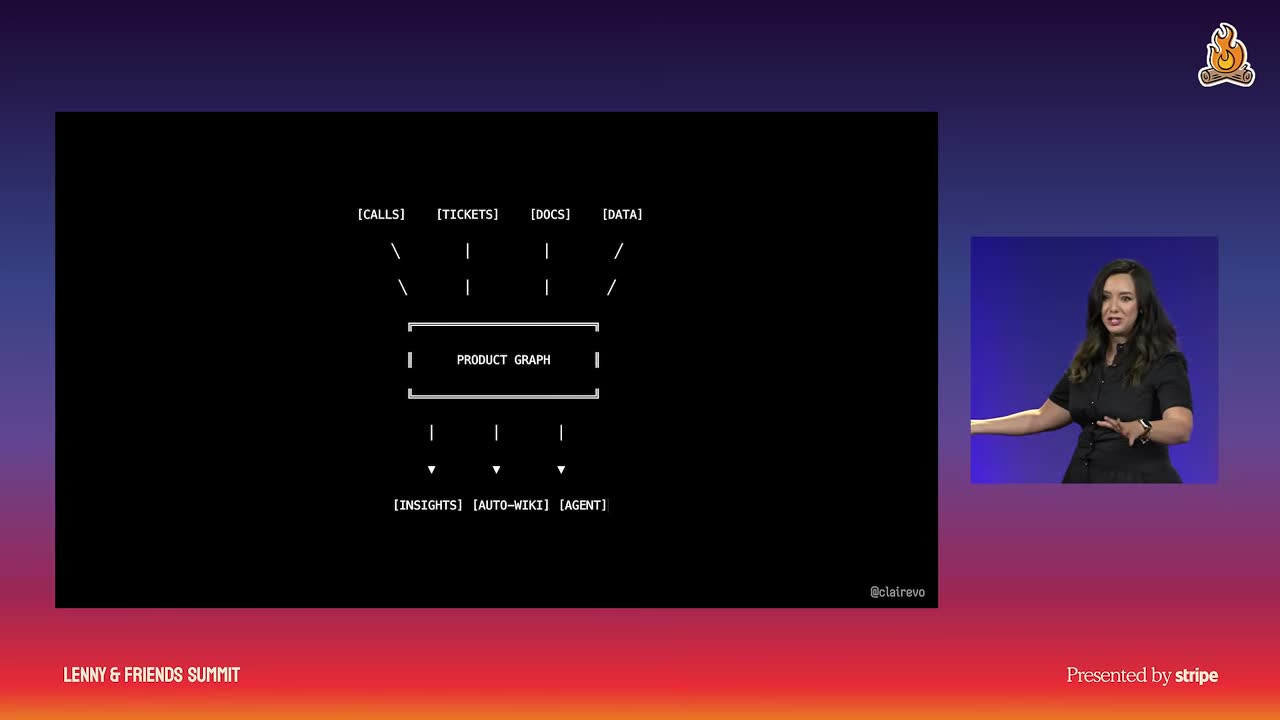
Product graph diagram: calls, tickets, docs and data feed insights, auto-wiki and agents.

Everyone’s shipping more. Does any of it matter? | Claire Vo
Claire Vo's own product, where PRs are up 3x and she rearchitected it 70 times "because I could". Its product graph, a semantic graph and auto wiki of customer knowledge, was built nearly in one shot but felt like a competitor copy, so she kept it feature flagged off until she had conviction.
ChatPRD's product graph was easy to build but too close to competitors. Claire Vo built ChatPRD's product graph, which pulls everything a company knows about customers into a semantic graph and an auto wiki for agents, almost in one shot. Customers called it interesting, but she felt it matched competitors feature for feature and belonged in the trash.
She doubted the ROI, wondered whether the web interface should be agent first, and wanted something surprising that competitors could not imagine. Her diagnosis is the parity trap: competitors talk to the same customers and "they're all arriving at the same obvious conclusion and building the same obvious product."
Keep a feature flagged off until you have conviction it is right. Vo kept the working product graph behind a feature flag, rebuilding it repeatedly, because customers would build on it once they saw it and shipping the wrong thing would burn their trust.
She frames each ship as a probe (a small bet), an experiment (a durable test of a conviction) or a promise (something customers can build on), and the product graph sat in the promise category. Quote: "code is abundant customer trust is not."
ChatPRD's AI factory tripled output without proving any of it mattered. Vo's PRs are up 3x, she rearchitected ChatPRD 70 times "because I could", and customer fixes run automatically from intake through a bot to a fix, with issue tracking replaced by just shipping PRs. She calls the result "code to nowhere".
Her test for teams: ask "whose revenue is going up proportionate with the amount of PRs." She suggests measuring big swings taken per month instead of PRs or revenue per headcount, with the evidence that would prove or kill a conviction defined up front.
Product graph diagram: calls, tickets, docs and data feed insights, auto-wiki and agents.
Lessons in product leadership and AI strategy from Glean, Google, Amazon, and Slack | Tamar Yehoshua
Claire Vo built it on weekends and earns six figures from it, showing what one person can build with AI.
More in AI assistants
 AI assistants
OpenAI
An AI research and product company behind ChatGPT, Codex and the Dots agent.


 51 sources · 151 tips
 AI assistants
ChatGPT
OpenAI's AI assistant app used for chat, plugins and agent work.
51 sources · 102 tips AI assistants
Anthropic
An AI company that builds the Claude models and products such as Claude chat and Cowork.
 25 sources · 71 tips
 AI assistants
Claude
Anthropic's AI assistant and model family, used for chat, coding and agentic work.
 19 sources · 35 tips
 AI assistants
ElevenLabs
A voice AI company with text-to-speech, dubbing, speech-to-text and music models, plus consumer and creator apps.
 6 sources · 37 tips
 AI assistants
Gemini
Google's AI assistant app, available as a chatbot and moving toward a personal agent.
11 sources · 13 tips AI assistants
NotebookLM
A Google Labs app that answers questions about your own sources and turns them into AI-hosted audio shows.
2 sources · 18 tips AI assistants
Tolan
A voice-first AI companion app with an animated alien character that remembers your conversations.
2 sources · 17 tips