Gemini
Google's AI assistant app, available as a chatbot and moving toward a personal agent.
Gemini has over a billion users and runs on a six-month roadmap, with Google aiming for one prompt box and no modes. Its team pulled a feature after flat early data and publicly thanked the PM who recommended it. Builders also use Gemini's API to ship fast (Halo AI in two to three weeks) and Gemini 3 for UI work. Lesson: reward kill calls, simplify the interface, and match models to jobs.
- 1Test outside the buildingTake the prototype to real people
- 2Watch their eyesDo they light up and lean in?
- 3Early test falls flatDAU and retention too thin to judge
- 4PM recommends not launchingThe team knows before the leader
- 5Leader thanks her publiclyWoodward replied all to thank her
From Josh Woodward interview
What was said about Gemini
1Running Gemini like a lab team
Gemini plans on a rolling six-month roadmap, not multi-year plans. Josh Woodward, who oversees both Google Labs and the Gemini app, plans around the roughly six-month window in which new models land. He keeps a multi-year vision but not a multi-year roadmap, and pushes for 50 to 100 days from idea to a meaningful milestone.
A project that began 48 hours before the interview, sparked by a demo seen two days earlier, could not have been planned. "We have a 6-month road map on this team."
Track what is almost possible and move when it becomes possible. Labs keeps a list of capabilities that are nearly possible, plus 82 predictions about the future, with tech thresholds for each such as model latency, number of languages and modalities. When one crosses over, like a phase shift from solid to gas, the team moves before rivals.
The tech must also match a real user problem, ideally one people will pay to solve. Woodward expects to be wrong nine times out of ten but says a team needs a point of view. Ideas such as NotebookLM, Flow, AI Studio and Google Beam started with small obsessed groups hacking on weekends, not design sprints.
Judge early prototypes by people's eyes, not DAU or retention. Woodward's team shows prototypes outside the building and watches whether people's eyes light up and they lean in. At that stage DAU, MAU and D7 retention are too thin to mean anything.
Being impressed is too low a bar, since dazzling demos arrive hourly, so the reaction should be paired with a behavior shift and a group who can't live without the product. The method is unvalidated, and no case is given where it misled a team. "You're looking at people's eyes. And like that is the metric."
A Gemini PM killed her own feature and was publicly thanked. Early data on a Gemini feature came back flat after in-person user testing, and the PM recommended against launching. Woodward replied to all to thank her.
His view is that the team knows an idea is dead before the leader does, from fading passion and having tried everything. The leader's job is to make it safe to say so, so the team can pivot without blame. "The team usually knows before the leader knows."
The billion-user app and the tiny lab share a zero-to-one culture. Gemini has over a billion users while Labs celebrates 10,000-user products, yet both draw role-blurring builders who love AI and share one priority order: users first, Google second, the product third.
Woodward argues a lab needs independence, sometimes reporting to the CEO, because weird ideas die under an existing business unit. He claims most corporate labs fizzle within three to four years, a claim offered without data or named examples.
2The vision: one prompt box, no modes
Gemini is heading toward one prompt box with no modes or toggles. Google's vision for Gemini is a personal, proactive, powerful assistant where users say what they want in a single box and it acts. Woodward calls this a UX simplification happening across the industry.
He says the eventual form, chatbot or personal agent, is yet to be invented, and that the biggest consumer openings lie in scarce things like time, money and shared real-life memories. "Forget the modes and toggles. Just like one prompt box."
3Pichai's one-model decision
Google put every AI product on a single Gemini model. After the rocky Bard launch, Sundar Pichai in 2023 merged Brain and DeepMind into Google DeepMind under Demis Hassabis and decreed one model, Gemini, for all internal and external AI products, because scaling laws make several giant models a repeated huge cost.
The merger broke DeepMind's original independence terms. Gemini reached early public access in December 2023, six months after being announced, and Gemini 1.5 shipped a 1 million token context window by February 2024. "No more different models, no more different teams."
4Gemini 3 and the race with ChatGPT
Gemini overtook ChatGPT as the top app after a model release. Gemini reached number one in the app store, above ChatGPT, and stayed there through the following week. Robby Stein read this as a sign Google's AI products are landing with consumers.
Woodward names Nano Banana on Gemini as one of the moments of obvious product-market fit that the team swarmed.
Each model launch resets product-market fit for everyone. OpenAI's market share dipped when Gemini 3 launched. Elena Verna uses this to argue AI teams must recapture product-market fit roughly every three months.
Her advice is to bet on new capabilities before models land, then scale in short blitzes between reinventions.
5How builders use Gemini
Gemini's long context handles inputs other models can't. A PM exported a whole Discord channel into Gemini after its context window grew and asked about sentiment, top requested features and complaints; he called the result a goldmine. Andrew Wilkinson loaded all his medical records into Gemini 2.5 because other models couldn't process them.
The PM said he would never have had time to read the channel himself.
Builders assign Gemini 3 to frontend and design work. Zevi Arnovitz uses Gemini 3 for UI from the same markdown plan file where a fast model handles backend, Claude leads planning and Codex takes the hardest bugs. He describes Gemini as a scientist whose process looks scary but whose design is beautiful.
Pairing models offsets weaknesses such as Gemini's messy thought process in Antigravity. He also uses Gemini to generate StudyMate's quizzes.
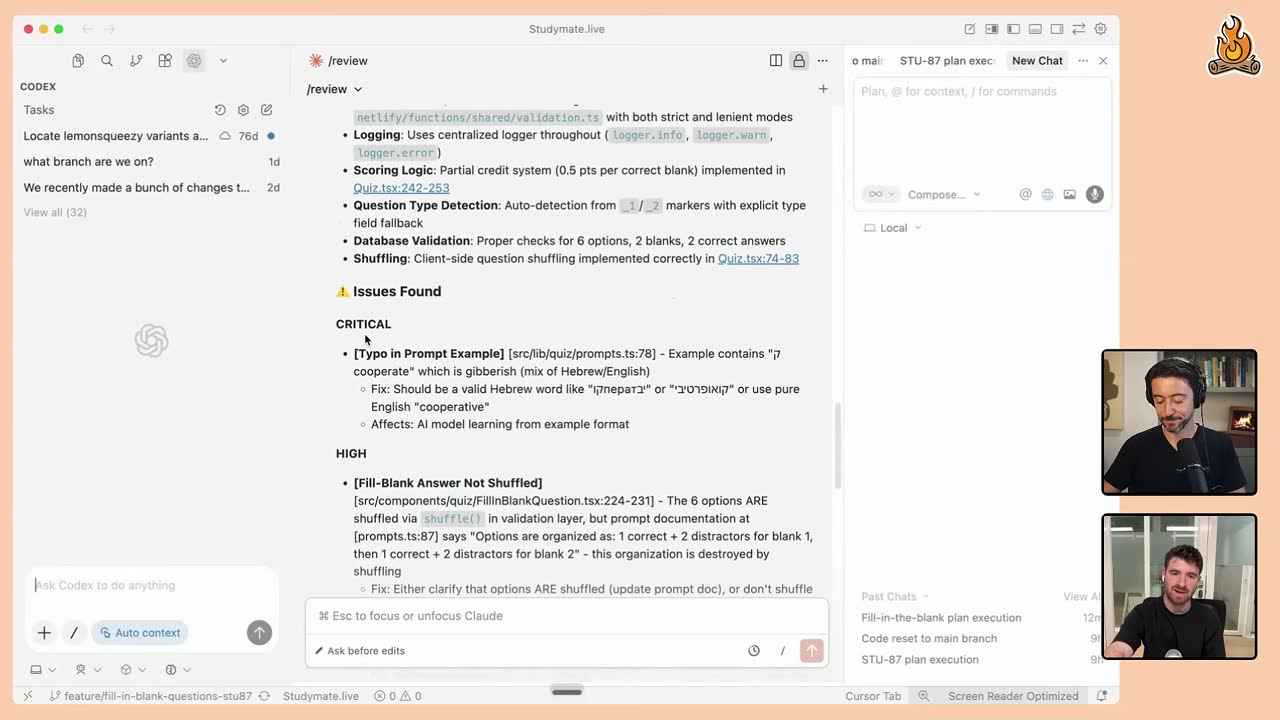
Claude's /review output flags a critical prompt typo and a high-severity unshuffled fill-blank issue. Base44 routes hard algorithms and bug loops to Gemini. Base44's pipeline reads each prompt and picks a model: Claude for initial app generation and UI, Gemini for complex algorithms or when Claude is stuck in a bug loop.
Heavy models plan the change and fast models like Flash or o4-mini patch the file. Maor Shlomo says the routing has worked pretty well.
Cheap, capable Gemini APIs power whole products. Every runs the models in its apps on Gemini because it is powerful and very cheap. Dillion Verma built Halo AI in two to three weeks on a new Gemini API he spotted in July.
Verma also runs every million-view video through Gemini for transcripts and summaries that feed a creator coaching agent in Discord.
Model rankings shift weekly, so keep testing Gemini against rivals. Some developers on Jaime's team prefer Gemini for coding, though he plans with Claude Code and says the ranking changes weekly. Tamar Yehoshua urges PMs to use ChatGPT, Claude and Gemini daily rather than trying once and giving up.

Why every company now needs to think and operate like a lab team | Josh Woodward (VP Google Labs)
It has over a billion users and runs on a six-month roadmap. Google's vision is a personal, proactive, powerful assistant with one prompt box and no modes, and a PM once recommended pulling a feature after flat early data.
Gemini plans on a rolling six-month roadmap, not multi-year plans. Josh Woodward, who oversees both Google Labs and the Gemini app, plans around the roughly six-month window in which new models land. He keeps a multi-year vision but not a multi-year roadmap, and pushes for 50 to 100 days from idea to a meaningful milestone.
A project that began 48 hours before the interview, sparked by a demo seen two days earlier, could not have been planned. "We have a 6-month road map on this team."
Track what is almost possible and move when it becomes possible. Labs keeps a list of capabilities that are nearly possible, plus 82 predictions about the future, with tech thresholds for each such as model latency, number of languages and modalities. When one crosses over, like a phase shift from solid to gas, the team moves before rivals.
The tech must also match a real user problem, ideally one people will pay to solve. Woodward expects to be wrong nine times out of ten but says a team needs a point of view. Ideas such as NotebookLM, Flow, AI Studio and Google Beam started with small obsessed groups hacking on weekends, not design sprints.
Judge early prototypes by people's eyes, not DAU or retention. Woodward's team shows prototypes outside the building and watches whether people's eyes light up and they lean in. At that stage DAU, MAU and D7 retention are too thin to mean anything.
Being impressed is too low a bar, since dazzling demos arrive hourly, so the reaction should be paired with a behavior shift and a group who can't live without the product. The method is unvalidated, and no case is given where it misled a team. "You're looking at people's eyes. And like that is the metric."
A Gemini PM killed her own feature and was publicly thanked. Early data on a Gemini feature came back flat after in-person user testing, and the PM recommended against launching. Woodward replied to all to thank her.
His view is that the team knows an idea is dead before the leader does, from fading passion and having tried everything. The leader's job is to make it safe to say so, so the team can pivot without blame. "The team usually knows before the leader knows."
The billion-user app and the tiny lab share a zero-to-one culture. Gemini has over a billion users while Labs celebrates 10,000-user products, yet both draw role-blurring builders who love AI and share one priority order: users first, Google second, the product third.
Woodward argues a lab needs independence, sometimes reporting to the CEO, because weird ideas die under an existing business unit. He claims most corporate labs fizzle within three to four years, a claim offered without data or named examples.
Gemini is heading toward one prompt box with no modes or toggles. Google's vision for Gemini is a personal, proactive, powerful assistant where users say what they want in a single box and it acts. Woodward calls this a UX simplification happening across the industry.
He says the eventual form, chatbot or personal agent, is yet to be invented, and that the biggest consumer openings lie in scarce things like time, money and shared real-life memories. "Forget the modes and toggles. Just like one prompt box."
Gemini overtook ChatGPT as the top app after a model release. Gemini reached number one in the app store, above ChatGPT, and stayed there through the following week. Robby Stein read this as a sign Google's AI products are landing with consumers.
Woodward names Nano Banana on Gemini as one of the moments of obvious product-market fit that the team swarmed.

Why Most Apps Are Failing in 2026: 7 Mistakes Killing Your App Success
Some developers on Jaime's team like Gemini for coding, though he says the tool ranking changes weekly.
Model rankings shift weekly, so keep testing Gemini against rivals. Some developers on Jaime's team prefer Gemini for coding, though he plans with Claude Code and says the ranking changes weekly. Tamar Yehoshua urges PMs to use ChatGPT, Claude and Gemini daily rather than trying once and giving up.

0 to $300k/mo in 45 days with my ai app (just copy me)
A new Gemini API spotted in July let Halo AI be built in two to three weeks. It also transcribes and summarizes every million-view video for the creator coaching agent.
Cheap, capable Gemini APIs power whole products. Every runs the models in its apps on Gemini because it is powerful and very cheap. Dillion Verma built Halo AI in two to three weeks on a new Gemini API he spotted in July.
Verma also runs every million-view video through Gemini for transcripts and summaries that feed a creator coaching agent in Discord.
How a Meta PM ships products without ever writing code | Zevi Arnovitz
Gemini generates StudyMate's quizzes. Gemini 3 is the risky but gifted designer for frontend work, with an alarming thought process in Antigravity but beautiful results.
Builders assign Gemini 3 to frontend and design work. Zevi Arnovitz uses Gemini 3 for UI from the same markdown plan file where a fast model handles backend, Claude leads planning and Codex takes the hardest bugs. He describes Gemini as a scientist whose process looks scary but whose design is beautiful.
Pairing models offsets weaknesses such as Gemini's messy thought process in Antigravity. He also uses Gemini to generate StudyMate's quizzes.
Claude's /review output flags a critical prompt typo and a high-severity unshuffled fill-blank issue.
The new AI growth playbook for 2026 | How Lovable hit $200M ARR in one year
The launch of Gemini 3 cost OpenAI market share, an example of how each model release resets product-market fit.
Each model launch resets product-market fit for everyone. OpenAI's market share dipped when Gemini 3 launched. Elena Verna uses this to argue AI teams must recapture product-market fit roughly every three months.
Her advice is to bet on new capabilities before models land, then scale in short blitzes between reinventions.
Inside Google's AI turnaround: AI Mode, AI Overviews, and vision for AI-powered search | Robby Stein
It reached number one in the app store, above ChatGPT, the week before recording and was still there at recording time. Stein sees it as a sign Google's AI products are landing with consumers.
Gemini overtook ChatGPT as the top app after a model release. Gemini reached number one in the app store, above ChatGPT, and stayed there through the following week. Robby Stein read this as a sign Google's AI products are landing with consumers.
Woodward names Nano Banana on Gemini as one of the moments of obvious product-market fit that the team swarmed.

Google Part III: The AI Company. Google is amazingly well-positioned... will they win in AI?
Pichai decreed one model for all internal and external AI products because scaling laws make several giant models too costly. Gemini reached early public access in December 2023 and Gemini 1.5 shipped a 1 million token context window by February 2024.
Google put every AI product on a single Gemini model. After the rocky Bard launch, Sundar Pichai in 2023 merged Brain and DeepMind into Google DeepMind under Demis Hassabis and decreed one model, Gemini, for all internal and external AI products, because scaling laws make several giant models a repeated huge cost.
The merger broke DeepMind's original independence terms. Gemini reached early public access in December 2023, six months after being announced, and Gemini 1.5 shipped a 1 million token context window by February 2024. "No more different models, no more different teams."
The AI-native startup: 5 products, 7-figure revenue, 100% AI-written code. | Dan Shipper (Every)
Powers the models inside Every's apps because it is powerful and very cheap. Dan wants to try its new CLI tool.
Cheap, capable Gemini APIs power whole products. Every runs the models in its apps on Gemini because it is powerful and very cheap. Dillion Verma built Halo AI in two to three weeks on a new Gemini API he spotted in July.
Verma also runs every million-view video through Gemini for transcripts and summaries that feed a creator coaching agent in Discord.
Solo founder, $80M exit, 6 months: The Base44 bootstrapped startup success story | Maor Shlomo
Base44 routes hard algorithms and bug loops to Gemini, and uses fast models like Flash to patch files after heavy models plan the change.
Base44 routes hard algorithms and bug loops to Gemini. Base44's pipeline reads each prompt and picks a model: Claude for initial app generation and UI, Gemini for complex algorithms or when Claude is stuck in a bug loop.
Heavy models plan the change and fast models like Flash or o4-mini patch the file. Maor Shlomo says the routing has worked pretty well.
I’ve run 75+ businesses. Here’s why you’re probably chasing the wrong idea. | Andrew Wilkinson
Wilkinson loaded all his medical records into Gemini 2.5 because the other models couldn't process them.
Gemini's long context handles inputs other models can't. A PM exported a whole Discord channel into Gemini after its context window grew and asked about sentiment, top requested features and complaints; he called the result a goldmine. Andrew Wilkinson loaded all his medical records into Gemini 2.5 because other models couldn't process them.
The PM said he would never have had time to read the channel himself.
Lessons in product leadership and AI strategy from Glean, Google, Amazon, and Slack | Tamar Yehoshua
A PM fed a whole Discord channel transcript into Gemini after its context window grew. He asked about sentiment, top requested features and complaints, and called the result a goldmine.
Gemini's long context handles inputs other models can't. A PM exported a whole Discord channel into Gemini after its context window grew and asked about sentiment, top requested features and complaints; he called the result a goldmine. Andrew Wilkinson loaded all his medical records into Gemini 2.5 because other models couldn't process them.
The PM said he would never have had time to read the channel himself.
Model rankings shift weekly, so keep testing Gemini against rivals. Some developers on Jaime's team prefer Gemini for coding, though he plans with Claude Code and says the ranking changes weekly. Tamar Yehoshua urges PMs to use ChatGPT, Claude and Gemini daily rather than trying once and giving up.
More in AI assistants
 AI assistants
OpenAI
An AI research and product company behind ChatGPT, Codex and the Dots agent.

 51 sources · 151 tips
 AI assistants
ChatGPT
OpenAI's AI assistant app used for chat, plugins and agent work.
51 sources · 102 tips AI assistants
Anthropic
An AI company that builds the Claude models and products such as Claude chat and Cowork.
25 sources · 71 tips AI assistants
Claude
Anthropic's AI assistant and model family, used for chat, coding and agentic work.
19 sources · 35 tips AI assistants
ElevenLabs
A voice AI company with text-to-speech, dubbing, speech-to-text and music models, plus consumer and creator apps.
 6 sources · 37 tips
 AI assistants
NotebookLM
A Google Labs app that answers questions about your own sources and turns them into AI-hosted audio shows.
2 sources · 18 tips AI assistants
Tolan
A voice-first AI companion app with an animated alien character that remembers your conversations.
2 sources · 17 tipsGenie
A ChatGPT-powered chat app that writes marketing copy, taglines, tweets and app store descriptions from short prompts.
3 sources · 13 tips