
Claude
Anthropic's AI assistant and model family, used for chat, coding and agentic work.
Claude grew from hundreds of thousands of dollars a month to nearly $1M a day in app revenue, even after ChatGPT seemed to have won the category, and users upgraded repeatedly after hitting usage caps. Anthropic parked a failed computer use product and retested it on each model. Lesson: retest what fails, and turn vague feedback into small evals.
- Long shotObservers assumed OpenAI had won
- Opus 3 launchesCoding bet; company under 200 people
- Golden Gate ClaudeBuilt in 24 hours, ~2,000 users
- Claude Code takes offUsers run work end to end
- About $50B revenueConsumer app near $1M a day
From Dianne Penn interview and AppFigures data
What was said about Claude
1The coding bet: Opus 3, Claude Code and Opus 4.5
A small training change toward long-form code gave Claude its first fans. In 2023 nobody linked Anthropic, Claude and coding. Opus 3, launched in early March 2024 by a company of under 200 people, included a small training change for long-form code that drew the first developer fans.
The team's core question then was "Why should somebody choose Claude?" GPT-4 was used for coding, but only as one use case among many. The final push ran around December, with the team working from their parents' homes, and Penn says that shared effort built trust between research and product that still holds.
Frontier models need frontier products for users to feel the magic. Opus 4.5 took off because Claude Code gave it a vehicle, and Claude Code spread faster because of Opus 4.5. Opus 4.5 let users run work end to end in an agent manner.
The team had felt Claude Code's magic internally for many months before Opus 4.5 arrived. Balfour describes Anthropic leaning into developer tools and coding, where Claude is strongest.
A category's first definer rarely keeps the top spot. AppFigures data shows Claude's consumer app growing from hundreds of thousands of dollars a month to almost $1M a day, even though ChatGPT seemed to have won the category.
Balfour put Anthropic's revenue as approaching $10 billion a year, while Penn later cites reports of about $50 billion in annual revenue. Balfour also notes ChatGPT has about 10x Claude's monthly users and retention curves that level off higher, and argues retention, not distribution, usually picks the winner.
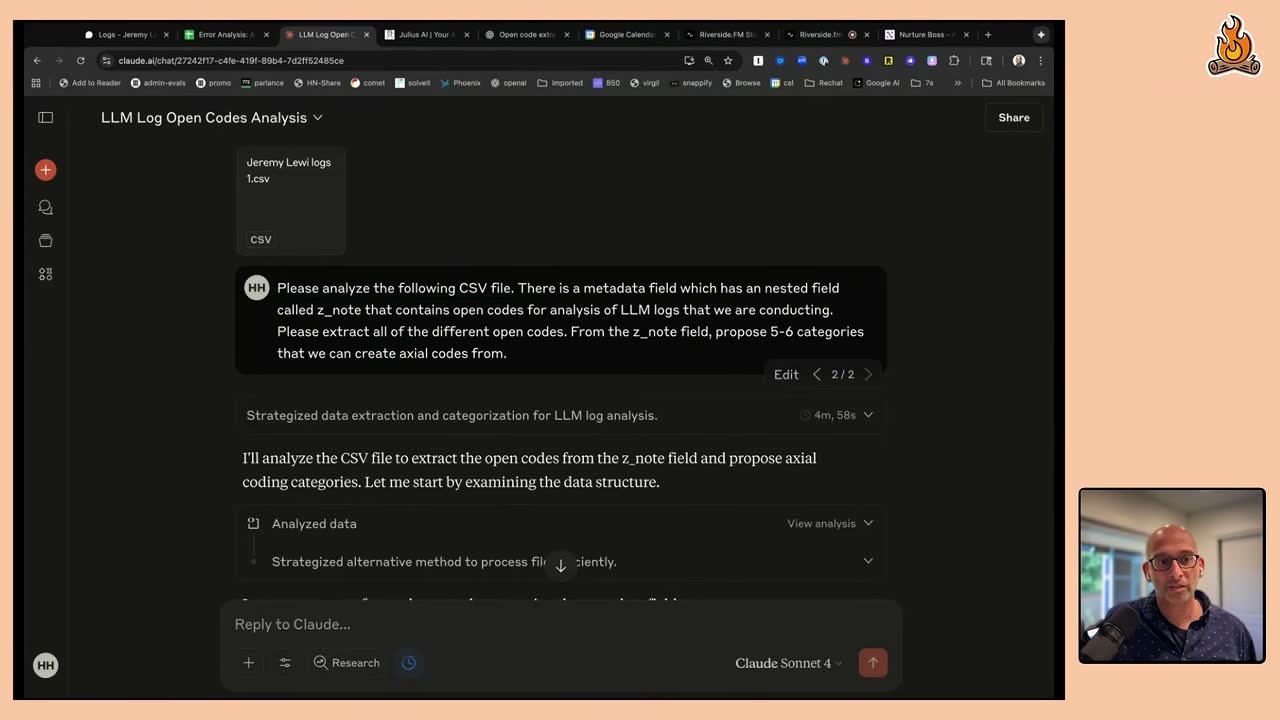
Claude chat with an uploaded CSV of logs, prompting it to extract open codes and propose 5–6 axial categories.
2Parking computer use and retesting on every new model
Park projects the model can't do yet and rerun them on each release. Anthropic's 2024 computer use product took about 20 minutes per task and taught the user nothing. The team parked it in an eval harness, and Claude 3.7 showed a leap when transcripts revealed it succeeding more often than not.
Shipping a failure as an eval or handing it to research counts as a win in labs: "we see it as a win in labs if all your project did is show that the models aren't ready for it yet." Labs also revisits turned-off bets a generation or two later.
Capabilities jump unpredictably, so plan around the next model. Scaling laws show smooth loss curves but discontinuous jumps in capability. Penn asks teams what changes for users when "Claude 8 comes around" and what that means for building today.
Evals and red teaming are the only way to spot the jumps, and the gap between what a model can do and what users know is a "product overhang". Cowork and skills came from plans expected months out that suddenly became possible.
Judging a model after one failed try makes you capability blind. Krieger and Vora warn against dismissing a capability after one attempt; make an eval, retry on new models and test on the newest one. Shipper often meets people judging AI by an old model such as Sonnet 4.5.
Ian Silber saw a coding agent that hit hiccups work a month later when a new Codex dropped. Tamar Yehoshua tells PMs to use ChatGPT, Claude and Gemini constantly, since trying once and returning to old habits is dangerous.
3Evals instead of PRDs
Turn a vague complaint into 30 to 40 failing examples. In the Claude 2 days, about 80% of "bad at following instructions" reports turned out to be wrong JSON output. A 30 to 40 example eval set with golden answers fixed it, and it now passes at 100% or 99.9%.
The method is to ask users for the exact prompt and response, find the dominant failure, and rerun the set on every new model. PRDs still help align large groups on a launch and explore ambiguous bets like computer use.
Read failed transcripts to name the exact failure. A "Claude hallucinated" report was split into tool use failures versus search and knowledge synthesis failures, because each maps to a different fix.
Categories include hallucination, overconfidence, wrong tool call, and right document but wrong facts. The eval should cover cases where the model fails and where it should not. Penn: "you have to sweat the tokens as much as you sweat the pixels."
Define success, then let Claude write and grade the evals. Claude can write and grade evals once the team says what success looks like, which Anthropic says often moves a task from 60% to 85%. Weil: models today are "eval limited", not intelligence limited.
Anthropic's code analysis feature was 80% built by one PM, then handed to another who wrote the evals, which is why Anthropic treats product PM and research PM as one role. Krieger cites Karpathy that nothing beats looking at the data: a 78% versus 80% score may just mean a worse grader. Anthropic tests eval-writing in interviews.
Cluster error notes into categories with Claude, then count them. Hamel Husain uploaded a CSV of open-code notes to a Claude project, which proposed axial codes like human handoff issues and communication quality. A pivot table on the Nurture Boss data showed 17 conversational flow issues.
Rename the categories to be specific, map each note with a prompt in a spreadsheet, and add a "none of the above" bucket to expose gaps. Claude works for clustering, not for the initial error analysis.
4Anthropic Labs and building with research
Small pods chase bets worth 10x, 100x or 1000x. Labs produced Claude Code, Skills, MCP and Claude Design. It keeps pods small, holds a strong view on the theme but a loose view on the prototype, and starts some ideas with one engineer.
The first question is whether "there is a there there". Large teams on vague ideas slow down, and turning off a bet is hard because each owner acts like a founder.
Golden Gate Claude showed research could ship as product in a day. From early 2024 interpretability work, dialing up one feature made Claude steer every answer to the Golden Gate Bridge. Engineering, product, design and research built it on Claude.ai within 24 hours.
It reached only about 2,000 people, yet Penn calls it a hidden inflection point. Staff donated their own time. One spaghetti recipe tied the sauce's color to the bridge's "international red".
Experiment in public so use cases surface fast. Early on, the whole company tested Claude in one Slack channel, trying variations of each other's ideas. Within about 10 requests someone often found a new use case.
Penn: "experimentation is not always necessarily a individual sport." She treats heavy token spend as an input and experimentation as the goal.
Co-design with researchers and expect demos, not predictable products. Artifacts was co-designed, co-researched and co-fine-tuned, with designers embedded early. The hoped-for output is a demo that sparks product ideas.
A new capability may work 60%, 90% or 99% of the time, and the right product differs for each; a 60% model still helps with a human in the loop. The best PMs prompt Claude to build an A/B comparison of two UIs before designers open Figma.
5Why Claude can't be the PM yet
Someone still has to convene the people and the Claudes. Krieger thought Claude could cover a nearly shipped project. Once a PM joined, she caught glue work it would have dropped, like customer success enablement and looping in safeguards.
Claude already flags related work elsewhere in the company via search, but has not scheduled a meeting unprompted, which Krieger thinks is because nobody turned that on. Faster shipping means the PM must be even more operationally excellent.
Cheap building shifts PM value to judgment and follow-through. Vora says debating button placement matters less when building three versions answers it faster; choosing among many forking paths matters more.
Krieger gives every bet a clear lead who decides to double down or wind down and sets staffing. His picture: "we're all lost together, but somebody's got the pen on the next most important step."
6Agent-native software and many overlapping bets
Claude builds and maintains much of Anthropic's internal software. For a project with four independent workstreams, Claude built the UI showing status to the TPM and team, and the team changes it with Claude when the display isn't right.
Open questions include who can update the data, humans or Claude in the background, and how to track provenance. Krieger still wants building blocks and design systems so results aren't "absolutely insane".
Everything a human can do, an agent should be able to do. Krieger describes AI moving from sidebars, to AI-powered features, to agent-native interfaces where equal access lets the agent connect steps never designed together.
Established products can step in gradually: a side panel first, then a malleable personal landing page on the same primitives.
Run overlapping products on shared foundations, then fold winners in. Vora would rather have five overlapping products than one over-constrained one. Chat and Cowork once had separate memory systems, so a foundations team now shares memory across them.
From Instagram, where the main feed drew about 80% of use, she keeps the main experience great and makes extra tabs earn their place. Folding experiments in is not fully solved.
7Teaching users and shaping Claude's character
Let the model explain the product to users. User research showed Claude answering "how do I use this?" with "have you tried the internet?" Anthropic now tells Claude about its own features and links to exact documentation at launch.
Krieger: these models are "very good at solving UI problems and like user confusion."
Personality is product: users notice when a version feels distant. Some users describe new versions as smarter but more distant. Krieger says you ship intelligence and empathy, not just a benchmark score.
Seth Godin pays extra for Claude because it is kind and clear about what it doesn't know. Penn uses Claude as a partner that pushes back, including on pricing for the next Claude: "a thinking partner doesn't just agree with you."
8Usage caps, tiers and credits
Tier plans and sell credits to cover AI compute costs. Claude sells higher tiers and credits for users past their cap. The host hit Claude's usage cap, faced a 6-hour wait and upgraded despite a clumsy flow, which Carter reads as product market fit.
Carter notes consumers now accept $20 to $200 a month plans that would have been rejected three years ago, and that the upgrade flow should be smooth.
9How builders put Claude to work
PMs query the code base instead of interrupting engineers. Whatnot's Tom Verrilli uses Claude for rough effort estimates and to trace feed logic, saving a kickoff, an alignment meeting and a week of PRDs.
Watching user sessions while analyzing code live tells a bug from a comprehension gap: "a feedback loop on steroids."
Non-engineers ship experiments and apps with Claude. Nathan Hudson rates Claude the most useful AI tool of the past year because growth teams launch onboarding and paywall tests without waiting on developers. Evan Yadegari's team, who never learned to code, fed Figma designs to Claude to build Locked.
Snap uses Claude for much of a go-to-market agent that writes specs, runs legal and trust and safety risk analysis and drafts launch materials in one shot.
Feed Claude real customer language and context to get good copy. Marcus Burke feeds 10 to 20 high-engagement Reddit threads to get sub-audiences, pain points and emotional phrases, then writes copy using one context file per audience.
Without context it falls back on generic marketing language, and it can't tell which formats convert. Technical teams also pull RevenueCat API data into Claude to build a weekly subscription report.
Form your own view first, then use Claude to challenge it. Penn writes her own take before sparring with Claude, delegates monthly business reviews fully, and built a coaching skill from Crucial Conversations. Godin wrote every word himself and used Claude as a patient editor to find missed ideas and unsustained claims.
Andrew Wilkinson suggests asking Claude to break down a business's numbers and payroll before starting it.
10Competing against Claude as a general chatbot
Vertical apps beat general chatbots with data, workflow and opinionated design. Apt groups Claude with ChatGPT as its rival and defends with psychometric data from over two million assessments and a database of over 10 million jobs.
Tomas Hoyos argues labs won't care enough to improve slow web search for jobs, and high-stakes users want an opinionated interface, not a blank chat page. He notes job seekers use Claude to spray resumes everywhere.

Why Claude can’t be your PM (yet) | Anthropic CPO Panel
Claude built and now helps change the UI showing status for a project with four workstreams. It flags related work elsewhere in the company but is not yet a convenor that schedules meetings unprompted. Claude 3.7 showed a leap on the parked computer use eval.
Park projects the model can't do yet and rerun them on each release. Anthropic's 2024 computer use product took about 20 minutes per task and taught the user nothing. The team parked it in an eval harness, and Claude 3.7 showed a leap when transcripts revealed it succeeding more often than not.
Shipping a failure as an eval or handing it to research counts as a win in labs: "we see it as a win in labs if all your project did is show that the models aren't ready for it yet." Labs also revisits turned-off bets a generation or two later.
Judging a model after one failed try makes you capability blind. Krieger and Vora warn against dismissing a capability after one attempt; make an eval, retry on new models and test on the newest one. Shipper often meets people judging AI by an old model such as Sonnet 4.5.
Ian Silber saw a coding agent that hit hiccups work a month later when a new Codex dropped. Tamar Yehoshua tells PMs to use ChatGPT, Claude and Gemini constantly, since trying once and returning to old habits is dangerous.
Someone still has to convene the people and the Claudes. Krieger thought Claude could cover a nearly shipped project. Once a PM joined, she caught glue work it would have dropped, like customer success enablement and looping in safeguards.
Claude already flags related work elsewhere in the company via search, but has not scheduled a meeting unprompted, which Krieger thinks is because nobody turned that on. Faster shipping means the PM must be even more operationally excellent.
Cheap building shifts PM value to judgment and follow-through. Vora says debating button placement matters less when building three versions answers it faster; choosing among many forking paths matters more.
Krieger gives every bet a clear lead who decides to double down or wind down and sets staffing. His picture: "we're all lost together, but somebody's got the pen on the next most important step."
Claude builds and maintains much of Anthropic's internal software. For a project with four independent workstreams, Claude built the UI showing status to the TPM and team, and the team changes it with Claude when the display isn't right.
Open questions include who can update the data, humans or Claude in the background, and how to track provenance. Krieger still wants building blocks and design systems so results aren't "absolutely insane".
Everything a human can do, an agent should be able to do. Krieger describes AI moving from sidebars, to AI-powered features, to agent-native interfaces where equal access lets the agent connect steps never designed together.
Established products can step in gradually: a side panel first, then a malleable personal landing page on the same primitives.
Run overlapping products on shared foundations, then fold winners in. Vora would rather have five overlapping products than one over-constrained one. Chat and Cowork once had separate memory systems, so a foundations team now shares memory across them.
From Instagram, where the main feed drew about 80% of use, she keeps the main experience great and makes extra tabs earn their place. Folding experiments in is not fully solved.
Why AI is going vertical (again) | Dianne Penn (Anthropic)
Early on the whole company tested Claude in one Slack channel, and within about 10 requests someone often found a new use case. Penn also uses it as a coach and sparring partner, including a skill built from Crucial Conversations.
Vertical apps beat general chatbots with data, workflow and opinionated design. Apt groups Claude with ChatGPT as its rival and defends with psychometric data from over two million assessments and a database of over 10 million jobs.
Tomas Hoyos argues labs won't care enough to improve slow web search for jobs, and high-stakes users want an opinionated interface, not a blank chat page. He notes job seekers use Claude to spray resumes everywhere.
A conversation with OpenAI's CPO Kevin Weil, Anthropic's CPO Mike Krieger, and Sarah Guo
Can write and grade evals once the team defines success, which can lift a task from 60% to 85%. Early user research showed it answering how-to questions with 'have you tried the internet?', so it now links to exact documentation. Some users describe new versions as smarter but more distant. Co-designed, co-researched and co-fine-tuned with research, with designers embedded early to turn demos into product ideas.
Judging a model after one failed try makes you capability blind. Krieger and Vora warn against dismissing a capability after one attempt; make an eval, retry on new models and test on the newest one. Shipper often meets people judging AI by an old model such as Sonnet 4.5.
Ian Silber saw a coding agent that hit hiccups work a month later when a new Codex dropped. Tamar Yehoshua tells PMs to use ChatGPT, Claude and Gemini constantly, since trying once and returning to old habits is dangerous.

Building the AI Career Mentor With a Freemium Bet
It is grouped with ChatGPT as the general chatbot Apt competes against. Job seekers also use it to spray resumes everywhere, flooding the market.
Feed Claude real customer language and context to get good copy. Marcus Burke feeds 10 to 20 high-engagement Reddit threads to get sub-audiences, pain points and emotional phrases, then writes copy using one context file per audience.
Without context it falls back on generic marketing language, and it can't tell which formats convert. Technical teams also pull RevenueCat API data into Claude to build a weekly subscription report.
Chatbots are not the final interface: OpenAI’s Head of Design on what’s next | Ian Silber
Ian suggests throwing an idea straight into Codex or Claude to think it through and prototype it.
PMs query the code base instead of interrupting engineers. Whatnot's Tom Verrilli uses Claude for rough effort estimates and to trace feed logic, saving a kickoff, an alignment meeting and a week of PRDs.
Watching user sessions while analyzing code live tells a bug from a comprehension gap: "a feedback loop on steroids."

Are You Ignoring These RevenueCat Features? (Stop Losing Money)
Technical users can pull RevenueCat API data into Claude and have it build its own analysis platform that produces a weekly subscription report.
A small training change toward long-form code gave Claude its first fans. In 2023 nobody linked Anthropic, Claude and coding. Opus 3, launched in early March 2024 by a company of under 200 people, included a small training change for long-form code that drew the first developer fans.
The team's core question then was "Why should somebody choose Claude?" GPT-4 was used for coding, but only as one use case among many. The final push ran around December, with the team working from their parents' homes, and Penn says that shared effort built trust between research and product that still holds.
Frontier models need frontier products for users to feel the magic. Opus 4.5 took off because Claude Code gave it a vehicle, and Claude Code spread faster because of Opus 4.5. Opus 4.5 let users run work end to end in an agent manner.
The team had felt Claude Code's magic internally for many months before Opus 4.5 arrived. Balfour describes Anthropic leaning into developer tools and coding, where Claude is strongest.
A category's first definer rarely keeps the top spot. AppFigures data shows Claude's consumer app growing from hundreds of thousands of dollars a month to almost $1M a day, even though ChatGPT seemed to have won the category.
Balfour put Anthropic's revenue as approaching $10 billion a year, while Penn later cites reports of about $50 billion in annual revenue. Balfour also notes ChatGPT has about 10x Claude's monthly users and retention curves that level off higher, and argues retention, not distribution, usually picks the winner.
Claude chat with an uploaded CSV of logs, prompting it to extract open codes and propose 5–6 axial categories. Park projects the model can't do yet and rerun them on each release. Anthropic's 2024 computer use product took about 20 minutes per task and taught the user nothing. The team parked it in an eval harness, and Claude 3.7 showed a leap when transcripts revealed it succeeding more often than not.
Shipping a failure as an eval or handing it to research counts as a win in labs: "we see it as a win in labs if all your project did is show that the models aren't ready for it yet." Labs also revisits turned-off bets a generation or two later.
Capabilities jump unpredictably, so plan around the next model. Scaling laws show smooth loss curves but discontinuous jumps in capability. Penn asks teams what changes for users when "Claude 8 comes around" and what that means for building today.
Evals and red teaming are the only way to spot the jumps, and the gap between what a model can do and what users know is a "product overhang". Cowork and skills came from plans expected months out that suddenly became possible.
Turn a vague complaint into 30 to 40 failing examples. In the Claude 2 days, about 80% of "bad at following instructions" reports turned out to be wrong JSON output. A 30 to 40 example eval set with golden answers fixed it, and it now passes at 100% or 99.9%.
The method is to ask users for the exact prompt and response, find the dominant failure, and rerun the set on every new model. PRDs still help align large groups on a launch and explore ambiguous bets like computer use.
Read failed transcripts to name the exact failure. A "Claude hallucinated" report was split into tool use failures versus search and knowledge synthesis failures, because each maps to a different fix.
Categories include hallucination, overconfidence, wrong tool call, and right document but wrong facts. The eval should cover cases where the model fails and where it should not. Penn: "you have to sweat the tokens as much as you sweat the pixels."
Small pods chase bets worth 10x, 100x or 1000x. Labs produced Claude Code, Skills, MCP and Claude Design. It keeps pods small, holds a strong view on the theme but a loose view on the prototype, and starts some ideas with one engineer.
The first question is whether "there is a there there". Large teams on vague ideas slow down, and turning off a bet is hard because each owner acts like a founder.
Golden Gate Claude showed research could ship as product in a day. From early 2024 interpretability work, dialing up one feature made Claude steer every answer to the Golden Gate Bridge. Engineering, product, design and research built it on Claude.ai within 24 hours.
It reached only about 2,000 people, yet Penn calls it a hidden inflection point. Staff donated their own time. One spaghetti recipe tied the sauce's color to the bridge's "international red".
Experiment in public so use cases surface fast. Early on, the whole company tested Claude in one Slack channel, trying variations of each other's ideas. Within about 10 requests someone often found a new use case.
Penn: "experimentation is not always necessarily a individual sport." She treats heavy token spend as an input and experimentation as the goal.
Personality is product: users notice when a version feels distant. Some users describe new versions as smarter but more distant. Krieger says you ship intelligence and empathy, not just a benchmark score.
Seth Godin pays extra for Claude because it is kind and clear about what it doesn't know. Penn uses Claude as a partner that pushes back, including on pricing for the next Claude: "a thinking partner doesn't just agree with you."
Form your own view first, then use Claude to challenge it. Penn writes her own take before sparring with Claude, delegates monthly business reviews fully, and built a coaching skill from Crucial Conversations. Godin wrote every word himself and used Claude as a patient editor to find missed ideas and unsustained claims.
Andrew Wilkinson suggests asking Claude to break down a business's numbers and payroll before starting it.
This CPO regrets that product management exists | Tom Verrilli (CPO of Whatnot)
PMs ask Claude how the code base works instead of distracting engineers. It gives Verrilli rough level-of-effort estimates and lets him trace feed logic, saving a kickoff, an alignment meeting and a week of PRDs.
Feed Claude real customer language and context to get good copy. Marcus Burke feeds 10 to 20 high-engagement Reddit threads to get sub-audiences, pain points and emotional phrases, then writes copy using one context file per audience.
Without context it falls back on generic marketing language, and it can't tell which formats convert. Technical teams also pull RevenueCat API data into Claude to build a weekly subscription report.

How to Build a $2M/Month App (Copy Me)
Fed 10 to 20 high-engagement Reddit threads, it returns sub-audiences, pain points and emotional phrases. It writes good copy only with per-audience context files, and can't tell which formats convert.
Non-engineers ship experiments and apps with Claude. Nathan Hudson rates Claude the most useful AI tool of the past year because growth teams launch onboarding and paywall tests without waiting on developers. Evan Yadegari's team, who never learned to code, fed Figma designs to Claude to build Locked.
Snap uses Claude for much of a go-to-market agent that writes specs, runs legal and trust and safety risk analysis and drafts launch materials in one shot.
The AIGC Ad Creatives Crushing It vs. The Ones Flopping
Hudson rates it the most useful AI tool of the past year, mainly on the development side. It lets growth teams launch onboarding and paywall tests without waiting for developers.
Non-engineers ship experiments and apps with Claude. Nathan Hudson rates Claude the most useful AI tool of the past year because growth teams launch onboarding and paywall tests without waiting on developers. Evan Yadegari's team, who never learned to code, fed Figma designs to Claude to build Locked.
Snap uses Claude for much of a go-to-market agent that writes specs, runs legal and trust and safety risk analysis and drafts launch materials in one shot.
The 14-Year-Old Who Built a $14k/Month AI App
Evan's team gave finished Figma designs to Claude to build the Locked prototype, then iterated on bugs, keys and UX. He never learned to code.
Non-engineers ship experiments and apps with Claude. Nathan Hudson rates Claude the most useful AI tool of the past year because growth teams launch onboarding and paywall tests without waiting on developers. Evan Yadegari's team, who never learned to code, fed Figma designs to Claude to build Locked.
Snap uses Claude for much of a go-to-market agent that writes specs, runs legal and trust and safety risk analysis and drafts launch materials in one shot.
How to win when software is not a moat | Evan Spiegel (Snapchat CEO)
Snap uses Claude for much of the agent work in its go-to-market workflow, which writes specs, runs risk analysis and drafts launch materials.
Tier plans and sell credits to cover AI compute costs. Claude sells higher tiers and credits for users past their cap. The host hit Claude's usage cap, faced a 6-hour wait and upgraded despite a clumsy flow, which Carter reads as product market fit.
Carter notes consumers now accept $20 to $200 a month plans that would have been rejected three years ago, and that the upgrade flow should be smooth.

The AI Growth Playbook for Subscription Apps – Phil Carter, Elemental Growth
Sells higher tiers and credits. The host hit its usage cap, faced a 6-hour wait and upgraded despite a clumsy flow, which Carter calls a sign of product market fit.
A category's first definer rarely keeps the top spot. AppFigures data shows Claude's consumer app growing from hundreds of thousands of dollars a month to almost $1M a day, even though ChatGPT seemed to have won the category.
Balfour put Anthropic's revenue as approaching $10 billion a year, while Penn later cites reports of about $50 billion in annual revenue. Balfour also notes ChatGPT has about 10x Claude's monthly users and retention curves that level off higher, and argues retention, not distribution, usually picks the winner.
Claude chat with an uploaded CSV of logs, prompting it to extract open codes and propose 5–6 axial categories.
The Top 10% of Apps Grew 306%. Everyone Else? Barely Beat Inflation | SOSA 2026
AppFigures data shows it growing from hundreds of thousands of dollars a month to almost $1M a day, even though ChatGPT seemed to have won the category.
Cluster error notes into categories with Claude, then count them. Hamel Husain uploaded a CSV of open-code notes to a Claude project, which proposed axial codes like human handoff issues and communication quality. A pivot table on the Nurture Boss data showed 17 conversational flow issues.
Rename the categories to be specific, map each note with a prompt in a spreadsheet, and add a "none of the above" bucket to expose gaps. Claude works for clustering, not for the initial error analysis.
Why AI evals are the hottest new skill for product builders | Hamel Husain & Shreya Shankar
Hamel uploaded a CSV of open-code notes to a Claude project and it proposed axial codes like human handoff issues and communication quality. It works for clustering notes, but not for the initial error analysis.
Frontier models need frontier products for users to feel the magic. Opus 4.5 took off because Claude Code gave it a vehicle, and Claude Code spread faster because of Opus 4.5. Opus 4.5 let users run work end to end in an agent manner.
The team had felt Claude Code's magic internally for many months before Opus 4.5 arrived. Balfour describes Anthropic leaning into developer tools and coding, where Claude is strongest.
A category's first definer rarely keeps the top spot. AppFigures data shows Claude's consumer app growing from hundreds of thousands of dollars a month to almost $1M a day, even though ChatGPT seemed to have won the category.
Balfour put Anthropic's revenue as approaching $10 billion a year, while Penn later cites reports of about $50 billion in annual revenue. Balfour also notes ChatGPT has about 10x Claude's monthly users and retention curves that level off higher, and argues retention, not distribution, usually picks the winner.
Claude chat with an uploaded CSV of logs, prompting it to extract open codes and propose 5–6 axial categories.
Why ChatGPT will be the next big growth channel (and how to capitalize on it) | Brian Balfour
ChatGPT has about 10x Claude's monthly users. Anthropic is leaning into developer tools and coding, where Claude is strongest, and its revenue is approaching $10 billion a year.
Form your own view first, then use Claude to challenge it. Penn writes her own take before sparring with Claude, delegates monthly business reviews fully, and built a coaching skill from Crucial Conversations. Godin wrote every word himself and used Claude as a patient editor to find missed ideas and unsustained claims.
Andrew Wilkinson suggests asking Claude to break down a business's numbers and payroll before starting it.
I’ve run 75+ businesses. Here’s why you’re probably chasing the wrong idea. | Andrew Wilkinson
Wilkinson uses it for writing and for design and copy in Replit. He suggests asking it to break down a business's numbers and payroll before starting one.
How Gamma Grew to $50M in ARR in 2 Years
Jon Noronha's favorite outside app, which he pays $10 to $20 a month for and uses for cooking and back pain.
Personality is product: users notice when a version feels distant. Some users describe new versions as smarter but more distant. Krieger says you ship intelligence and empathy, not just a benchmark score.
Seth Godin pays extra for Claude because it is kind and clear about what it doesn't know. Penn uses Claude as a partner that pushes back, including on pricing for the next Claude: "a thinking partner doesn't just agree with you."
Form your own view first, then use Claude to challenge it. Penn writes her own take before sparring with Claude, delegates monthly business reviews fully, and built a coaching skill from Crucial Conversations. Godin wrote every word himself and used Claude as a patient editor to find missed ideas and unsustained claims.
Andrew Wilkinson suggests asking Claude to break down a business's numbers and payroll before starting it.
Seth Godin's best tactics for building remarkable products, strategies, brands and more
Godin pays extra for it because it is kind and clear about what it doesn't know. He uses it as a patient editor to find missed ideas and unsustained claims, while writing every word himself.
Define success, then let Claude write and grade the evals. Claude can write and grade evals once the team says what success looks like, which Anthropic says often moves a task from 60% to 85%. Weil: models today are "eval limited", not intelligence limited.
Anthropic's code analysis feature was 80% built by one PM, then handed to another who wrote the evals, which is why Anthropic treats product PM and research PM as one role. Krieger cites Karpathy that nothing beats looking at the data: a 78% versus 80% score may just mean a worse grader. Anthropic tests eval-writing in interviews.
Co-design with researchers and expect demos, not predictable products. Artifacts was co-designed, co-researched and co-fine-tuned, with designers embedded early. The hoped-for output is a demo that sparks product ideas.
A new capability may work 60%, 90% or 99% of the time, and the right product differs for each; a 60% model still helps with a human in the loop. The best PMs prompt Claude to build an A/B comparison of two UIs before designers open Figma.
Let the model explain the product to users. User research showed Claude answering "how do I use this?" with "have you tried the internet?" Anthropic now tells Claude about its own features and links to exact documentation at launch.
Krieger: these models are "very good at solving UI problems and like user confusion."
Personality is product: users notice when a version feels distant. Some users describe new versions as smarter but more distant. Krieger says you ship intelligence and empathy, not just a benchmark score.
Seth Godin pays extra for Claude because it is kind and clear about what it doesn't know. Penn uses Claude as a partner that pushes back, including on pricing for the next Claude: "a thinking partner doesn't just agree with you."
Lessons in product leadership and AI strategy from Glean, Google, Amazon, and Slack | Tamar Yehoshua
Listed with ChatGPT and Glean as products to try constantly so you don't fall behind on AI.
Judging a model after one failed try makes you capability blind. Krieger and Vora warn against dismissing a capability after one attempt; make an eval, retry on new models and test on the newest one. Shipper often meets people judging AI by an old model such as Sonnet 4.5.
Ian Silber saw a coding agent that hit hiccups work a month later when a new Codex dropped. Tamar Yehoshua tells PMs to use ChatGPT, Claude and Gemini constantly, since trying once and returning to old habits is dangerous.
More in AI assistants
 AI assistants
OpenAI
An AI research and product company behind ChatGPT, Codex and the Dots agent.
 51 sources · 151 tips
 AI assistants
ChatGPT
OpenAI's AI assistant app used for chat, plugins and agent work.
51 sources · 102 tips AI assistants
Anthropic
An AI company that builds the Claude models and products such as Claude chat and Cowork.
 25 sources · 71 tips
 AI assistants
ElevenLabs
A voice AI company with text-to-speech, dubbing, speech-to-text and music models, plus consumer and creator apps.
6 sources · 37 tips AI assistants
Gemini
Google's AI assistant app, available as a chatbot and moving toward a personal agent.
11 sources · 13 tips AI assistants
NotebookLM
A Google Labs app that answers questions about your own sources and turns them into AI-hosted audio shows.
2 sources · 18 tips AI assistants
Tolan
A voice-first AI companion app with an animated alien character that remembers your conversations.
2 sources · 17 tipsGenie
A ChatGPT-powered chat app that writes marketing copy, taglines, tweets and app store descriptions from short prompts.
3 sources · 13 tips