
ChatGPT
OpenAI's AI assistant app used for chat, plugins and agent work.
ChatGPT reached about 1.2 billion users by shipping imperfect features (agent mode, Work) and iterating on feedback, while moving toward one input that picks the right model and harness. Its $20 a month price reset consumer expectations (125,000 payers reach $30M ARR versus about 500,000 at $4.99). Lesson: hide complexity, price against the anchor, and re-release failed ideas when models improve.
- 1Non-coders adopt CodexMarketing, finance, legal used the coding app
- 2Add Codex elsewherePut into ChatGPT desktop and Atlas
- 3Users stay in CodexPeople still didn't leave the Codex app
- 4Generalize Codex itselfStart simple, add complexity as needed
- 5One input picks everythingSystem chooses harness and model, no modes
From OpenAI's ChatGPT and Codex leads
What was said about ChatGPT
1Peter Thiel and the bet on the text box
OpenAI went all in on ChatGPT when insiders wanted to pivot. About two months after launch, growth looked unstable and many at OpenAI wanted to focus on five or six other things. Peter Thiel told Sam Altman it was an obvious mistake to do anything else, because the power was a Google-style text box that does the right thing for any input.
Altman went hard on ChatGPT even though it had no feeds, network effects or lock-in. It reached about a billion users in under four years. Thiel's words: "It's an obvious mistake to do anything but this."
2Merging chat, work and Codex into one product
Users should type a task and never pick a mode or model. The north star is that ChatGPT's billion users type a task and the system picks the right harness and model. Chat, work mode and Codex differ mostly in UI: work mode runs on Codex underneath with the coding UI removed, and all of Codex's capabilities will eventually ship in ChatGPT.
Feedback showed people liked work's capability but sometimes wanted the speed of chat, so the chat and work toggle is being merged. Tibo Sottiaux says even he tires of model pickers: "you kind of need a PhD in model pickers." Ian Silber's design goal is one input that knows whether to answer fast, chat or go off and do work, with advanced options still exposed for those who want them.
Where users go despite the wrong surface shows what to generalize. Marketing, comms, finance and legal staff used the Codex app even though it showed them code and asked for approvals. OpenAI added Codex to the ChatGPT desktop app and the Atlas browser for them, but nobody left the Codex app, so the team generalized Codex itself.
Internal product-market fit on engineering and research work came before launch, then spread to non-technical teams. Codex has grown 6x since January to over 5 million weekly active users. A merge like this can still draw a 2,000-message internal Slack thread calling it stupid.
The agent mode toggle was a stepping stone users could follow. OpenAI shipped an admittedly imperfect agent mode toggle so over a billion ChatGPT users could get an agentic harness without disrupting developer workflows. The toggle is expected to go away within a year.
Tara Seshan's view is that users accept turns in a product when they can follow a coherent story and see what is happening behind the scenes, so a team can deprecate a lot without burning bridges. The obvious next step after the toggle is no toggle.
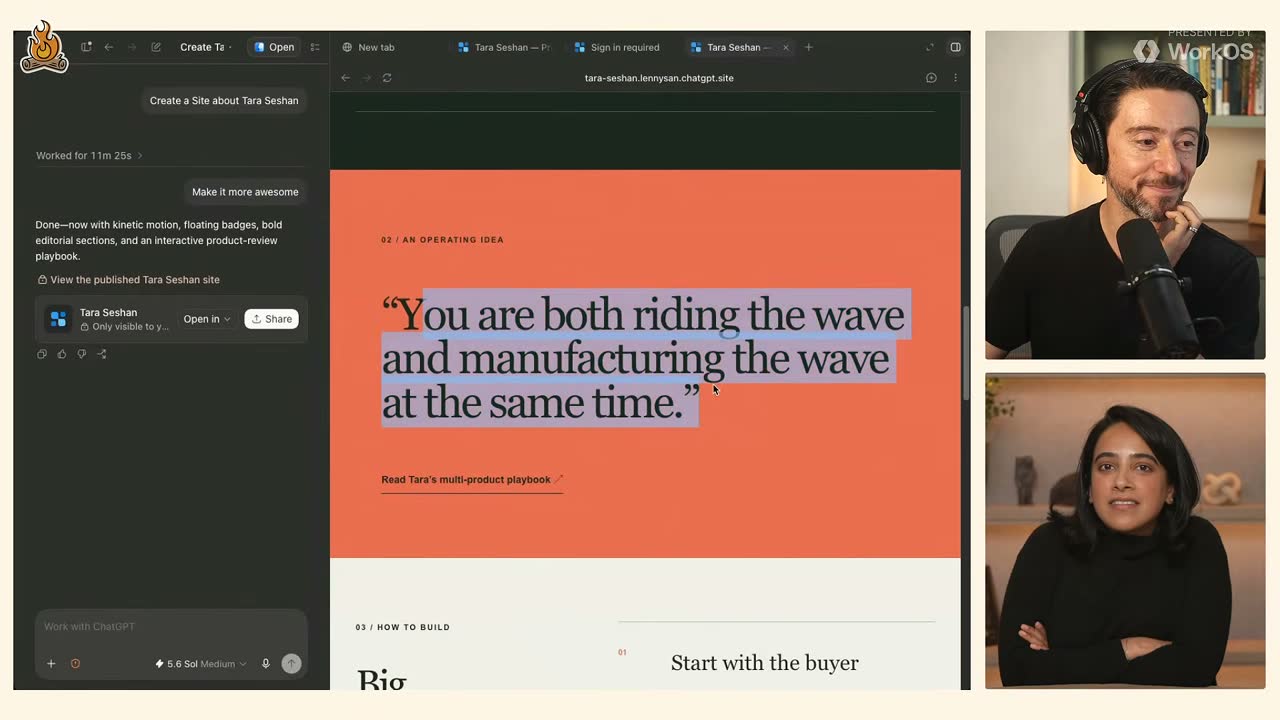
ChatGPT-built Tara Seshan site featuring the quote "riding the wave and manufacturing the wave at the same time." Chat is the front door, with specialist interfaces behind it. Alexander Embiricos sees chat as the right entry point when people don't yet know what to use a tool for, like messaging a teammate in Slack, while experts can open a GUI to work deep in the code.
Someone who uses ChatGPT outside work will simply ask it for help at work without learning every connector. He frames this as a one-year view, not a plan.
3Shipping imperfect and building for the next model
Ship done before perfect when the product is transformative. The ChatGPT Work launch drew confusion comments, and the team iterated quickly in response. Tara Seshan, who came from Stripe where every enum name was weighed, says nothing compares to watching real users try a feature.
Her fix for the urge to over-plan is to name the one most important thing to test and run the fastest possible test. Enterprises say they cannot absorb the pace, but the team builds what users need, not what they say they need.
Altman argues deploying imperfect AI early is how it gets safe. Sam Altman says putting products into the world, getting feedback from real customers and seeing where they break makes them both good and safe, as accident reporting and postmortems did for aviation.
OpenAI ships imperfect models, studies failures and shares what it learns. "You're not going to solve it by disconnecting yourself from reality."
Build for where models will be in two to three months. Tara Seshan says building for today's models fails and building for a model a year away fails too, and both are equally wrong. OpenAI plans in 60 to 90 day horizons because its market cannot be modeled like Stripe's payments market.
Andrew Ambrosino is confident the Codex app would have failed if released in November instead of February, and the only difference was the models. The two-to-three-month rule rests on the speakers' experience, not data.
Re-release ideas that failed only because the model wasn't ready. Operator, the agent in Atlas and the in-app browser in Codex are the same idea re-released with better intelligence, with very different outcomes. Old code is treated as an artifact to test against future models.
Ian Silber gives the same advice: early voice mode and computer use barely worked when he joined, and now OpenAI uses both to build software. "What was totally broken yesterday now actually just kind of works."
Obsess only over durable features and move fast on the rest. For durable surfaces like the ChatGPT composer, the team tries 100 things, throws out 99 and ships one. Other work goes from idea to ship in about 4 hours and is built in public.
Heavy design effort goes where the technology is unlikely to change next month. Bigger bets like the 'personal life' vision get whiteboarding, Figma, prototypes and dogfooding first.
4Plugins, sign-in with ChatGPT and the platform bet
OpenAI chose to be a platform, not to build every product. Altman wants one direct interface to AI and one API to build anything on top, with the best AI at every point of the cost and performance curve. He says OpenAI should not compete with its customers or try to subsume the economy.
The aim is 100 million new businesses and 8 billion people using it. ChatGPT, Codex and the API are being merged into one interface plus one API.
Plugins earn recommendations through retention and quality, not wording. ChatGPT recommends plugins inside conversations based on retention numbers and plugin quality. A strong plugin can reach a significant slice of about 1.2 billion users, and a weak one stops being recommended.
Getting people to write about you does not help; the test is whether the plugin lets ChatGPT do something new. "Obviously, if your plugin is not quite good, they will stop being recommended."
Partners get paid when subscribers spend usage in their products. When subscribers spend their ChatGPT usage through a plugin like Notion or Figma, or a product using sign-in with ChatGPT, the partner gets a revenue share. Sign-in with ChatGPT already has 16 partners.
It began as a virtual handshake with the creators of Pi and OpenCode, who agreed to use the sign-in and trusted each other not to do anything shady. Revenue sharing was not mentioned in the keynote.
Capabilities stack in layers, with computer use as the backstop. ChatGPT treats native features, first and third party plugins and computer use as an array of tools exposed through shared hooks. If a plugin or MCP is missing, computer use still finishes the task.
Nan Yu says an agent that gets 99% of the way and then fails is worse than one that never starts. Computer use may be slow and cost many tokens, but "it will 100% do the job for you."
5The $20 price anchor and tiered plans
ChatGPT's $20 a month reset what consumers pay for apps. Before ChatGPT, consumers rarely paid more than about $60 a year for an app. Its $20 a month plan made premium pricing credible for apps that truly solve a problem.
Fewer payers at higher prices means less acquisition spend and infrastructure. Waking Up charges $20 a month and $150 a year and earns over $1M a month on about 25K downloads a month.
Tiers and credits cover AI's usage-driven compute costs. ChatGPT pairs a $20 a month plan with a $200 Pro plan and sells credits, and its free-tier lockouts trained users to expect usage limits. Tolan copied the split with Light, Plus and Unlimited, and hundreds or thousands pay $200 a month for Unlimited.
Phil Carter's pattern: non-AI features and a taste of AI in a basic plan, full AI usage in a pro or max plan, plus paid credits beyond the cap. $20 to $200 a month plans would have been rejected three years ago.
Most free users never see the paid features worth buying. Most free users never tried thinking pro or deep research. Jeff Morris suggests offering one deep research a month so free users see what the paid tier does.
Flighty uses a similar taste: the first flight is free with pro features, then premium locks. Ben Thompson argues ChatGPT should have leaned on ads from the start.
6Moving past the blank chat box
Context-aware elements help users express intent without prompt engineering. ChatGPT ships tap-through follow-up questions for open-ended asks and writing blocks that hold an email or letter you edit directly. Writing blocks made drafting much better than plain chat text.
Image generation gets its own tools, and the interface should change based on who the user is and what they are doing. Nan Yu expects products to drive themselves to give a gentle on-ramp to users stuck at an empty input box.
Give most users a simple default and test advanced features with power users. Usage runs from recipe ideas to automating a farm, and from free users to people paying hundreds of dollars. Most get a streamlined experience, while new things like the desktop app and Codex are tried first with people who care.
"We can experiment early with the people that really care."
Proactive help should appear in context, not as notifications. If agents help thousands of times a day, push notifications become unbearable, so OpenAI favors mixed-initiative UX like autocomplete, where being wrong costs little. ChatGPT Pulse already gives daily updates on things users may care about.
The Atlas browser exists partly to control what the AI sees and give a place for contextual actions. Next steps include suggestions from calendar and Slack.
Knowledge-work agents must show process and citations, not just output. Code can be checked with tests, but a final deck number cannot be trusted alone. Building ChatGPT Work taught the team to expose in-progress work, citations and reasoning.
"I can't simply look at the deck in the end and see the numbers."
7How the team watches quality and new users
Re-sign up as a new user and watch D7 retention. Alexander Embiricos keeps several ChatGPT Pro accounts at about $200 a month each to feel the sign-up experience from scratch. Early retention counters the pull to build only for power users.
"the feeling of being a user and the early retention stats are still like super important for us"
Regenerations are implicit failure signals that should become evals. A user regenerating a ChatGPT answer is an implicit signal of a failure pattern. Evals guard known must-not-fail behavior, while production monitoring shows which traces to inspect at high volume.
When monitoring finds a failure mode you care about, it becomes a new eval. Codex pairs evals with A/B tests, user reactions and social media feedback.
8Building products next to ChatGPT
Compete on what a chat box can't do, not on persona. Tolan focuses on emotional connection, and many of its users also use ChatGPT for work emails. Purpose says a celebrity name plus content is no different from asking ChatGPT to act like that person, so it adds validated frameworks.
About 100 million people use ChatGPT for life advice every month. Raj Singh calls a vanilla chat box a commodity.
Validate ChatGPT's App Store keyword ideas against real search data. Steve P. Young found ChatGPT's keyword suggestions had literally no App Store search volume. Check each against an ASO tool's traffic score.

OpenAI’s Head of ChatGPT: We’re entering a new era of AI (again) | Tibo Sottiaux
Serves about 1.2 billion users and recommends plugins in conversations based on retention and quality. Codex capabilities will eventually ship inside it, and the chat and work toggle is being merged.
Tiers and credits cover AI's usage-driven compute costs. ChatGPT pairs a $20 a month plan with a $200 Pro plan and sells credits, and its free-tier lockouts trained users to expect usage limits. Tolan copied the split with Light, Plus and Unlimited, and hundreds or thousands pay $200 a month for Unlimited.
Phil Carter's pattern: non-AI features and a taste of AI in a basic plan, full AI usage in a pro or max plan, plus paid credits beyond the cap. $20 to $200 a month plans would have been rejected three years ago.
Compete on what a chat box can't do, not on persona. Tolan focuses on emotional connection, and many of its users also use ChatGPT for work emails. Purpose says a celebrity name plus content is no different from asking ChatGPT to act like that person, so it adds validated frameworks.
About 100 million people use ChatGPT for life advice every month. Raj Singh calls a vanilla chat box a commodity.
Stop planning for 2027: how OpenAI builds product 90 days at a time | Tara Sesha and Nan Yu (OpenAI)
An imperfect agent mode toggle shipped so an agentic harness could reach over a billion ChatGPT users without disrupting developer workflows. The toggle is expected to go away within a year, and the product is a platform with native features and plugins.
Users should type a task and never pick a mode or model. The north star is that ChatGPT's billion users type a task and the system picks the right harness and model. Chat, work mode and Codex differ mostly in UI: work mode runs on Codex underneath with the coding UI removed, and all of Codex's capabilities will eventually ship in ChatGPT.
Feedback showed people liked work's capability but sometimes wanted the speed of chat, so the chat and work toggle is being merged. Tibo Sottiaux says even he tires of model pickers: "you kind of need a PhD in model pickers." Ian Silber's design goal is one input that knows whether to answer fast, chat or go off and do work, with advanced options still exposed for those who want them.
Plugins earn recommendations through retention and quality, not wording. ChatGPT recommends plugins inside conversations based on retention numbers and plugin quality. A strong plugin can reach a significant slice of about 1.2 billion users, and a weak one stops being recommended.
Getting people to write about you does not help; the test is whether the plugin lets ChatGPT do something new. "Obviously, if your plugin is not quite good, they will stop being recommended."
Partners get paid when subscribers spend usage in their products. When subscribers spend their ChatGPT usage through a plugin like Notion or Figma, or a product using sign-in with ChatGPT, the partner gets a revenue share. Sign-in with ChatGPT already has 16 partners.
It began as a virtual handshake with the creators of Pi and OpenCode, who agreed to use the sign-in and trusted each other not to do anything shady. Revenue sharing was not mentioned in the keynote.
AI’s third era: the rise of persistent AI coworkers | Tara Seshan (OpenAI’s product lead)
The goal is that a billion chat users type a task and the system picks the right harness and model, with no choice between modes. The Work launch drew confusion comments and the team iterated quickly in response.
The agent mode toggle was a stepping stone users could follow. OpenAI shipped an admittedly imperfect agent mode toggle so over a billion ChatGPT users could get an agentic harness without disrupting developer workflows. The toggle is expected to go away within a year.
Tara Seshan's view is that users accept turns in a product when they can follow a coherent story and see what is happening behind the scenes, so a team can deprecate a lot without burning bridges. The obvious next step after the toggle is no toggle.
ChatGPT-built Tara Seshan site featuring the quote "riding the wave and manufacturing the wave at the same time." Ship done before perfect when the product is transformative. The ChatGPT Work launch drew confusion comments, and the team iterated quickly in response. Tara Seshan, who came from Stripe where every enum name was weighed, says nothing compares to watching real users try a feature.
Her fix for the urge to over-plan is to name the one most important thing to test and run the fastest possible test. Enterprises say they cannot absorb the pace, but the team builds what users need, not what they say they need.
Build for where models will be in two to three months. Tara Seshan says building for today's models fails and building for a model a year away fails too, and both are equally wrong. OpenAI plans in 60 to 90 day horizons because its market cannot be modeled like Stripe's payments market.
Andrew Ambrosino is confident the Codex app would have failed if released in November instead of February, and the only difference was the models. The two-to-three-month rule rests on the speakers' experience, not data.
Capabilities stack in layers, with computer use as the backstop. ChatGPT treats native features, first and third party plugins and computer use as an array of tools exposed through shared hooks. If a plugin or MCP is missing, computer use still finishes the task.
Nan Yu says an agent that gets 99% of the way and then fails is worse than one that never starts. Computer use may be slow and cost many tokens, but "it will 100% do the job for you."
Context-aware elements help users express intent without prompt engineering. ChatGPT ships tap-through follow-up questions for open-ended asks and writing blocks that hold an email or letter you edit directly. Writing blocks made drafting much better than plain chat text.
Image generation gets its own tools, and the interface should change based on who the user is and what they are doing. Nan Yu expects products to drive themselves to give a gentle on-ramp to users stuck at an empty input box.
Chatbots are not the final interface: OpenAI’s Head of Design on what’s next | Ian Silber
Ian leads its design. The composer changes daily (try 100 things, ship one), some features go from idea to ship in about 4 hours, and it is moving toward adaptive, proactive interfaces with writing blocks and tap-through follow-ups. Ian uses it to visualize ideas, summarize Slack messages and prep for meetings. It runs fully in the cloud, so he can start a task away from a computer and get an artifact back, and it offers suggestions based on calendar and Slack.
Why OpenAI is merging Codex and ChatGPT and the future of knowledge work | Andrew Ambrosino
The team added Codex to the ChatGPT desktop app for non-technical users, but people still did not leave the Codex app. A merge of the two can draw a 2,000-message internal Slack thread calling it stupid. Part of the thread from Operator to Codex, the same agent idea re-released as models improved. Its Owl stack later powered Codex's in-app browser with multitab and enterprise login security.
Users should type a task and never pick a mode or model. The north star is that ChatGPT's billion users type a task and the system picks the right harness and model. Chat, work mode and Codex differ mostly in UI: work mode runs on Codex underneath with the coding UI removed, and all of Codex's capabilities will eventually ship in ChatGPT.
Feedback showed people liked work's capability but sometimes wanted the speed of chat, so the chat and work toggle is being merged. Tibo Sottiaux says even he tires of model pickers: "you kind of need a PhD in model pickers." Ian Silber's design goal is one input that knows whether to answer fast, chat or go off and do work, with advanced options still exposed for those who want them.
Ship done before perfect when the product is transformative. The ChatGPT Work launch drew confusion comments, and the team iterated quickly in response. Tara Seshan, who came from Stripe where every enum name was weighed, says nothing compares to watching real users try a feature.
Her fix for the urge to over-plan is to name the one most important thing to test and run the fastest possible test. Enterprises say they cannot absorb the pace, but the team builds what users need, not what they say they need.
Build for where models will be in two to three months. Tara Seshan says building for today's models fails and building for a model a year away fails too, and both are equally wrong. OpenAI plans in 60 to 90 day horizons because its market cannot be modeled like Stripe's payments market.
Andrew Ambrosino is confident the Codex app would have failed if released in November instead of February, and the only difference was the models. The two-to-three-month rule rests on the speakers' experience, not data.
Knowledge-work agents must show process and citations, not just output. Code can be checked with tests, but a final deck number cannot be trusted alone. Building ChatGPT Work taught the team to expose in-progress work, citations and reasoning.
"I can't simply look at the deck in the end and see the numbers."
Inside OpenAI: 2026 is the year of agents, AI’s biggest bottleneck, and why compute isn’t the issue
A job that took two to three engineers two to three weeks now takes one engineer about one week. The browser lets the agent see inside the rendering engine and surface contextual help, and the team is now ramping up on Windows. Embiricos keeps several ChatGPT Pro accounts at about $200 a month to dogfood the sign-up experience as a new user. Chat is seen as the right front door for agents.
OpenAI went all in on ChatGPT when insiders wanted to pivot. About two months after launch, growth looked unstable and many at OpenAI wanted to focus on five or six other things. Peter Thiel told Sam Altman it was an obvious mistake to do anything else, because the power was a Google-style text box that does the right thing for any input.
Altman went hard on ChatGPT even though it had no feeds, network effects or lock-in. It reached about a billion users in under four years. Thiel's words: "It's an obvious mistake to do anything but this."
Users should type a task and never pick a mode or model. The north star is that ChatGPT's billion users type a task and the system picks the right harness and model. Chat, work mode and Codex differ mostly in UI: work mode runs on Codex underneath with the coding UI removed, and all of Codex's capabilities will eventually ship in ChatGPT.
Feedback showed people liked work's capability but sometimes wanted the speed of chat, so the chat and work toggle is being merged. Tibo Sottiaux says even he tires of model pickers: "you kind of need a PhD in model pickers." Ian Silber's design goal is one input that knows whether to answer fast, chat or go off and do work, with advanced options still exposed for those who want them.
Altman argues deploying imperfect AI early is how it gets safe. Sam Altman says putting products into the world, getting feedback from real customers and seeing where they break makes them both good and safe, as accident reporting and postmortems did for aviation.
OpenAI ships imperfect models, studies failures and shares what it learns. "You're not going to solve it by disconnecting yourself from reality."
OpenAI chose to be a platform, not to build every product. Altman wants one direct interface to AI and one API to build anything on top, with the best AI at every point of the cost and performance curve. He says OpenAI should not compete with its customers or try to subsume the economy.
The aim is 100 million new businesses and 8 billion people using it. ChatGPT, Codex and the API are being merged into one interface plus one API.
Inside ChatGPT: The fastest growing product in history | Nick Turley (OpenAI)
Grew to 700 million weekly users after shipping 10 days after the decision, as a research demo expected to fail. Retention gains split roughly into thirds: better models and personality, new capabilities like search and memory, and classic product work like removing login. Plus at $20 was priced via a Van Westendorp survey, and a $200 tier carries o3 Pro and GPT-5 Pro.
Users should type a task and never pick a mode or model. The north star is that ChatGPT's billion users type a task and the system picks the right harness and model. Chat, work mode and Codex differ mostly in UI: work mode runs on Codex underneath with the coding UI removed, and all of Codex's capabilities will eventually ship in ChatGPT.
Feedback showed people liked work's capability but sometimes wanted the speed of chat, so the chat and work toggle is being merged. Tibo Sottiaux says even he tires of model pickers: "you kind of need a PhD in model pickers." Ian Silber's design goal is one input that knows whether to answer fast, chat or go off and do work, with advanced options still exposed for those who want them.
Re-release ideas that failed only because the model wasn't ready. Operator, the agent in Atlas and the in-app browser in Codex are the same idea re-released with better intelligence, with very different outcomes. Old code is treated as an artifact to test against future models.
Ian Silber gives the same advice: early voice mode and computer use barely worked when he joined, and now OpenAI uses both to build software. "What was totally broken yesterday now actually just kind of works."
Obsess only over durable features and move fast on the rest. For durable surfaces like the ChatGPT composer, the team tries 100 things, throws out 99 and ships one. Other work goes from idea to ship in about 4 hours and is built in public.
Heavy design effort goes where the technology is unlikely to change next month. Bigger bets like the 'personal life' vision get whiteboarding, Figma, prototypes and dogfooding first.
Context-aware elements help users express intent without prompt engineering. ChatGPT ships tap-through follow-up questions for open-ended asks and writing blocks that hold an email or letter you edit directly. Writing blocks made drafting much better than plain chat text.
Image generation gets its own tools, and the interface should change based on who the user is and what they are doing. Nan Yu expects products to drive themselves to give a gentle on-ramp to users stuck at an empty input box.
Give most users a simple default and test advanced features with power users. Usage runs from recipe ideas to automating a farm, and from free users to people paying hundreds of dollars. Most get a streamlined experience, while new things like the desktop app and Codex are tried first with people who care.
"We can experiment early with the people that really care."
Proactive help should appear in context, not as notifications. If agents help thousands of times a day, push notifications become unbearable, so OpenAI favors mixed-initiative UX like autocomplete, where being wrong costs little. ChatGPT Pulse already gives daily updates on things users may care about.
The Atlas browser exists partly to control what the AI sees and give a place for contextual actions. Next steps include suggestions from calendar and Slack.
From ChatGPT to Instagram to Uber: The quiet architect behind the world’s most popular products
Deng was VP of product and built the first growth team, shipping Enterprise, voice, memory, desktop and custom GPTs. Pairing PMs with post-training researchers drove its gains, and a model designer role shaped its tone and vibe.
Compete on what a chat box can't do, not on persona. Tolan focuses on emotional connection, and many of its users also use ChatGPT for work emails. Purpose says a celebrity name plus content is no different from asking ChatGPT to act like that person, so it adds validated frameworks.
About 100 million people use ChatGPT for life advice every month. Raj Singh calls a vanilla chat box a commodity.
OpenAI’s CPO on how AI changes must-have skills, moats, coding, startup playbooks, more | Kevin Weil
Stays the default through shipping first and being one place for everything, even with atrocious model names. At 400 million users, reasoning summaries were cut to one or two sentences.
ChatGPT's $20 a month reset what consumers pay for apps. Before ChatGPT, consumers rarely paid more than about $60 a year for an app. Its $20 a month plan made premium pricing credible for apps that truly solve a problem.
Fewer payers at higher prices means less acquisition spend and infrastructure. Waking Up charges $20 a month and $150 a year and earns over $1M a month on about 25K downloads a month.
A conversation with OpenAI's CPO Kevin Weil, Anthropic's CPO Mike Krieger, and Sarah Guo
Under two years old, and going back to GPT-3.5 would feel awful. Enterprises build thousands of custom GPTs, and a viral prompt asking it to describe a user from past interactions made people react as if to a person.
Where users go despite the wrong surface shows what to generalize. Marketing, comms, finance and legal staff used the Codex app even though it showed them code and asked for approvals. OpenAI added Codex to the ChatGPT desktop app and the Atlas browser for them, but nobody left the Codex app, so the team generalized Codex itself.
Internal product-market fit on engineering and research work came before launch, then spread to non-technical teams. Codex has grown 6x since January to over 5 million weekly active users. A merge like this can still draw a 2,000-message internal Slack thread calling it stupid.
Build for where models will be in two to three months. Tara Seshan says building for today's models fails and building for a model a year away fails too, and both are equally wrong. OpenAI plans in 60 to 90 day horizons because its market cannot be modeled like Stripe's payments market.
Andrew Ambrosino is confident the Codex app would have failed if released in November instead of February, and the only difference was the models. The two-to-three-month rule rests on the speakers' experience, not data.
Re-release ideas that failed only because the model wasn't ready. Operator, the agent in Atlas and the in-app browser in Codex are the same idea re-released with better intelligence, with very different outcomes. Old code is treated as an artifact to test against future models.
Ian Silber gives the same advice: early voice mode and computer use barely worked when he joined, and now OpenAI uses both to build software. "What was totally broken yesterday now actually just kind of works."
Inside OpenAI | Logan Kilpatrick (head of developer relations)
Moving past text toward more modalities and agents, with GPTs meant to bring in the next few hundred million people. A rival must solve about 10 user problems ChatGPT leaves unsolved before people switch.

How Tolan 3X'd Subscriber Conversion after Shifting to Freemium
Shows the same tier split as Tolan with a $20 a month plan and a $200 Pro plan. Many Tolan users also use it for work emails alongside Tolan.
Tiers and credits cover AI's usage-driven compute costs. ChatGPT pairs a $20 a month plan with a $200 Pro plan and sells credits, and its free-tier lockouts trained users to expect usage limits. Tolan copied the split with Light, Plus and Unlimited, and hundreds or thousands pay $200 a month for Unlimited.
Phil Carter's pattern: non-AI features and a taste of AI in a basic plan, full AI usage in a pro or max plan, plus paid credits beyond the cap. $20 to $200 a month plans would have been rejected three years ago.
Why companies are becoming a series of loops | Anish Acharya (a16z)
Its 'work' agent runs in the cloud and caches browser credentials. Its full duplex voice mode can see all your threads, so you can call it and ask what your coding agents are doing.
Proactive help should appear in context, not as notifications. If agents help thousands of times a day, push notifications become unbearable, so OpenAI favors mixed-initiative UX like autocomplete, where being wrong costs little. ChatGPT Pulse already gives daily updates on things users may care about.
The Atlas browser exists partly to control what the AI sees and give a place for contextual actions. Next steps include suggestions from calendar and Slack.
Regenerations are implicit failure signals that should become evals. A user regenerating a ChatGPT answer is an implicit signal of a failure pattern. Evals guard known must-not-fail behavior, while production monitoring shows which traces to inspect at high volume.
When monitoring finds a failure mode you care about, it becomes a new eval. Codex pairs evals with A/B tests, user reactions and social media feedback.

Sam Altman on Building OpenAI & Betting on the Impossible
About two months after launch growth looked unstable and staff wanted five or six other directions, but Peter Thiel argued it was the Google-style text box. It has under four years of history and about a billion users, and is being merged with Codex into one interface.
Most free users never see the paid features worth buying. Most free users never tried thinking pro or deep research. Jeff Morris suggests offering one deep research a month so free users see what the paid tier does.
Flighty uses a similar taste: the first flight is free with pro features, then premium locks. Ben Thompson argues ChatGPT should have leaned on ads from the start.
How Purpose Hit $1M ARR in 14 Days
About 100 million people use it for life advice questions every month. Raj sees a vanilla chat box as a commodity, and says asking it to answer like a celebrity is not meaningfully different from rival celebrity apps.

$172M of App Building Advice in 50 Minutes
Its $20 a month price reset what people will pay for a phone app. Before it, consumers rarely paid more than about $60 a year.
Chat is the front door, with specialist interfaces behind it. Alexander Embiricos sees chat as the right entry point when people don't yet know what to use a tool for, like messaging a teammate in Slack, while experts can open a GUI to work deep in the code.
Someone who uses ChatGPT outside work will simply ask it for help at work without learning every connector. He frames this as a one-year view, not a plan.
Proactive help should appear in context, not as notifications. If agents help thousands of times a day, push notifications become unbearable, so OpenAI favors mixed-initiative UX like autocomplete, where being wrong costs little. ChatGPT Pulse already gives daily updates on things users may care about.
The Atlas browser exists partly to control what the AI sees and give a place for contextual actions. Next steps include suggestions from calendar and Slack.
Re-sign up as a new user and watch D7 retention. Alexander Embiricos keeps several ChatGPT Pro accounts at about $200 a month each to feel the sign-up experience from scratch. Early retention counters the pull to build only for power users.
"the feeling of being a user and the early retention stats are still like super important for us"

This Fitness App Makes $200K a Month Using Only AI Video Ads
Used to generate a custom avatar image of a strong woman in a military outfit, prompted to show her abs and arms, for an AI ad.
Validate ChatGPT's App Store keyword ideas against real search data. Steve P. Young found ChatGPT's keyword suggestions had literally no App Store search volume. Check each against an ASO tool's traffic score.

The AI Growth Playbook for Subscription Apps – Phil Carter, Elemental Growth
Sells higher tiers and credits, and its free-tier lockouts trained users to expect usage limits. LLM answers like its are taking search share from Google.
Why most AI products fail: Lessons from 50+ AI deployments at OpenAI, Google & Amazon
A user regenerating an answer is an implicit signal of a failure pattern. People also talk to it differently than two years ago, and ChatGPT Pulse already gives daily updates on things users may care about.
From Tinder to VC: Jeff Morris on Product-Market Fit, Monetization, and AI-Driven Growth
Most free users never tried thinking pro or deep research. Jeff suggests offering one deep research a month so free users can see what the paid tier does. Ben Thompson argues it should have leaned on ads from the start.
The new AI growth playbook for 2026 | How Lovable hit $200M ARR in one year
Elena uses its deep thinking mode for brainstorming, though it takes long and sometimes offers nothing new. User expectations of it are night and day compared with eight months ago.
The Most Important Element of App Store Optimization (ASO Keyword Research)
Its keyword suggestions for the App Store had no search volume, so ideas from it must be validated against real search data.
Al Engineering 101 with Chip Huyen (Nvidia, Stanford, Netflix)
Many companies pay for ChatGPT subscriptions and run upskilling workshops, then see low usage and wonder what is wrong.

Google Part III: The AI Company. Google is amazingly well-positioned... will they win in AI?
It was built in about a week on GPT-3.5 and launched November 30, 2022. It reached 1 million users in under a week, triggering Pichai's code red.
A 4-step framework for building delightful products | Nesrine Changuel (Spotify, Google, Skype)
It is the example of exceeding expectations so far that it amazes people. AI products must blow the user's mind before anyone pays attention.
Why AI evals are the hottest new skill for product builders | Hamel Husain & Shreya Shankar
Shreya would bet money it reports no error on a flawed trace, since it lacks product context. It can still cluster notes into axial codes.
The ultimate guide to AEO: How to get ChatGPT to recommend your product | Ethan Smith (Graphite)
ChatGPT's citations overlap with Google's results only about 35% of the time, and it sends Lenny's newsletter more referral traffic than Twitter. Its answers are a weighted random sample, so visibility must be tracked as share of voice.
How we restructured Airtable's entire org for AI | Howie Liu (co-founder and CEO)
Frictionless try-it-yourself access took it to 700 million weekly users, about 10% of humanity, in under three years. Its visible design is minimal, and the real design is in how it responds to queries.
How 80,000 companies build with AI: Products as organisms and the death of org charts | Asha Sharma
Stayed the same product through GPT-5, with the model telling the product what to do. One view is that it is in its MS-DOS era, with a Windows version still to come.
Why ChatGPT will be the next big growth channel (and how to capitalize on it) | Brian Balfour
Balfour's pick as the next big distribution platform because memory and context are its moat. Menlo Ventures data shows its retention curves level off higher with a smile shape, it has about 10x Claude's monthly users, and it is hiring for agent platform roles. He expects preferred partners within about six months, then an open platform, and it already sends Lenny's newsletter more traffic than Twitter.
The AI-native startup: 5 products, 7-figure revenue, 100% AI-written code. | Dan Shipper (Every)
Dan opens o3 first because of its memory, which knows his writing should be punchy and concise. Teams test product ideas in it first, and CEO daily use predicts a company's AI gains.
Rapidly test and validate any startup idea with the 2-day Foundation Sprint
Replaced the trusted Google search with zero clicks and a direct answer, a clear differentiator that made people switch.
I’ve run 75+ businesses. Here’s why you’re probably chasing the wrong idea. | Andrew Wilkinson
Wilkinson uses it for health questions, voice mode and troubleshooting. It once warned him off a drug that clashed with his genetics, and deep research with o3-pro beats a $400 to $500 human researcher per guest.
AI prompt engineering in 2025: What works and what doesn’t | Sander Schulhoff
A Base64 encoded Spanish bomb question still got an answer from it a month before the interview. Some patients report it gave better diagnoses than specialists.
Anthropic's CPO on what comes next | Mike Krieger (co-founder of Instagram)
It owns the public's mind: people asked to name an AI company say ChatGPT. Krieger calls its consumer adoption lightning in a bottle, and Anthropic chooses not to chase it.
Growth tactics from OpenAI and Stripe’s first marketer | Krithika Shankarraman
It began as a research preview, and a monthly fee with a usage limit now looks obvious. Everyone knew it, but people struggled to see what it replaces, so marketing focused on use cases.
How Tolan Built a Viral AI Companion
Seen as a faceless orb whose wow is about logic and clever answers, while Tolan aims for the same wow on the emotional side. Its memory launch and the rolled-back sycophancy update show big labs want more than an assistant.
Inside monday.com’s transformation: Radical transparency, impact over output, & the path to $1B ARR
Daniel used it to explain his MRI results line by line before seeing his doctor. He also used it to get a view of competitors' AI pricing in about two hours.
How Duolingo Built Duolingo Max
Early access in late 2022 let Duolingo build features it had long wanted, personalized feedback on mistakes and free-form conversation. PMs also use GPT daily for Slack messages and writing specs.
Everyone’s an engineer now: Inside v0’s mission to create 100 million builders | Guillermo Rauch
Was good at JavaScript, Tailwind and Next.js from the start because open source code was in its training data. v0's first prototype ran on GPT 3.5, and o1 unstuck a Luma Labs designer.
Insights from RevenueCat’s 2025 State of Subscription Apps Report
Consumers don't care that it is a thin wrapper, and its brand is strong enough that people at a school career day said ChatGPT rather than AI. It attracted a thousand fast followers.
Superhuman's secret to success | Rahul Vohra (CEO and founder)
The consulting firm piloting Superhuman found only one other tool it bought that saved comparable time, which was ChatGPT.
An operator’s guide to product strategy | Chandra Janakiraman (CPO at VRChat, ex-Meta, Headspace)
It can build head-to-head heat maps of competitors and draft a mock strategy. Its mock strategy for VRChat was well informed but recommended investment in too many areas.
Seth Godin's best tactics for building remarkable products, strategies, brands and more
Godin uses it only when he has no other option because it over-promises and under-delivers.
Becoming an AI PM | Aman Khan (Arize AI, ex-Spotify, Apple, Cruise)
Its launch felt like an iPhone moment, and it is an example of an AI product PM role where the model is the core. Many companies copied it by building chatbots on their own data, with poorly understood usage.
Lessons in product leadership and AI strategy from Glean, Google, Amazon, and Slack | Tamar Yehoshua
On Tamar's list of products to try constantly. Its retention is reportedly fairly low because it is not in people's workflow, and chat is harder to learn than search.
What AI means for your product strategy | Paul Adams (CPO of Intercom)
Its launch on November 29th was Intercom's before-after moment. Adams pays for it to use Vision on mobile, such as photographing a dinner to ask how healthy it is.
Leveraging growth advisors, mastering SEO, and honing your craft | Luc Levesque (Shopify, Meta)
It now handles 50% of Luc's daily searches instead of Google. Growth teams must learn to teach AI what they do and why they are best at it.
Lessons on product sense, AI, the first mile experience, and the messy middle | Scott Belsky (Adobe)
A Hollywood director asks it for five scenarios and uses none, yet it still widens his options by showing what he doesn't want. Belsky says it mines the center and doesn't find edges that become the center.
Mastering paid growth | Jonathan Becker (Thrive Digital)
Drafts RFP responses that are 80% good, so about 10 hours of editing replaces a week of work by five or six people. Also generates ad copy variants the team wouldn't have thought of.
How to achieve hypergrowth in your business and career | Carilu Dietrich (Atlassian)
May be the fastest-growing product in history because people are so excited to use it.
More in AI assistants
 AI assistants
OpenAI
An AI research and product company behind ChatGPT, Codex and the Dots agent.
51 sources · 151 tips AI assistants
Anthropic
An AI company that builds the Claude models and products such as Claude chat and Cowork.
25 sources · 71 tips AI assistants
Claude
Anthropic's AI assistant and model family, used for chat, coding and agentic work.
19 sources · 35 tips AI assistants
ElevenLabs
A voice AI company with text-to-speech, dubbing, speech-to-text and music models, plus consumer and creator apps.
6 sources · 37 tips AI assistants
Gemini
Google's AI assistant app, available as a chatbot and moving toward a personal agent.
11 sources · 13 tips AI assistants
NotebookLM
A Google Labs app that answers questions about your own sources and turns them into AI-hosted audio shows.
2 sources · 18 tips AI assistants
Tolan
A voice-first AI companion app with an animated alien character that remembers your conversations.
2 sources · 17 tipsGenie
A ChatGPT-powered chat app that writes marketing copy, taglines, tweets and app store descriptions from short prompts.
3 sources · 13 tips