
Boost App Social
A subscription iOS app for Instagram hashtag research and growth, later sold to a buyer.
Boost App Social went from a failed web hashtag tool to $100k MRR as an iOS subscription app, scaling Meta ad spend from $100 to $10k a day at $40 to $100 a year. About 1 in 85 creatives won, and roughly $800k of $1.5 to 1.8M spend was wasted. It sold for seven figures with about 300 perpetual creator contracts. Lesson: test creatives at volume, secure creative rights, and build a niche business app.
- 1Cold email creators1,000 Gmail accounts, 10 to 20% replies
- 2Pay $100 up frontProves the offer is not a scam
- 3Sign perpetual-rights contractsAbout 300 contracts, footage owned outright
- 4Re-edit with hooks, captionsOutcome hook, then green screen demo
- 5Spend on Meta adsOne video out of 85 wins
From Alex, Boost App Social founder interview
What was said about Boost App Social
1From failed web hashtag tool to a $100k MRR iOS app
A failed web tool worked once moved to where users paste hashtags. The first product, a web hashtag tool built on a vector database that suggested related hashtags, found no product market fit. Rebuilt for iOS, it fit how people work: they research hashtags on the phone and paste them straight into Instagram.
Going from web to mobile had been a clunky handoff. With added features and Meta ads, the iOS version scaled to $100k MRR.
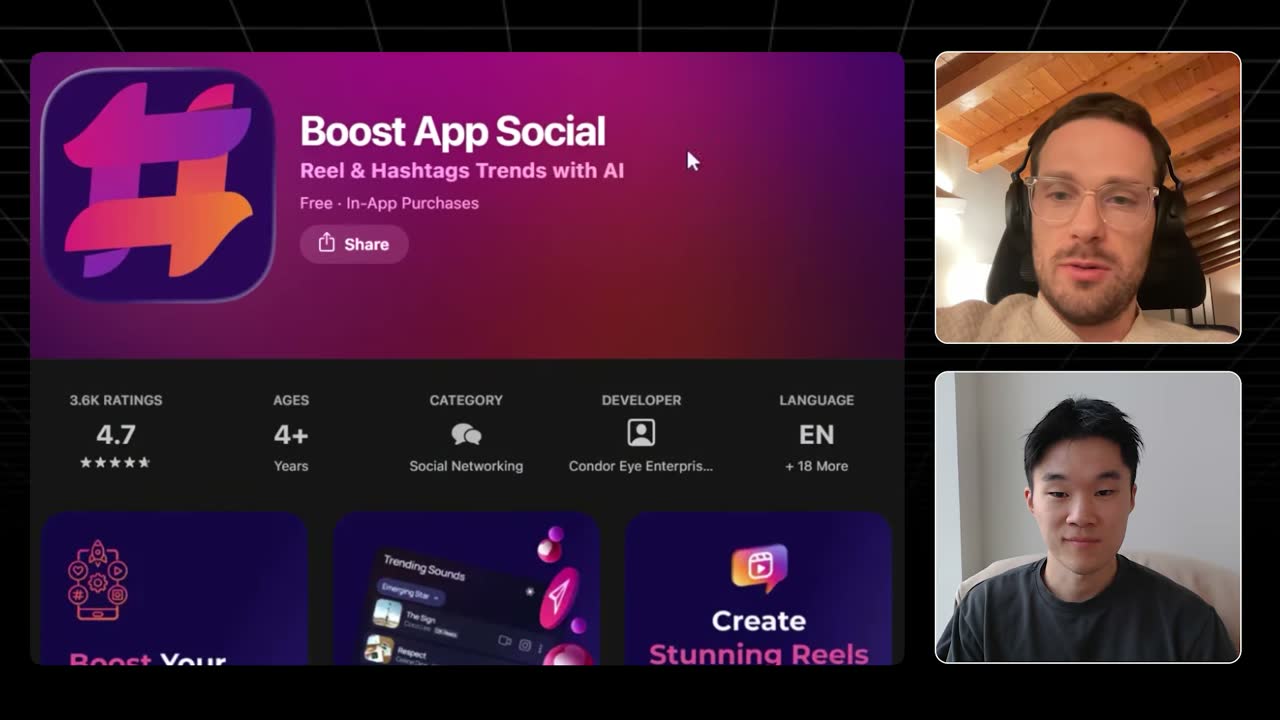
Boost App Social's App Store page: free hashtag and Reels trends app rated 4.7 from 3.6K ratings. They learned subscription apps by copying what worked, then A/B testing. Hashtag Expert already had traction and Alex's team had a better hashtag database, which pulled them into subscription apps. At first they did not understand the math, statistics, onboarding flows or paywalls, so they broke down successful apps and ran many A/B tests in Mixpanel.
Alex later built Screens.design, a library of full onboarding and paywall flows from 2,200 apps. "We didn't understand the importance of onboarding flows and paywalls."
Features beyond hashtags and a business audience supported a $40 to $100 price. Adding features beyond hashtags raised retention and willingness to pay at $40 to $100 a year. Alex argues niche business apps convert better because users who spend $200 to $300 a year and make back $2,000 see it as a no-brainer.
He credits the business angle with better conversion, profitability and a better exit, and warns against cloning consumer apps in favor of fresh niches, such as a devotional app for women rather than a generic one.
2The volume math: only about one ad in 85 wins
From Alex, Boost App Social founder interview
Plan for volume, since roughly one creative in 85 takes the spend. Spend scaled from $100 a day to $500, $1,000 and then $10k a day on Meta. Total spend was about $1.5 to $1.8 million over roughly two and a half years, with about $800k wasted on bad creatives, banned accounts and videos that barely worked.
"One video out of 85 would get all the ad spend and work," and an occasional winner paid back hundreds of thousands in profit. Elsewhere Alex says 97% of creatives fail, so the exact win rate is inconsistent.
Meta and the audience decide half of a creative's fate. Meta predicts which creatives will work, even from things like color, and pushes spend toward them. A creative the team loved could still flop after $20k of spend if Meta or the audience did not take to it.
Alex says the creator does half and Meta decides the other half: "it's not fair, it's not nice" but it is how it works. Single mistakes are costly too: duplicating an ad at 11:30 p.m. burned $8k.
3The creator supply machine: 1,000 Gmail accounts, Telegram and owned rights
Cold email at massive scale supplied creators cheaply, with 10 to 20% replies. A script sent about 10 emails a day from each of 1,000 Gmail accounts loaded onto a shared inbox, pulling addresses from creators' Instagram bios. Replies came back at roughly 10 to 20%, with no paid creator platform.
Alex calls it "a little bit black hatty". The sending tool was built in-house over years, and creators who list an email in their bio expect pitches. Tools like Instantly and Smartlead now do similar sending.
A mapped pipeline moved replies through VAs and Telegram to signed contracts. Alex diagrammed the flow first: email, reply, a VA conversation with a pre-recorded video from Alex, a Telegram group, then a signed contract. The head of VAs ran it from that diagram.
Telegram beat email for fast back-and-forth, big files, contracts and returned MP4s, though the team worried it looked sketchy to creators.
Paying creators $100 up front proved the offer was real. Promising creators got about $100 before the work, which made them feel it was not a scam and got them onto Telegram expecting more, such as another $1,000. Only one or two took the money and vanished.
Alex treats those losses as "a cost of doing business."
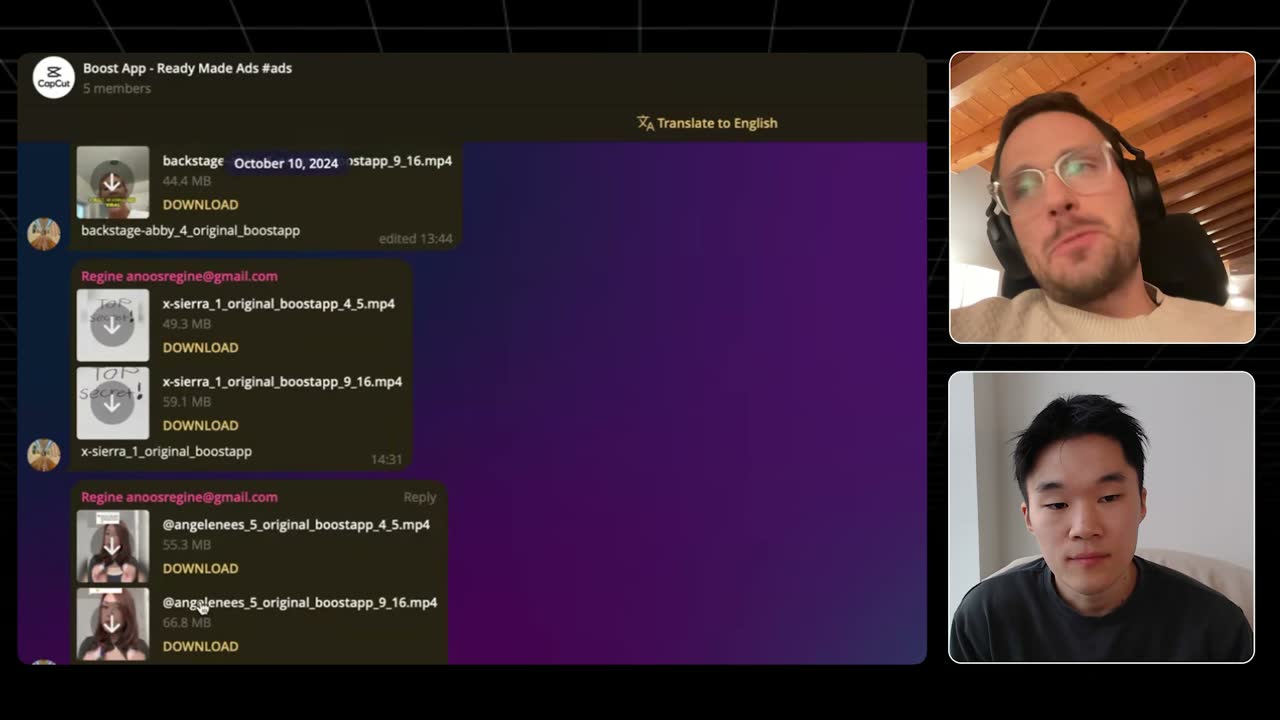
Telegram group "Boost App - Ready Made Ads" where creators deliver finished UGC ad videos in 4:5 and 9:16 formats. Perpetual-rights contracts meant the company owned every creative outright. Each creator signed away rights permanently, including the right to edit, trim and mix footage, so no renewals were needed and no creator could demand $100k when an ad took off. About 300 contracts and 200 to 300 videos built up this way.
Those contracts transferred to the buyer at the sale.
4The creative formula: captions, green screen, hooks
Four years of spend reduced to captions, green screen demos and strong hooks. About 80% of users watch Instagram and TikTok without sound, so captions are required. Green screen demos let one person talk while the app's features play behind them, and the first 5 seconds decide the ad, so the hook must work in both copy and opening visual.
The pattern is a hook about a desired outcome, then about 30 seconds of product demo. Alex says it took four years and $1.5 million to earn those three words.
Give creators a hook sheet and loose rules, then re-edit hard. Each creator got an A4 sheet of hooks that worked for the app's customers; the founders only rejected obviously low-effort hooks. Formats were talking to camera, green screen over a notes app, and lifestyle testimonials.
The team re-cut footage with Mr. Beast style quick transitions. Alex's example hook: "I couldn't believe it was possible that hashtags helped grow a profile."
Specific-problem hooks beat generic ones, and AI visuals are next. A hook naming one narrow frustration, like "How to avoid getting stuck on 1,000 views," may reach 1 million. Alex sees AI-made opening scenes as the next edge, producing visuals creators filming in an apartment could not.
People still edit and multiply the footage around the AI elements.
5Meta bans and platform risk
Persisting through six to eight bans produced the data others never got. The ad accounts were banned six to eight times, some permanently, sometimes without any policy breach. Each recovery took months of offshore support requests, legal calls and appeals.
Alex says most people quit after the first or second ban, and that promoting an Instagram marketing tool makes it easy to cross the line. A Meta rep came only after heavy spending.
A business built only on paid ads should sell or diversify. Bans or doubled CPMs could wreck a business whose profit rests on a statistical game run on one platform. Alex sold partly to "take chips off the table" and now mixes organic growth into Screens.design.
6Selling the ad system for seven figures
The buyer paid for the ad infrastructure, not just the app. Boost App Social sold for seven figures in January after a four to five month deal. The buyer got the warmed-up ad account, the Meta rep, about 300 creator contracts and the dashboards.
The app's business-user audience also helped its conversions, which attracted the buyer. No exact price is given.
Escrow, a dual-qualified lawyer and references protected a sale to an unknown buyer. Facing a secretive private equity style buyer, Alex hired a lawyer qualified in Europe and the US, used a roughly 100-page contract and a Singapore escrow, and spoke to a founder who had sold to them via the broker.
Of the four to five months, 1.5 to 3 were mostly legal work. Not being in a rush gave negotiating strength.

Copy This Facebook Ads Strategy, It'll Blow Up Your App
Grew from a failed web hashtag tool to $100k MRR on Meta ads, scaling spend from $100 to $10k a day with a $40 to $100 a year price. It was sold for seven figures in January after a four to five month deal, with about 300 creator contracts and the ad account.
A failed web tool worked once moved to where users paste hashtags. The first product, a web hashtag tool built on a vector database that suggested related hashtags, found no product market fit. Rebuilt for iOS, it fit how people work: they research hashtags on the phone and paste them straight into Instagram.
Going from web to mobile had been a clunky handoff. With added features and Meta ads, the iOS version scaled to $100k MRR.
Boost App Social's App Store page: free hashtag and Reels trends app rated 4.7 from 3.6K ratings. They learned subscription apps by copying what worked, then A/B testing. Hashtag Expert already had traction and Alex's team had a better hashtag database, which pulled them into subscription apps. At first they did not understand the math, statistics, onboarding flows or paywalls, so they broke down successful apps and ran many A/B tests in Mixpanel.
Alex later built Screens.design, a library of full onboarding and paywall flows from 2,200 apps. "We didn't understand the importance of onboarding flows and paywalls."
Features beyond hashtags and a business audience supported a $40 to $100 price. Adding features beyond hashtags raised retention and willingness to pay at $40 to $100 a year. Alex argues niche business apps convert better because users who spend $200 to $300 a year and make back $2,000 see it as a no-brainer.
He credits the business angle with better conversion, profitability and a better exit, and warns against cloning consumer apps in favor of fresh niches, such as a devotional app for women rather than a generic one.
Plan for volume, since roughly one creative in 85 takes the spend. Spend scaled from $100 a day to $500, $1,000 and then $10k a day on Meta. Total spend was about $1.5 to $1.8 million over roughly two and a half years, with about $800k wasted on bad creatives, banned accounts and videos that barely worked.
"One video out of 85 would get all the ad spend and work," and an occasional winner paid back hundreds of thousands in profit. Elsewhere Alex says 97% of creatives fail, so the exact win rate is inconsistent.
Meta and the audience decide half of a creative's fate. Meta predicts which creatives will work, even from things like color, and pushes spend toward them. A creative the team loved could still flop after $20k of spend if Meta or the audience did not take to it.
Alex says the creator does half and Meta decides the other half: "it's not fair, it's not nice" but it is how it works. Single mistakes are costly too: duplicating an ad at 11:30 p.m. burned $8k.
Cold email at massive scale supplied creators cheaply, with 10 to 20% replies. A script sent about 10 emails a day from each of 1,000 Gmail accounts loaded onto a shared inbox, pulling addresses from creators' Instagram bios. Replies came back at roughly 10 to 20%, with no paid creator platform.
Alex calls it "a little bit black hatty". The sending tool was built in-house over years, and creators who list an email in their bio expect pitches. Tools like Instantly and Smartlead now do similar sending.
A mapped pipeline moved replies through VAs and Telegram to signed contracts. Alex diagrammed the flow first: email, reply, a VA conversation with a pre-recorded video from Alex, a Telegram group, then a signed contract. The head of VAs ran it from that diagram.
Telegram beat email for fast back-and-forth, big files, contracts and returned MP4s, though the team worried it looked sketchy to creators.
Paying creators $100 up front proved the offer was real. Promising creators got about $100 before the work, which made them feel it was not a scam and got them onto Telegram expecting more, such as another $1,000. Only one or two took the money and vanished.
Alex treats those losses as "a cost of doing business."
Telegram group "Boost App - Ready Made Ads" where creators deliver finished UGC ad videos in 4:5 and 9:16 formats. Perpetual-rights contracts meant the company owned every creative outright. Each creator signed away rights permanently, including the right to edit, trim and mix footage, so no renewals were needed and no creator could demand $100k when an ad took off. About 300 contracts and 200 to 300 videos built up this way.
Those contracts transferred to the buyer at the sale.
Four years of spend reduced to captions, green screen demos and strong hooks. About 80% of users watch Instagram and TikTok without sound, so captions are required. Green screen demos let one person talk while the app's features play behind them, and the first 5 seconds decide the ad, so the hook must work in both copy and opening visual.
The pattern is a hook about a desired outcome, then about 30 seconds of product demo. Alex says it took four years and $1.5 million to earn those three words.
Give creators a hook sheet and loose rules, then re-edit hard. Each creator got an A4 sheet of hooks that worked for the app's customers; the founders only rejected obviously low-effort hooks. Formats were talking to camera, green screen over a notes app, and lifestyle testimonials.
The team re-cut footage with Mr. Beast style quick transitions. Alex's example hook: "I couldn't believe it was possible that hashtags helped grow a profile."
Specific-problem hooks beat generic ones, and AI visuals are next. A hook naming one narrow frustration, like "How to avoid getting stuck on 1,000 views," may reach 1 million. Alex sees AI-made opening scenes as the next edge, producing visuals creators filming in an apartment could not.
People still edit and multiply the footage around the AI elements.
Persisting through six to eight bans produced the data others never got. The ad accounts were banned six to eight times, some permanently, sometimes without any policy breach. Each recovery took months of offshore support requests, legal calls and appeals.
Alex says most people quit after the first or second ban, and that promoting an Instagram marketing tool makes it easy to cross the line. A Meta rep came only after heavy spending.
A business built only on paid ads should sell or diversify. Bans or doubled CPMs could wreck a business whose profit rests on a statistical game run on one platform. Alex sold partly to "take chips off the table" and now mixes organic growth into Screens.design.
The buyer paid for the ad infrastructure, not just the app. Boost App Social sold for seven figures in January after a four to five month deal. The buyer got the warmed-up ad account, the Meta rep, about 300 creator contracts and the dashboards.
The app's business-user audience also helped its conversions, which attracted the buyer. No exact price is given.
Escrow, a dual-qualified lawyer and references protected a sale to an unknown buyer. Facing a secretive private equity style buyer, Alex hired a lawyer qualified in Europe and the US, used a roughly 100-page contract and a Singapore escrow, and spoke to a founder who had sold to them via the broker.
Of the four to five months, 1.5 to 3 were mostly legal work. Not being in a rush gave negotiating strength.
More in Marketing & growth tools
 Marketing & growth tools
App Masters
An app marketing and growth consultancy run by Steve P. Young, which also hosts a podcast.
 115 sources · 465 tips
Apple Search Ads
Apple's ad platform for promoting apps in the App Store.
 44 sources · 132 tips
 Marketing & growth tools
Meta
The parent company of Facebook, Instagram, WhatsApp and Threads, run by Mark Zuckerberg.


 42 sources · 106 tips
 Marketing & growth tools
Sensor Tower
An app intelligence and ASO platform with keyword rankings, competitor research and download estimates.
42 sources · 90 tips Marketing & growth tools
Mobile Action
An app store optimization and mobile marketing intelligence platform.
28 sources · 81 tips Marketing & growth tools
HubSpot
A CRM and marketing software platform built for small and medium businesses.
14 sources · 41 tips Marketing & growth tools
AdMob
Google's mobile ad monetization platform with mediation, open bidding and unified payments for app developers.
10 sources · 47 tips Marketing & growth tools
AppsFlyer
A mobile attribution and marketing analytics platform for app marketers.
17 sources · 30 tips