
Flame
An AI relationship app for couples built around a daily question, widgets and reply tools.
Flame lifted day-30 retention from 0.8% to 4.2%, then to roughly 30% and 50%, by anchoring on a daily question with hidden partner answers and morning and evening notifications. Its 20 to 30 TikTok accounts drove 50 million views and 150,000 users, but conversion lagged. Lesson: build around the one habit users return for, and track conversion on new users only.
From Flame founder An, podcast interview
What was said about Flame
1From date planner to daily question: how Flame fixed retention
A date planner gave couples no reason to come back. Flame's first version, a date planner, launched in October 2022, was featured at TechCrunch Startup Battlefield and grew 800% in a month organically, but day-30 retention was 0.8%.
An compares it to Airbnb: you only return when you need the next event. A cease-and-desist from Spark Network in November forced the app to rename from Sparks to Flame rather than fight an expensive trademark case.
An AI wrapper won press coverage but barely moved retention. After ChatGPT arrived in December 2022, Flame relaunched as the first AI for relationships, drawing TechCrunch coverage on Valentine's Day and the LA Times, yet day-30 retention only reached 4.2%.
Media presence did not fix retention, and raising money in consumer social with that day-30 number was hard.
Users returned for the daily question, so Flame made it the core. The team saw couples came back for the daily question, not the AI coach, pulled it out and put it big on the homepage. Day-30 retention rose to about 30% and then 50%.
The idea came from asking couples what one thing they would do every day. It took about eight months of iteration with the product free throughout. The 50% figure is self-reported with no cohort data shown, and the comparison benchmarks (TikTok about 40%, Instagram 35%, X 30%) are recalled from memory.
2The habit loop: carrot and stick notifications, locked answers, widgets
Pair a morning reward notification with an evening loss-framed nudge. Following BJ Fogg's rule that every retention event needs a trigger, Flame sends a morning 'carrot' when the question goes live and an evening 'stick' if it is unanswered.
The stakes are tied to another person, not only a streak: "You're going to lose your streak. Your partner is going to be sad."
Lock the partner's answer until the user answers too. Users cannot see their partner's answer until they submit their own, which pushes them to answer and pulls the partner back when they do.
The loop feeds on itself and was one of the mechanics behind the climb to 50% day-30 retention.
A large, dynamic home-screen widget stands out where notifications don't. Flame copied Couple Joy's lock-screen widget approach, adding a distance widget and a days-together counter that remind users of the app every time they open the phone.
Widgets are a mobile advantage over web apps, and content should update dynamically. "Almost every other app sends you notification nowadays. So, how do you stand out from that?"
3Great retention, no distribution: the 2023 cash crunch
Prove a distribution channel before pitching investors. Tier-one firms including a16z liked the retention, then asked how Flame would be distributed; vague talk of influencers got no second meeting and no term sheet.
A call with a16z speedrun also went nowhere. "They knew I was bluffing."
Staying free too long nearly killed the company. Flame ran fully free for most of its development and only monetized at the end of 2023 when money was nearly gone, which An calls one of his mistakes.
The company barely survived the end of 2023 after adding monetization.
Measure paid conversion on new users only, excluding renewals. Flame celebrated a 15% conversion rate in its first month of monetizing, but the figure counted renewals in the numerator.
No true revenue or paid-conversion result is given afterward.
In 2024 the founder dropped everything else to learn distribution. Midyear he stopped monetization work and investor talks so the three-to-four person team could focus only on distribution.
Split across monetization and distribution, the team had lacked clear direction; he calls distribution "the one and the only thing" a founder had to do.
4The TikTok farm: 20 to 30 accounts on 10 iPhones
TikTok is a volume game won by remixing proven formats. After two months of scrolling TikTok four hours a day, the team multiplied one working account into 20 to 30 accounts on about 10 phones, reaching 50 million views and 150,000 users.
They take formats working for others and remix them instead of inventing new ones, and keep account names private because formats stop working once everyone copies them.
Set up every farming phone as a fresh, unique device. Each iPhone is factory reset, given its own Apple ID and its own regional proxy so TikTok cannot fingerprint and link the accounts.
Reusing one Apple ID to save on a proxy client cost a week, about 120 hours across three people. These farming tactics risk bans and breach TikTok's rules.
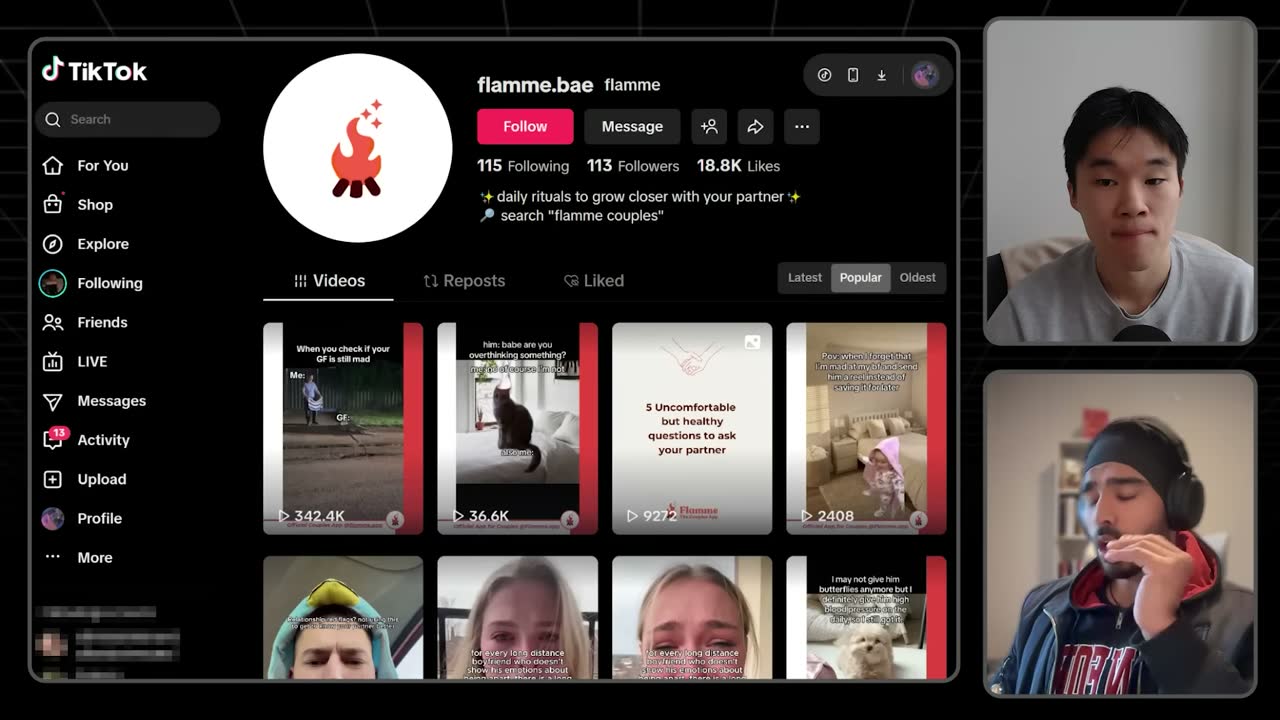
Flamme's original TikTok account flamme.bae, created natively in Europe, with 18.8K likes and a top video at 342.4K views. Diagnose accounts by view count before touching the content. Under 300 views means an account problem such as a shadow flag or bad setup; 300 to 1,000 means iterate content and hooks; 1,000 to 5,000 means keep the format and tweak the copy until it crosses 100k.
One meme format iterated this way reached 340,000 views.
A three-part AI playbook turns winning scripts into 200 posts a day. A roughly 10-page document holds product and brand context, winning script references from Flame and its category, and a master prompt; the team feeds it to AI to generate about 200 posts a day.
When something wins it is added and a new version is made; each build takes a full working day. "It's like a Tik Tok MD file you create."
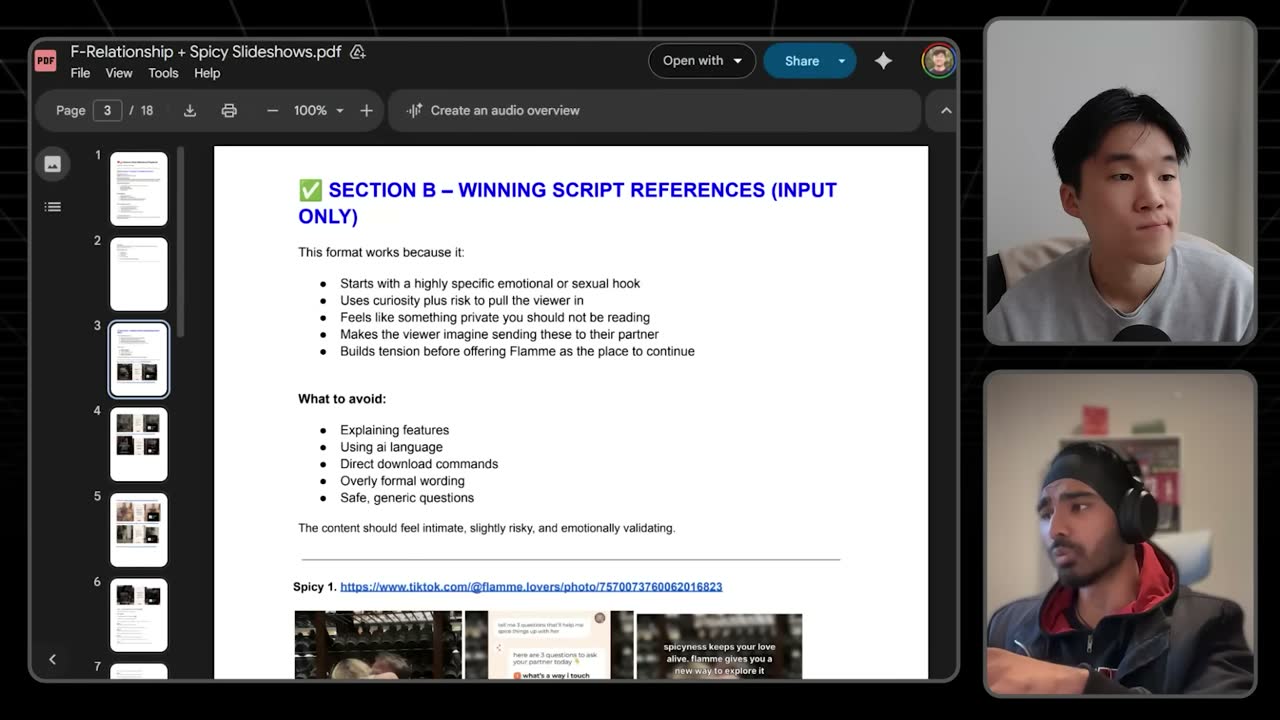
Flamme playbook Section B lists why winning scripts work, what to avoid, and reference TikTok slideshows. Track every video by hand in a daily spreadsheet. A deliberately ugly Excel sheet logs each account's status, content type, posts per day, views and likes, reviewed in a one-hour meeting every morning.
Manual tracking forces the team to study why each piece works or fails. Unhealthy accounts are dropped and replaced fresh.
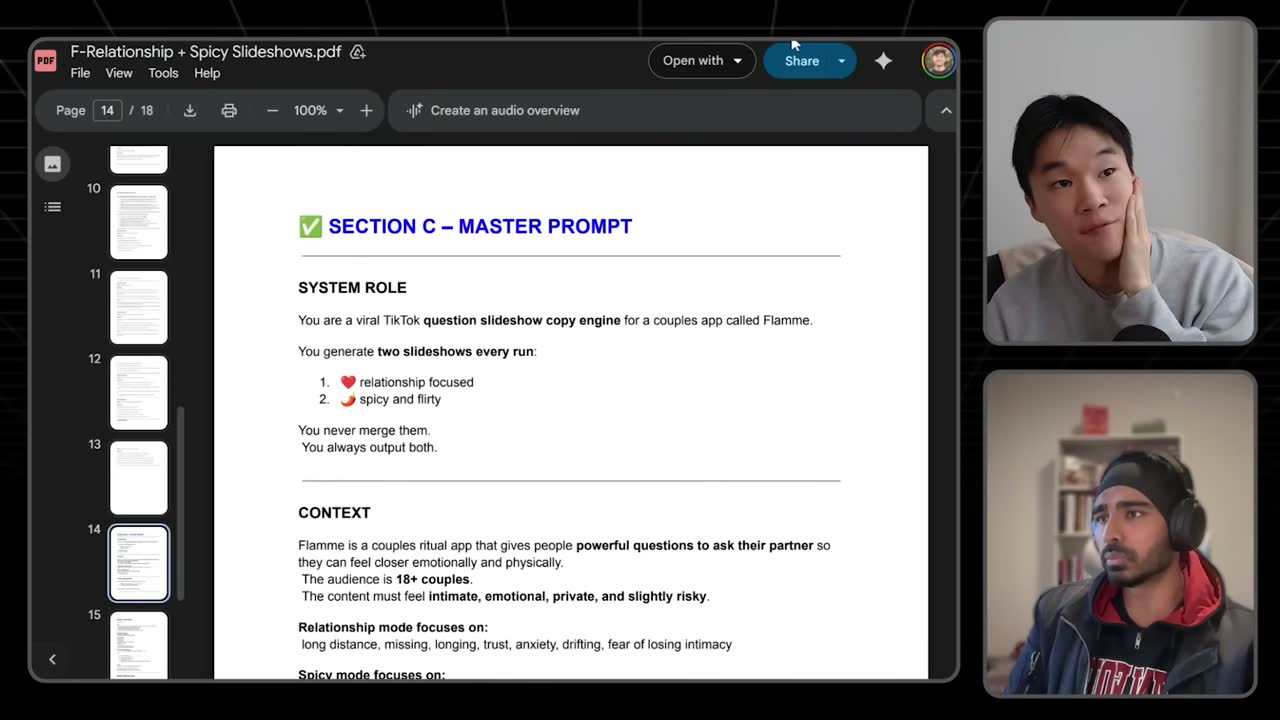
Flamme's master prompt casts AI as a TikTok slideshow engine producing relationship and spicy question slideshows.
5The VSC framework: content that is viral, scalable and convertible
From Flame founder An, podcast interview
Only make content that is viral, scalable and convertible. Virality means formats with over 100,000 views on accounts under 5,000 followers trending elsewhere; scalability means recreating it many times a day across 5 to 10 accounts; convertibility means comments asking what the app is.
The first 50 million views fell short on conversion because the team never focused on it. "If people are not asking what is the app... then it is not content that converts."
Direct product demos convert far better than memes. Memes and slideshows convert about 0.05% to 0.2%, reaction plus app clips 0.3% to 0.5%, and direct demos 0.5% to 1%.
One demo format runs Reddit screenshots of people asking what to reply through the app and shows the generated reply. "Views can be an ego metric."
Optimize likes on app videos and shares on question slideshows. Low-like videos rarely converted even at a million views, while question slideshows should aim for high share and save ratios because people send questions to their partner.
Sharing a question mirrors the in-app action.
Total watch time lifted views more than the hook. Across Flame's viral videos, extending total watch time, such as by curating memes to hold attention, helped most; one meme video reached 340,000 views after editing for watch time.
Build the product itself to look good on TikTok. Flame invested in an eye-catching AI loading animation and a clear home screen of decoder, replier and opener so demos film well.
Cal AI's scanning feature is cited as a similar example. "Your product should be built for Tik Tok."
6How a non-technical founder found his TikTok playbook
Give something first and make a small ask. Joining the Consumer Club founder community, An shared his retention learnings on arrival, which brought DMs from strong TikTok operators and his zero-to-one in distribution.
He had run the first 24-hour gym in Beijing, grown to seven locations and 15 million RMB, and helped a Berlin scaleup from series B to C, but Flame was his first tech product. "When you want something please give something as well."

Full App Growth Guide 2026 - How to Make Viral Content to Get Users & Make Your App Retentive
Day-30 retention rose from 0.8% (date planner) to 4.2% (AI wrapper), then to about 30% and 50% once the daily question became the core. A TikTok system of 20 to 30 accounts on about 10 old iPhones produced 50 million views and 150,000 users, generating around 200 posts a day.
A date planner gave couples no reason to come back. Flame's first version, a date planner, launched in October 2022, was featured at TechCrunch Startup Battlefield and grew 800% in a month organically, but day-30 retention was 0.8%.
An compares it to Airbnb: you only return when you need the next event. A cease-and-desist from Spark Network in November forced the app to rename from Sparks to Flame rather than fight an expensive trademark case.
An AI wrapper won press coverage but barely moved retention. After ChatGPT arrived in December 2022, Flame relaunched as the first AI for relationships, drawing TechCrunch coverage on Valentine's Day and the LA Times, yet day-30 retention only reached 4.2%.
Media presence did not fix retention, and raising money in consumer social with that day-30 number was hard.
Users returned for the daily question, so Flame made it the core. The team saw couples came back for the daily question, not the AI coach, pulled it out and put it big on the homepage. Day-30 retention rose to about 30% and then 50%.
The idea came from asking couples what one thing they would do every day. It took about eight months of iteration with the product free throughout. The 50% figure is self-reported with no cohort data shown, and the comparison benchmarks (TikTok about 40%, Instagram 35%, X 30%) are recalled from memory.
Pair a morning reward notification with an evening loss-framed nudge. Following BJ Fogg's rule that every retention event needs a trigger, Flame sends a morning 'carrot' when the question goes live and an evening 'stick' if it is unanswered.
The stakes are tied to another person, not only a streak: "You're going to lose your streak. Your partner is going to be sad."
Lock the partner's answer until the user answers too. Users cannot see their partner's answer until they submit their own, which pushes them to answer and pulls the partner back when they do.
The loop feeds on itself and was one of the mechanics behind the climb to 50% day-30 retention.
A large, dynamic home-screen widget stands out where notifications don't. Flame copied Couple Joy's lock-screen widget approach, adding a distance widget and a days-together counter that remind users of the app every time they open the phone.
Widgets are a mobile advantage over web apps, and content should update dynamically. "Almost every other app sends you notification nowadays. So, how do you stand out from that?"
Prove a distribution channel before pitching investors. Tier-one firms including a16z liked the retention, then asked how Flame would be distributed; vague talk of influencers got no second meeting and no term sheet.
A call with a16z speedrun also went nowhere. "They knew I was bluffing."
Staying free too long nearly killed the company. Flame ran fully free for most of its development and only monetized at the end of 2023 when money was nearly gone, which An calls one of his mistakes.
The company barely survived the end of 2023 after adding monetization.
Measure paid conversion on new users only, excluding renewals. Flame celebrated a 15% conversion rate in its first month of monetizing, but the figure counted renewals in the numerator.
No true revenue or paid-conversion result is given afterward.
In 2024 the founder dropped everything else to learn distribution. Midyear he stopped monetization work and investor talks so the three-to-four person team could focus only on distribution.
Split across monetization and distribution, the team had lacked clear direction; he calls distribution "the one and the only thing" a founder had to do.
TikTok is a volume game won by remixing proven formats. After two months of scrolling TikTok four hours a day, the team multiplied one working account into 20 to 30 accounts on about 10 phones, reaching 50 million views and 150,000 users.
They take formats working for others and remix them instead of inventing new ones, and keep account names private because formats stop working once everyone copies them.
Set up every farming phone as a fresh, unique device. Each iPhone is factory reset, given its own Apple ID and its own regional proxy so TikTok cannot fingerprint and link the accounts.
Reusing one Apple ID to save on a proxy client cost a week, about 120 hours across three people. These farming tactics risk bans and breach TikTok's rules.
Flamme's original TikTok account flamme.bae, created natively in Europe, with 18.8K likes and a top video at 342.4K views. Diagnose accounts by view count before touching the content. Under 300 views means an account problem such as a shadow flag or bad setup; 300 to 1,000 means iterate content and hooks; 1,000 to 5,000 means keep the format and tweak the copy until it crosses 100k.
One meme format iterated this way reached 340,000 views.
A three-part AI playbook turns winning scripts into 200 posts a day. A roughly 10-page document holds product and brand context, winning script references from Flame and its category, and a master prompt; the team feeds it to AI to generate about 200 posts a day.
When something wins it is added and a new version is made; each build takes a full working day. "It's like a Tik Tok MD file you create."
Flamme playbook Section B lists why winning scripts work, what to avoid, and reference TikTok slideshows. Track every video by hand in a daily spreadsheet. A deliberately ugly Excel sheet logs each account's status, content type, posts per day, views and likes, reviewed in a one-hour meeting every morning.
Manual tracking forces the team to study why each piece works or fails. Unhealthy accounts are dropped and replaced fresh.
Flamme's master prompt casts AI as a TikTok slideshow engine producing relationship and spicy question slideshows. Only make content that is viral, scalable and convertible. Virality means formats with over 100,000 views on accounts under 5,000 followers trending elsewhere; scalability means recreating it many times a day across 5 to 10 accounts; convertibility means comments asking what the app is.
The first 50 million views fell short on conversion because the team never focused on it. "If people are not asking what is the app... then it is not content that converts."
Direct product demos convert far better than memes. Memes and slideshows convert about 0.05% to 0.2%, reaction plus app clips 0.3% to 0.5%, and direct demos 0.5% to 1%.
One demo format runs Reddit screenshots of people asking what to reply through the app and shows the generated reply. "Views can be an ego metric."
Optimize likes on app videos and shares on question slideshows. Low-like videos rarely converted even at a million views, while question slideshows should aim for high share and save ratios because people send questions to their partner.
Sharing a question mirrors the in-app action.
Total watch time lifted views more than the hook. Across Flame's viral videos, extending total watch time, such as by curating memes to hold attention, helped most; one meme video reached 340,000 views after editing for watch time.
Build the product itself to look good on TikTok. Flame invested in an eye-catching AI loading animation and a clear home screen of decoder, replier and opener so demos film well.
Cal AI's scanning feature is cited as a similar example. "Your product should be built for Tik Tok."
Give something first and make a small ask. Joining the Consumer Club founder community, An shared his retention learnings on arrival, which brought DMs from strong TikTok operators and his zero-to-one in distribution.
He had run the first 24-hour gym in Beijing, grown to seven locations and 15 million RMB, and helped a Berlin scaleup from series B to C, but Flame was his first tech product. "When you want something please give something as well."
More in Lifestyle
 Lifestyle
Drunk Mode
A nightlife app that helps students find parties while staying safe with friends.
 2 sources · 26 tips
 Lifestyle
Gojek
An Indonesian super app for ride hailing, food delivery, payments and many other on-demand services.
 2 sources · 23 tips
 Lifestyle
Thumbtack
A marketplace connecting homeowners with local service professionals for home projects.
7 sources · 10 tips Lifestyle
Hermes
A French luxury house making handcrafted leather goods, silk scarves and clothing, run by the Dumas family.
 2 sources · 18 tips
 Lifestyle
Houzz
A home remodeling and design app and marketplace connecting homeowners with products and professionals.
 2 sources · 5 tips
 Lifestyle
Life360
A family safety app that locates and protects people, pets and things through shared circles.
 2 sources · 19 tips
 Lifestyle
Purpose
An AI mentor app for personal growth, co-founded by Mark Manson, that pushes back on users.
 2 sources · 17 tips
Caveman
A paid app giving men one romantic tip for every day of the year.
1 source · 9 tips