
A visual discovery app where people browse and save images and ideas.
Pinterest grew by showing value before asking for commitment. Letting visitors scroll three pages before the signup prompt lifted signups 15-20% in an A/B test. When Facebook closed its open graph and cheap signups dried up, it built SEO and rebuilt signup, onboarding and notifications around personal recommendations, reaching over 100 million active users. Lesson: let people experience the product first, and don't depend on one borrowed channel.
- Signup prompt appears at once
- Value not shown before the ask
- About three pages of free scrolling
- Signup prompt comes after browsing
Signups rose 15-20%
From Pinterest A/B test, via Casey Winters
What was said about Pinterest
1The free browsing test before signup
Letting visitors scroll three pages before the signup prompt raised signups. Pinterest A/B tested letting new users scroll through about three pages of content before asking them to sign up. Signups rose 15-20%.
The aim was to show value first, cut bounce rates and capture interest before the ask. It suits products where browsing content is itself the value. The 15-20% lift can serve as a rough benchmark when testing a delayed signup wall against an immediate prompt.
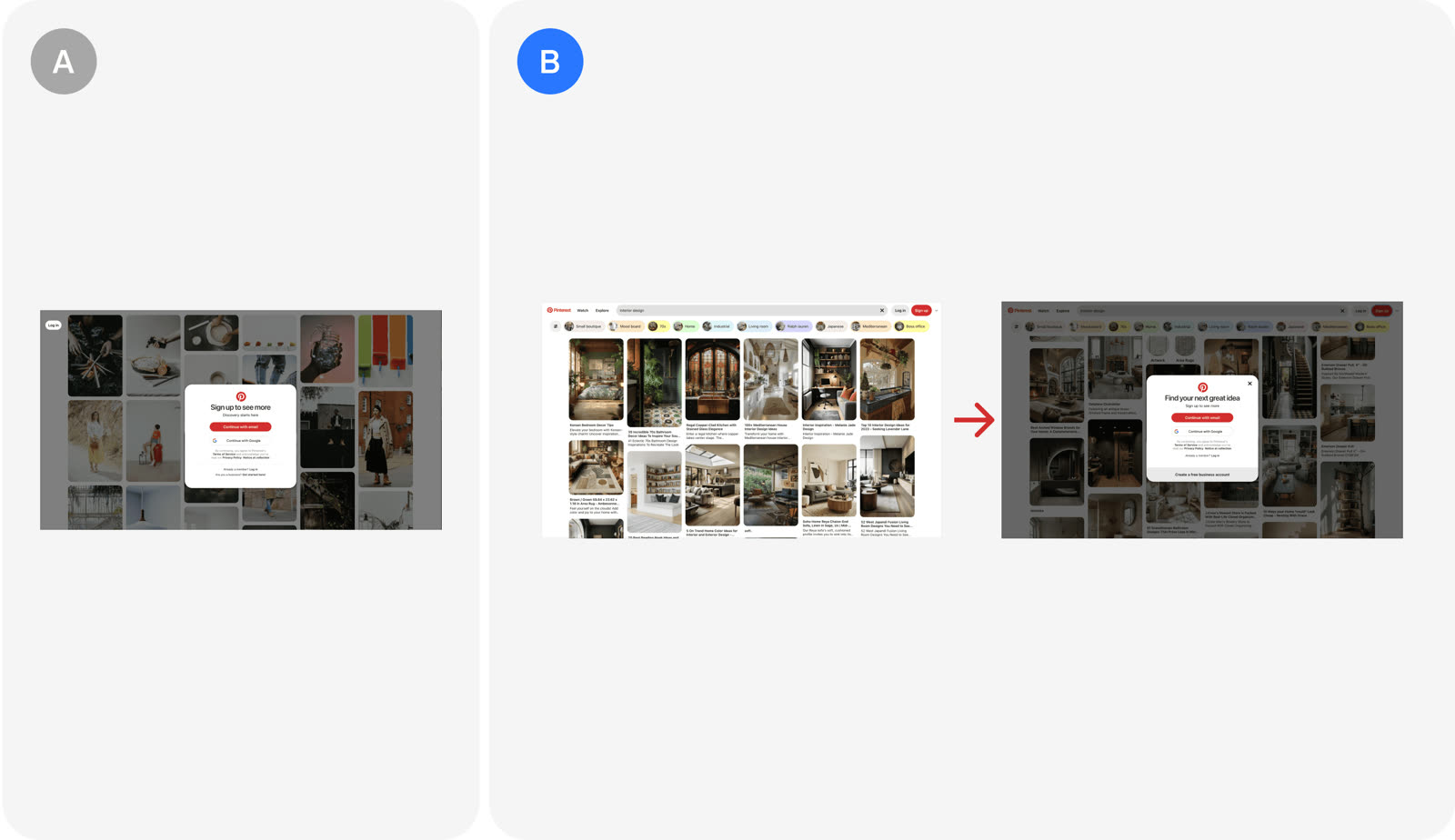
Version A and version B as Pinterest tested them.
2Rebuilding growth after Facebook shut off the open graph
Pinterest replaced lost Facebook signups by building SEO as a growth channel. When Facebook shut off the open graph, Pinterest lost a source of cheap signups. Casey Winters responded by building SEO.
Signup, onboarding and notifications were rebuilt around the new search traffic. Notifications moved from showing what friends save to giving personal recommendations. The product went on to have over 100 million active users.

Free content exploration before signup: Pinterest's A/B test
Pinterest A/B tested letting users scroll through three pages of content before the signup prompt, which raised signups by 15-20%. The aim was to show value first, cut bounce rates and capture interest before the ask.
Letting visitors scroll three pages before the signup prompt raised signups. Pinterest A/B tested letting new users scroll through about three pages of content before asking them to sign up. Signups rose 15-20%.
The aim was to show value first, cut bounce rates and capture interest before the ask. It suits products where browsing content is itself the value. The 15-20% lift can serve as a rough benchmark when testing a delayed signup wall against an immediate prompt.
Version A and version B as Pinterest tested them.

The hierarchy of engagement | Sarah Tavel (Benchmark, Greylock, Pinterest)
Pinners and repinners came back the next week with over 90% probability, so weekly active pinners became the North Star. Its picked-for-you feed may have been the first algorithmic feed in a social product, and each pin improved recommendations for everyone.
Pinterest replaced lost Facebook signups by building SEO as a growth channel. When Facebook shut off the open graph, Pinterest lost a source of cheap signups. Casey Winters responded by building SEO.
Signup, onboarding and notifications were rebuilt around the new search traffic. Notifications moved from showing what friends save to giving personal recommendations. The product went on to have over 100 million active users.

How SuperMe is Building the Professional Network for the AI Era
When Facebook shut off the open graph, Pinterest lost cheap signups, so Winters built SEO and rebuilt signup, onboarding and notifications around it. Notifications moved from what friends save to personal recommendations, and the product had over 100 million active users.
How OpenArt is Using AI to Reinvent Content Creation
Its inspiration model was the comparison for OpenArt's early prompt-sharing site. It also scaled SEO with templated pages.
How onX Built a Portfolio of Apps to Grow ARR by 10x
onX borrowed its experiment idea review process, and Pinterest ran millions of copy iterations across languages using a copy tuning tool.
Making and Leading Products People Love (Scott Belsky) | Lenny & Friends Summit 2024
It began as immediate bookmarking utility, with discovery only a hope. Around 2011 designers loaded each pin's dominant color before the image, and users said the site felt much faster with no backend change.
Reflections on a movement | Eric Ries (creator of the Lean Startup methodology)
Ben Silbermann is quoted saying founders don't know what minimum is or what viable is, which makes the MVP hard to define.
Leveraging growth advisors, mastering SEO, and honing your craft | Luc Levesque (Shopify, Meta)
Its user-created pages fit the large-page SEO bucket. It has produced strong growth people because of its high traffic and experiment culture, and Luc advised it.
Lessons on product sense, AI, the first mile experience, and the messy middle | Scott Belsky (Adobe)
Built on collecting interests rather than chasing likes. It sent heavy traffic to each pin's source, so sites added pin buttons themselves. Belsky was Ben Silbermann's first seed angel and a product advisor.
Thinking beyond frameworks | Casey Winters (Pinterest, Eventbrite, Airbnb, Tinder, Reddit, Grubhub)
Saving a pin signals its quality and your tastes, a data network effect that improves recommendations. Casey brought in heads of growth from Dropbox and Facebook to persuade colleagues there.

Do This Before You Advertise Your Mobile App
An ad network many app marketers ignore, which Steve finds strong for health and wellness. He discovered a few apps himself through it.
More in Social & Dating
 Social & Dating
A social network built around connecting people and sharing.

 58 sources · 128 tips
 Social & Dating
A photo and video sharing social app built around creators, Stories, Reels and feeds.
 38 sources · 79 tips
 Social & Dating
TikTok
A short-form video app where creators post content and can earn through a revenue-sharing program.
 35 sources · 75 tips
 Social & Dating
A professional networking platform for jobs, hiring and career content.
15 sources · 55 tips Social & Dating
Tinder
A dating app with tiered subscriptions plus boosts, Super Likes and other in-app purchases.
11 sources · 47 tips Social & Dating
Snap
The company behind Snapchat, a camera-first messaging app popular with teens.
6 sources · 29 tips Social & Dating
Discord
A chat and voice platform for gaming friends and communities.
10 sources · 29 tips Social & Dating
Snapchat
A camera-first messaging and social app built around close friends, Stories and AR lenses.
10 sources · 23 tips