
a16z Speedrun
A venture capital firm investing in technology startups.
a16z Speedrun now passes on ideas that are too small and backs larger ambition, since small ideas no longer stand out. It led Wabi's $20 million pre-seed a month after its public beta. Flame's call went nowhere because it lacked a distribution answer. Lesson: pitch big, and show real distribution before approaching investors.
- 1Generate variantsAgent creates every test variant
- 2Measure each variantResults tracked automatically
- 3Ship the winnerOnly the stat-sig winner goes live
- 4Start next experimentLoop restarts with a new test
From Anish Acharya, a16z Speedrun
What was said about a16z Speedrun
1Why a16z now passes on ideas that are too small
a16z now rejects small ideas, where it once rejected overly ambitious ones. Anish Acharya says that three years ago overly ambitious companies were passed on and a $100 million seed made no sense. Now ideas that are too small are what a16z avoids.
His reasoning is that AI removes the constraints that forced founders into narrow wedges. He cited Atoms as attempting something that would have felt insurmountable 5 to 10 years ago. The stance echoes Andreessen's first fund pitch: it would go to the moon or leave a moon-size crater. "An idea that's too small is not something that we want to engage with."
Plan the company as if models were near-infinitely smart and cheap. Acharya tells founders to ask how the company would be reorganized if models were infinitely intelligent and astonishingly cheap. In the near term, winners are the firms that adopt the technology most ambitiously and rethink how they are organized.
He expects many industries to keep their current competitive balance because they are not bound by intelligence. His example is Pizza Hut, Domino's, Papa John's and Round Table: all would get a data center of PhDs, and he doubts any one ends up with 99% of the market. He uses electricity as the comparison: it took 40 years to move from swapping out coal to redesigning factories.
2Anish Acharya's thesis: companies as loops of agents
Run business functions as agent loops that ship and measure work automatically. Acharya defines an agent as a model in a loop with tools, memory and skill files. A growth team's loop generates and measures every variant, ships the stat-sig winner and starts the next experiment.
In a coding bug loop, a report comes in, a repro and fix are made and the fix is reviewed. Low-risk fixes ship, high-risk ones wait for a human, and the loop can email the customer within about 5 minutes. When Kavak's agents get stuck they call a human, then learn from the trace so they need not call again. Kavak's six-week "Jedi Academy" ends with every employee, mechanics included, shipping an agent in production.
Humans stay essential because loops stall at a local maximum. Agents hill-climb to a plateau and cannot choose a new direction, so people must pick the next hill. Work that is easy to verify turns into loops, and hard-to-verify work like sales, support, strategy and exceptions stays human.
Acharya suggests asking what you know that the model does not. He reports a Google executive who laid no one off and now gets through two years of roadmap in three months; the hardest problem became knowing what to add to the roadmap. Lenny adds that OpenAI's go-to-market team uses Codex more than its engineers do.
Moats come from shipping the many small ideas competitors cannot see. Cursor was criticized for having no moat, then captured reasoning traces and trained its own models. Acharya says big ideas rest on a dozen invisible small ideas that copycats never see.
He sees the biggest consumer opening in loops that make people happier, since people spend time more than they save it and entertainment and social are the largest products. He frames the gap as product design, not model capability. His stance rests on anecdotes and a few indicators, such as record job postings for radiologists and programmers, rather than data on who gains or loses.
3What Speedrun-backed founders learned about raising
Show a distribution channel before pitching; retention alone did not win a16z Speedrun. Flame's founder had strong retention, but a call with a16z Speedrun went nowhere and tier-one investors kept asking how the product was distributed. With no real answer there was no second meeting or term sheet, so the team monetized to survive.
"They knew I was bluffing."
Pitch where the market is going, backed by revenue growth rather than usage. Sunflower, which lists a16z Speedrun among its investors, failed with a first deck built on the founder's background and usage numbers. The deck that raised after YC described the market's direction, positioned Sunflower in AI, showed revenue rising and included letters of intent from pilots.
Sunflower has raised about $6.5 million in total, with Flybridge leading the seed. "You can't raise funds based off of a playbook that came out of 2025."
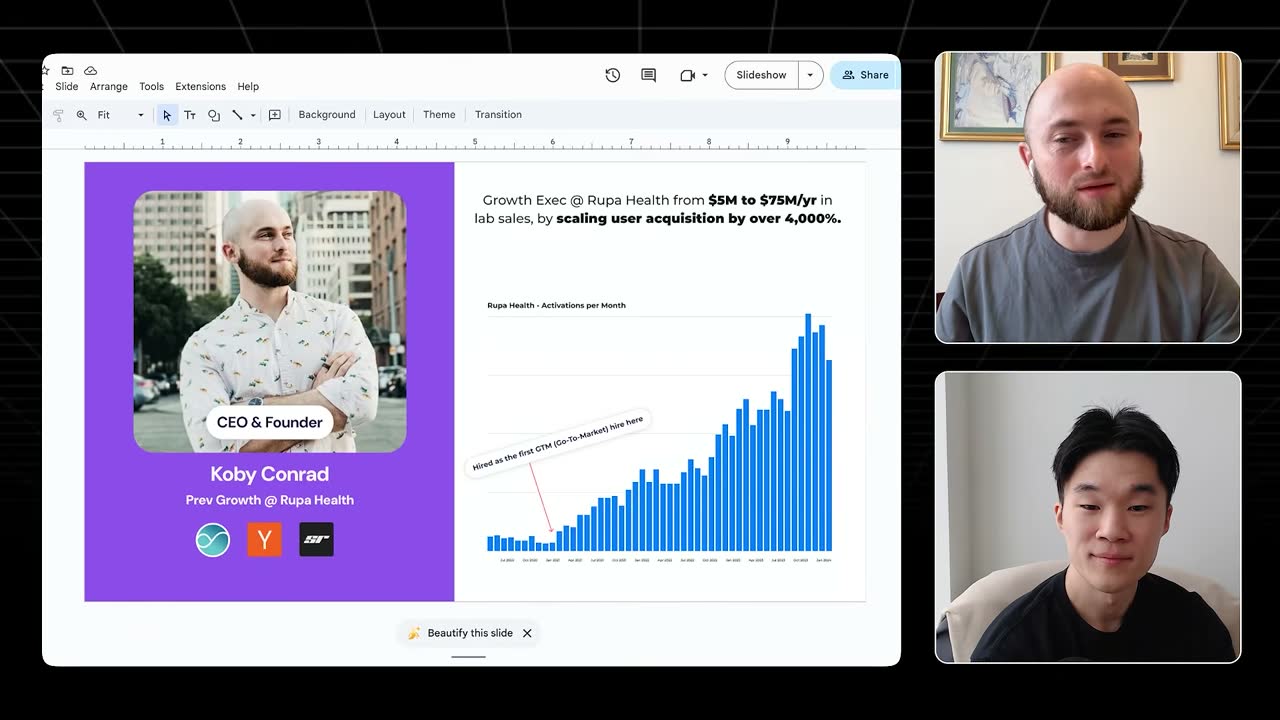
Sunflower pitch deck founder slide: Koby grew Rupa Health from $5M to $75M/yr, acquisition up 4,000%. a16z backs big early bets quickly after a public launch. It led Wabi's $20 million pre-seed round a month after Wabi's public beta launched in October 2025. Separately, Dmitri started a new company through Speedrun after selling YourMove AI, aiming to grow 10x faster with more resources.

Why companies are becoming a series of loops | Anish Acharya (a16z)
Now passes on ideas that are too small, where it once passed on ideas too ambitious. Andreessen's first fund pitch was that it would go to the moon or leave a moon-size crater.
a16z now rejects small ideas, where it once rejected overly ambitious ones. Anish Acharya says that three years ago overly ambitious companies were passed on and a $100 million seed made no sense. Now ideas that are too small are what a16z avoids.
His reasoning is that AI removes the constraints that forced founders into narrow wedges. He cited Atoms as attempting something that would have felt insurmountable 5 to 10 years ago. The stance echoes Andreessen's first fund pitch: it would go to the moon or leave a moon-size crater. "An idea that's too small is not something that we want to engage with."
Plan the company as if models were near-infinitely smart and cheap. Acharya tells founders to ask how the company would be reorganized if models were infinitely intelligent and astonishingly cheap. In the near term, winners are the firms that adopt the technology most ambitiously and rethink how they are organized.
He expects many industries to keep their current competitive balance because they are not bound by intelligence. His example is Pizza Hut, Domino's, Papa John's and Round Table: all would get a data center of PhDs, and he doubts any one ends up with 99% of the market. He uses electricity as the comparison: it took 40 years to move from swapping out coal to redesigning factories.
Run business functions as agent loops that ship and measure work automatically. Acharya defines an agent as a model in a loop with tools, memory and skill files. A growth team's loop generates and measures every variant, ships the stat-sig winner and starts the next experiment.
In a coding bug loop, a report comes in, a repro and fix are made and the fix is reviewed. Low-risk fixes ship, high-risk ones wait for a human, and the loop can email the customer within about 5 minutes. When Kavak's agents get stuck they call a human, then learn from the trace so they need not call again. Kavak's six-week "Jedi Academy" ends with every employee, mechanics included, shipping an agent in production.
Humans stay essential because loops stall at a local maximum. Agents hill-climb to a plateau and cannot choose a new direction, so people must pick the next hill. Work that is easy to verify turns into loops, and hard-to-verify work like sales, support, strategy and exceptions stays human.
Acharya suggests asking what you know that the model does not. He reports a Google executive who laid no one off and now gets through two years of roadmap in three months; the hardest problem became knowing what to add to the roadmap. Lenny adds that OpenAI's go-to-market team uses Codex more than its engineers do.
Moats come from shipping the many small ideas competitors cannot see. Cursor was criticized for having no moat, then captured reasoning traces and trained its own models. Acharya says big ideas rest on a dozen invisible small ideas that copycats never see.
He sees the biggest consumer opening in loops that make people happier, since people spend time more than they save it and entertainment and social are the largest products. He frames the gap as product design, not model capability. His stance rests on anecdotes and a few indicators, such as record job postings for radiologists and programmers, rather than data on who gains or loses.

How Wabi is Building “YouTube for Software” with a Platform for Creating Mini Apps
Led Wabi's $20 million pre-seed round a month after the public beta launched in October 2025.
a16z backs big early bets quickly after a public launch. It led Wabi's $20 million pre-seed round a month after Wabi's public beta launched in October 2025. Separately, Dmitri started a new company through Speedrun after selling YourMove AI, aiming to grow 10x faster with more resources.

I speedran an ai app from 0 to $1m/yr in 10 months
Listed among Sunflower's investors.
Pitch where the market is going, backed by revenue growth rather than usage. Sunflower, which lists a16z Speedrun among its investors, failed with a first deck built on the founder's background and usage numbers. The deck that raised after YC described the market's direction, positioned Sunflower in AI, showed revenue rising and included letters of intent from pilots.
Sunflower has raised about $6.5 million in total, with Flybridge leading the seed. "You can't raise funds based off of a playbook that came out of 2025."
Sunflower pitch deck founder slide: Koby grew Rupa Health from $5M to $75M/yr, acquisition up 4,000%.
Full App Growth Guide 2026 - How to Make Viral Content to Get Users & Make Your App Retentive
A call with a16z speedrun went nowhere, and tier-one investors asked how Flame would be distributed. Without a real answer there was no second conversation or term sheet.
Show a distribution channel before pitching; retention alone did not win a16z Speedrun. Flame's founder had strong retention, but a call with a16z Speedrun went nowhere and tier-one investors kept asking how the product was distributed. With no real answer there was no second meeting or term sheet, so the team monetized to survive.
"They knew I was bluffing."
he had nothing.. until he built a stupid simple $30k/mo app with AI
After selling YourMove AI he started a new company through Speedrun, aiming to grow 10x faster with more resources.
a16z backs big early bets quickly after a public launch. It led Wabi's $20 million pre-seed round a month after Wabi's public beta launched in October 2025. Separately, Dmitri started a new company through Speedrun after selling YourMove AI, aiming to grow 10x faster with more resources.
More in Investors & studios
 Investors & studios
Y Combinator
A startup accelerator that funds and advises early-stage companies.
 11 sources · 18 tips
 Investors & studios
Sequoia Capital
A venture capital firm that backs early-stage technology founders.
 8 sources · 18 tips
Blue Throne
An app acquirer that buys working consumer apps for seven and eight figures and scales them.
 4 sources · 6 tips
 Investors & studios
Bending Spoons
An Italian company that acquires digital businesses and runs them on one shared platform of proprietary tools.
 2 sources · 19 tips
Social
A bootstrapped app studio that buys apps after their viral peak and grows them with AI ads and testing.
1 source · 10 tips Investors & studios
Teledyne
A conglomerate founded in 1960 that bought niche businesses, ran an insurance investment arm, and repurchased its own stock.
 1 source · 17 tips
Volo Ventures
A venture firm investing in consumer apps and AI-powered consumer products.
1 source · 9 tips Investors & studios
First Round Capital
A seed-stage venture capital firm that backs early technology startups.
4 sources · 5 tips