Social
A bootstrapped app studio that buys apps after their viral peak and grows them with AI ads and testing.
Social buys apps after their viral peak and grows them with AI-made ads and constant testing, reaching $16M a year with 11 people on a $1M preseed. It runs about 100 A/B tests and 4,000 video ads a month across 22 apps, though most tests fail (2 of 20 are good). Lesson: log every test's hypothesis, keep humans on ad ideas, and automate execution.
- 1Run dozens of A/B testsDozens per app each month
- 2Lift revenue per userDoubled in 12 months, tripled in 18
- 3Higher LTV funds acquisitionAbout 3x LTV to CAC
- 4More users fund testsAcquisition pays for the next tests
From Social founders Patrick and Pablo
What was said about Social
1How Social reached $16M a year with a tiny team
A bootstrapped studio reached about $1M revenue per employee by pairing AI and testing. Social is three years old, raised only $1M preseed equity, and hit $11M annualized revenue with 11 people, now $16M a year. It runs 22 apps with over 40M downloads.
Monthly output includes about 100 A/B tests, about 4,000 AI video ads, hundreds of playable ads and thousands of static ads. New hires have lowered revenue per employee, and Patrick expects a few months to get back to it. The figures are the founders' own.
2Buying apps after their viral peak
Faded viral apps are often underpriced because sellers can't see the market. Social bought Celebs, a celebrity lookalike app, after its viral peak while it was declining and its owners didn't know how to grow it. At six years old it is bigger than ever and earns slightly more than Lipstick, which does just over $300K a month.
The pitch is that half the world is curious about which celebrity they look like. Patrick says people underestimate the potential of consumer software. Purchase prices, failed deals and how often bought apps fail to recover are not shown.
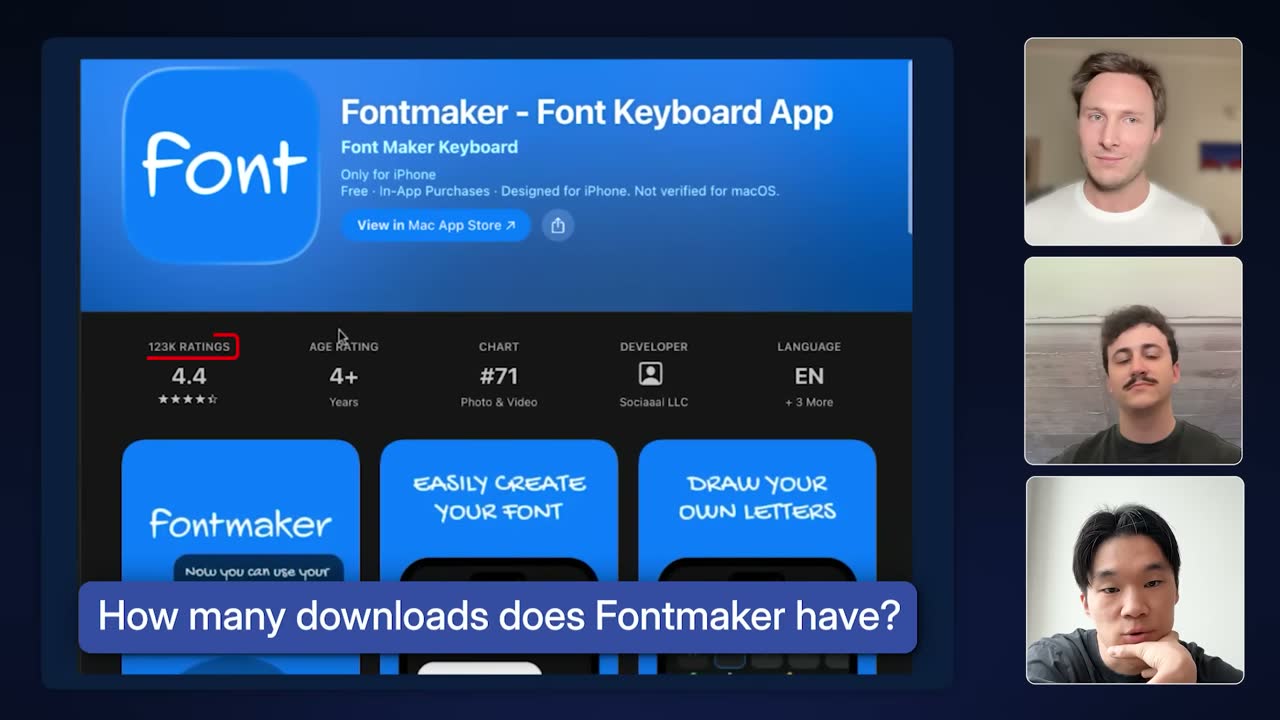
Fontmaker's App Store page: 123K ratings, 4.4 stars, #71 in Photo & Video. Buy if the app can scale profitably, not only if it retains well. The buy test is long-term profitable scale. Growing revenue 20x would return multiples of the purchase price, and sometimes the market is simply bigger than others think.
Utility apps retain well, but retention is not the only thesis. The top four apps are similar in size: Celebs, Lipstick, Font Maker (about $200K a month, about 7M downloads) and Autopaste. Hotspots was bought from Pablo, who became the first head of product.
Test demand with standardized ads before buying an app. Top down, Social looks at market structure, willingness to pay and growth speed. Bottom up, it runs standardized ads for apps it is considering or that don't exist yet, and compares them to an internal benchmark.
It then adds the app's own retention and any marketing data the owner has. Patrick's long-term aim is to buy an app from data alone, without knowing what it does.
Skip categories where your skills and monetization don't fit. Social avoids gaming and mostly avoids social networks, and buys utilities, dating assistants, entertainment apps and a couple of dating apps.
Games need a different skill set for building and distribution, and strong operators already exist. Social networks monetize differently and need big scale to matter.
3The growth loop and the testing machine
Better monetization funds more acquisition, which funds more tests. Dozens of A/B tests per app each month lift revenue per user, and the higher LTV pays for more user acquisition. Revenue per user roughly doubled in 12 months and tripled over 18 months across the portfolio, at about 3x LTV to CAC.
Celebs sells weekly subscriptions priced from $6.99 to $14.99.
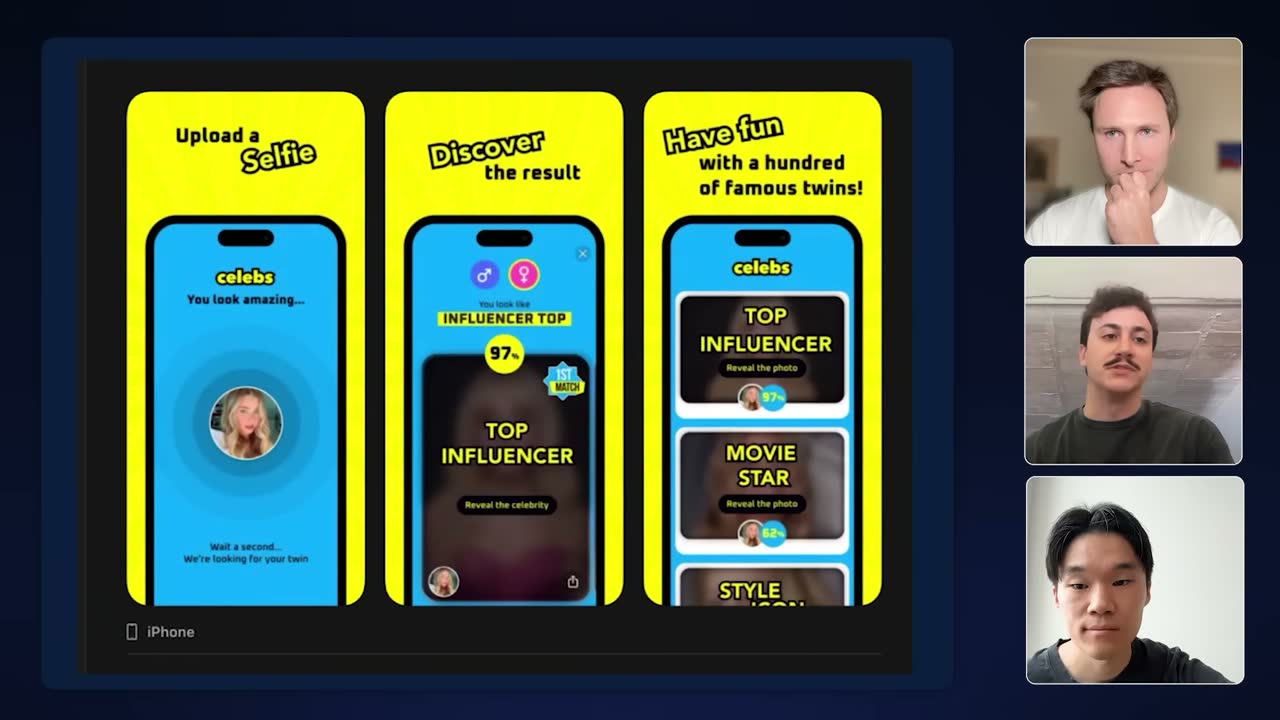
Celebs app store screenshots: upload a selfie, get a 97% celebrity twin match. Onboarding tests matter most because the funnel shrinks after it. The earlier an interaction, the bigger its impact, so adding or removing one onboarding screen can matter a lot. Early-stage apps test big first-screen changes; at about 1M users a month, they test across the whole app.
The same decision can be right for Celebs and wrong for Lipstick, so no answer carries automatically across apps.
Expect most tests to fail, and scale winners in stages. Of about 20 tests, Pablo expects roughly 10 neutral, 5 terrible, 3 interesting and 2 good. Tests start small and grow only if they work.
"We run probably 20 AV test. 10 of them are neutral, five are terrible, three seem to be giving us something interesting, two are good."
4Removing the onboarding paywall on Celebs
- Industry rule: paywall ends onboarding
- Users lost at the paywall
- First paywall mostly friction
- Paywall removed from onboarding
- Converts at about 10 later places
- Lost users converted better later
Won big after earlier attempts failed
From Social founders Patrick and Pablo
Celebs won by cutting its onboarding paywall, after several earlier attempts failed. Against the industry rule of a hard paywall at the end of onboarding, Social removed it. Users lost there converted better later in the funnel, and it won big.
Pablo says conversion can happen in about 10 places in the app; once the later ones were optimized, the first paywall was mostly friction. Variables like onboarding answers or gender interact, so one run proves little. How much of the win depends on Celebs' other conversion points is not shown.
Rerun old tests with big potential lift as the app changes. The team tried paywall removal many times as the product evolved; early tries didn't work, then one did.
Patrick says to revisit old assumptions, especially ones with a big possible lift, because a result holds only in its context.
Ask for payment at the moment users are most excited. If a better moment to sell exists after onboarding, use a very soft paywall and convert later. If not, keep a hard paywall or free trial in onboarding.
After removal, the goal is to reach the moment of maximal intrigue as fast as possible. A small app mostly needs this one decision, and the answer can change as the app improves.
Friction in onboarding can also help by creating a strong ad signal. Added onboarding friction can produce a strong signal used for signal engineering in ad campaigns.
Patrick says the real asset is a methodology and "nearly a philosophy" of continual testing, not a fixed playbook of one-off wins.
5Tagging every test so people and AI agents can learn
Record each test's hypothesis, result and learning in a shared backlog. Every test is tagged with why it ran, what happened and what was learned, so a new hire or an AI agent can reuse the lesson. "If I tell an agent I have been winning this AV test means nothing."
Pablo knows what to do in a new app because he lived through about 80 tests. The Celebs win was friction removal, so for another app the team pulls five to seven past friction-removal attempts as a starting list for the equivalent move there.
6The AI ad engine
AI makes every ad, but humans supply the ideas and taste. All of about 4,000 monthly video ads have been AI-made for over two years, with a six-person ads team on ideas, prep and editing. The creative team tripled in six months because more volume needed more diverse ideas.
Others went from 30 actor ads a month to 50 AI ads. Patrick frames AI as doing things that were impossible before, not only cutting costs: "by doing that it usually requires a lot more humans."
Explore new concepts and formats instead of endless variations of one ad. Variations of one ad stay in the same region of an infinite search space and decay over time, so the team tests widely for new angles, then goes deep where something works.
Brute force is impossible because there aren't enough impressions to test every ad.
Take ad inspiration from other industries, not just competitors. As market leader in its niches, Social has nobody to copy, so it uses AI to surface TikToks and videos from unrelated industries that creative analysts adapt.
Copying the leader gets some traction but won't make you the leader.
Test new ad concepts by hand, then automate the winners. Agentic video editing needs detailed, engineer-style prompts changing one variable at a time, so human editors are often faster while exploring. Once a use case, angle or concept is nailed, it gets automated.
7Building the WiseSam agent
Users warmed by an ad accept a long onboarding as happy friction. WiseSam, a safe, easy OpenClaw-style assistant for consumers, is sold through ads and a long onboarding that learns about the user, then shows a summary so the user feels listened to.
Visitors from the website skip the long flow because no ad primed them. Patrick says most 100-screen onboardings use about 10% of the answers; WiseSam uses what it learns inside the product.
Add AI agents to the process without automating the whole company. Social is now adding AI agents to how it buys apps, but says it will not automate the whole company.

$16M AI CEOs: How to Make $1.3M/Month With AI Apps
Reached $16M a year with a tiny team after raising only $1M preseed, hitting $11M annualized with 11 people. Runs about 100 A/B tests a month, about 4,000 AI video ads a month, and a portfolio of 22 apps with over 40M downloads.
A bootstrapped studio reached about $1M revenue per employee by pairing AI and testing. Social is three years old, raised only $1M preseed equity, and hit $11M annualized revenue with 11 people, now $16M a year. It runs 22 apps with over 40M downloads.
Monthly output includes about 100 A/B tests, about 4,000 AI video ads, hundreds of playable ads and thousands of static ads. New hires have lowered revenue per employee, and Patrick expects a few months to get back to it. The figures are the founders' own.
Faded viral apps are often underpriced because sellers can't see the market. Social bought Celebs, a celebrity lookalike app, after its viral peak while it was declining and its owners didn't know how to grow it. At six years old it is bigger than ever and earns slightly more than Lipstick, which does just over $300K a month.
The pitch is that half the world is curious about which celebrity they look like. Patrick says people underestimate the potential of consumer software. Purchase prices, failed deals and how often bought apps fail to recover are not shown.
Fontmaker's App Store page: 123K ratings, 4.4 stars, #71 in Photo & Video. Buy if the app can scale profitably, not only if it retains well. The buy test is long-term profitable scale. Growing revenue 20x would return multiples of the purchase price, and sometimes the market is simply bigger than others think.
Utility apps retain well, but retention is not the only thesis. The top four apps are similar in size: Celebs, Lipstick, Font Maker (about $200K a month, about 7M downloads) and Autopaste. Hotspots was bought from Pablo, who became the first head of product.
Test demand with standardized ads before buying an app. Top down, Social looks at market structure, willingness to pay and growth speed. Bottom up, it runs standardized ads for apps it is considering or that don't exist yet, and compares them to an internal benchmark.
It then adds the app's own retention and any marketing data the owner has. Patrick's long-term aim is to buy an app from data alone, without knowing what it does.
Skip categories where your skills and monetization don't fit. Social avoids gaming and mostly avoids social networks, and buys utilities, dating assistants, entertainment apps and a couple of dating apps.
Games need a different skill set for building and distribution, and strong operators already exist. Social networks monetize differently and need big scale to matter.
Better monetization funds more acquisition, which funds more tests. Dozens of A/B tests per app each month lift revenue per user, and the higher LTV pays for more user acquisition. Revenue per user roughly doubled in 12 months and tripled over 18 months across the portfolio, at about 3x LTV to CAC.
Celebs sells weekly subscriptions priced from $6.99 to $14.99.
Celebs app store screenshots: upload a selfie, get a 97% celebrity twin match. Onboarding tests matter most because the funnel shrinks after it. The earlier an interaction, the bigger its impact, so adding or removing one onboarding screen can matter a lot. Early-stage apps test big first-screen changes; at about 1M users a month, they test across the whole app.
The same decision can be right for Celebs and wrong for Lipstick, so no answer carries automatically across apps.
Expect most tests to fail, and scale winners in stages. Of about 20 tests, Pablo expects roughly 10 neutral, 5 terrible, 3 interesting and 2 good. Tests start small and grow only if they work.
"We run probably 20 AV test. 10 of them are neutral, five are terrible, three seem to be giving us something interesting, two are good."
Celebs won by cutting its onboarding paywall, after several earlier attempts failed. Against the industry rule of a hard paywall at the end of onboarding, Social removed it. Users lost there converted better later in the funnel, and it won big.
Pablo says conversion can happen in about 10 places in the app; once the later ones were optimized, the first paywall was mostly friction. Variables like onboarding answers or gender interact, so one run proves little. How much of the win depends on Celebs' other conversion points is not shown.
Rerun old tests with big potential lift as the app changes. The team tried paywall removal many times as the product evolved; early tries didn't work, then one did.
Patrick says to revisit old assumptions, especially ones with a big possible lift, because a result holds only in its context.
Ask for payment at the moment users are most excited. If a better moment to sell exists after onboarding, use a very soft paywall and convert later. If not, keep a hard paywall or free trial in onboarding.
After removal, the goal is to reach the moment of maximal intrigue as fast as possible. A small app mostly needs this one decision, and the answer can change as the app improves.
Friction in onboarding can also help by creating a strong ad signal. Added onboarding friction can produce a strong signal used for signal engineering in ad campaigns.
Patrick says the real asset is a methodology and "nearly a philosophy" of continual testing, not a fixed playbook of one-off wins.
Record each test's hypothesis, result and learning in a shared backlog. Every test is tagged with why it ran, what happened and what was learned, so a new hire or an AI agent can reuse the lesson. "If I tell an agent I have been winning this AV test means nothing."
Pablo knows what to do in a new app because he lived through about 80 tests. The Celebs win was friction removal, so for another app the team pulls five to seven past friction-removal attempts as a starting list for the equivalent move there.
AI makes every ad, but humans supply the ideas and taste. All of about 4,000 monthly video ads have been AI-made for over two years, with a six-person ads team on ideas, prep and editing. The creative team tripled in six months because more volume needed more diverse ideas.
Others went from 30 actor ads a month to 50 AI ads. Patrick frames AI as doing things that were impossible before, not only cutting costs: "by doing that it usually requires a lot more humans."
Explore new concepts and formats instead of endless variations of one ad. Variations of one ad stay in the same region of an infinite search space and decay over time, so the team tests widely for new angles, then goes deep where something works.
Brute force is impossible because there aren't enough impressions to test every ad.
Take ad inspiration from other industries, not just competitors. As market leader in its niches, Social has nobody to copy, so it uses AI to surface TikToks and videos from unrelated industries that creative analysts adapt.
Copying the leader gets some traction but won't make you the leader.
Test new ad concepts by hand, then automate the winners. Agentic video editing needs detailed, engineer-style prompts changing one variable at a time, so human editors are often faster while exploring. Once a use case, angle or concept is nailed, it gets automated.
Users warmed by an ad accept a long onboarding as happy friction. WiseSam, a safe, easy OpenClaw-style assistant for consumers, is sold through ads and a long onboarding that learns about the user, then shows a summary so the user feels listened to.
Visitors from the website skip the long flow because no ad primed them. Patrick says most 100-screen onboardings use about 10% of the answers; WiseSam uses what it learns inside the product.
Add AI agents to the process without automating the whole company. Social is now adding AI agents to how it buys apps, but says it will not automate the whole company.
More in Investors & studios
 Investors & studios
Y Combinator
A startup accelerator that funds and advises early-stage companies.


 11 sources · 18 tips
 Investors & studios
Sequoia Capital
A venture capital firm that backs early-stage technology founders.
 8 sources · 18 tips
Blue Throne
An app acquirer that buys working consumer apps for seven and eight figures and scales them.
 4 sources · 6 tips
 Investors & studios
Bending Spoons
An Italian company that acquires digital businesses and runs them on one shared platform of proprietary tools.
 2 sources · 19 tips
 Investors & studios
Teledyne
A conglomerate founded in 1960 that bought niche businesses, ran an insurance investment arm, and repurchased its own stock.
 1 source · 17 tips
Volo Ventures
A venture firm investing in consumer apps and AI-powered consumer products.
1 source · 9 tips Investors & studios
First Round Capital
A seed-stage venture capital firm that backs early technology startups.
4 sources · 5 tipsBenchmark
A venture capital firm that invests in consumer and marketplace startups.
3 sources · 4 tips