
YourMove AI
An AI tool that writes dating texts and profiles and generates photos for online daters.
YourMove AI began in 2022 as a text box giving three flirty replies, and took about 2.5 years to reach roughly $30k a month at about 80% margin, with SEO blog posts driving nearly half of traffic. The founder kept his job, used cheap Upwork contractors, and sold at $28k a month. Lesson: pick a painkiller problem, charge from launch, and keep testing channels.
- Weekend GPT flirting prototypeFriends immediately asked for access
- Started chargingAfter a mentor asked why not
- About $1,000 a monthSlow but consistent user growth
- $10k a monthProfiles and AI photos added
- $28k a monthPeaked at $30k, ~80% margin
From Dmitri, YourMove AI founder interview
What was said about YourMove AI
1From a drunken joke to a $30k/month app
Friends asking to use a rough prototype signaled real demand. In 2022 Dmitri, a data science manager building a Slackbot on Da Vinci 2, spent a weekend getting early GPT to flirt and put it on a website. Friends immediately asked for access and wanted to share it.
The first version was a text box: paste a Hinge message, get three flirty replies. He had built many products before but says, "I've never felt that pull. It was always kind of the push." He reads strong unprompted demand as a sign a product can be monetized.
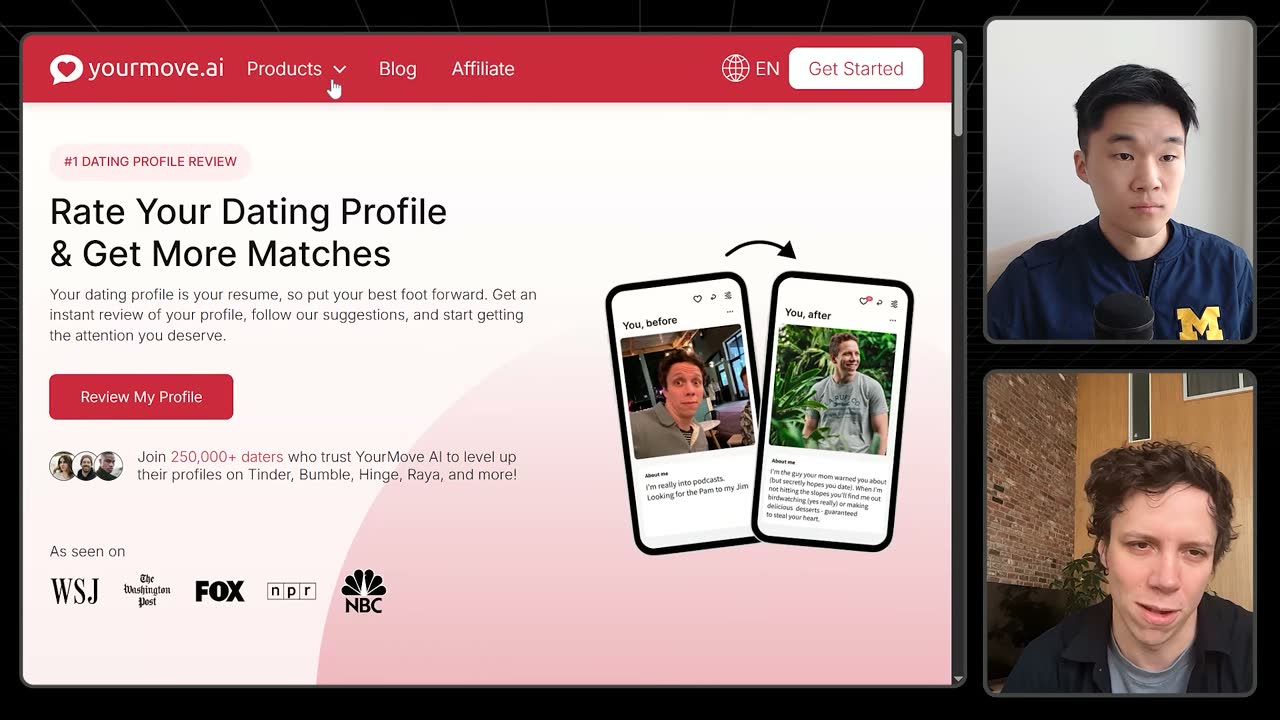
YourMove AI homepage pitching dating profile reviews, claiming 250,000+ daters and press from WSJ, NBC. The product grew by covering every step of online dating. YourMove AI expanded from text replies to writing profiles, picking photos and, about a year and a half before the interview, generating AI photos. It reached about $30k a month at roughly 80% margin.
He tried about 12 products, and texting, profiles and photos are the ones that survived. He started about a year before the "RizzGPT" wave but captured far less of the market because he couldn't yet build apps or market. Revenue peaked at $30k and was $28k when he sold the company, 4 to 5 months before the interview; no exit price is given.
Real money took 2.5 years, carried by steady traction signals. It took 6 months to start charging, 11 more months to reach about $1,000, then roughly a year each to $10k and $28k a month.
Slow but consistent user growth and users calling the tool transformative kept him going. Before this he spent about four years and three failed projects before earning his first dollar, and five years before leaving his job. He credits some luck: he was building on GPT-3 before ChatGPT existed.
Amazon page for MJ DeMarco's The Millionaire Fastlane, 4.7 stars from 13,446 reviews.
2Why dating was the right problem
Pick a painkiller problem so users need no convincing. Dating pain lasts until it is solved, so people pay and stay, and the landing page needs little explaining. A friend offered a $10,000 bounty to anyone who introduced him to his future wife.
Vitamin products like calendar tools, to-do apps or friend-making apps force you to convince people they need them; he names longevity as the exception. "It's much easier to make money on a product when you don't have to sell a person on why they need that product."
Look for problems that recent technology created. Dating apps became competitive enough that everyone must market themselves, which created demand for AI texting help.
Other examples he gives are screen time blockers, anti-AI-cheating tools and apps that check unfollowers.
Bootstrappers should choose small problems without network effects. He argues capital should match problem scale: small problems suit bootstrappers because competitors spend less and move slower. A couple of venture-backed competitors in his space went nowhere.
Products that fix problems created by bigger apps fit this, like a tweet helper rather than the next Twitter; building a dating app at home fails on both network effects and budget. His first failed project had a total addressable market under $1 million, so check market size before building.
3Press as fuel for SEO
- 1Get press coverageFox, CNBC, Wired, WSJ, Washington Post
- 2Earn strong backlinksNever paid for or hunted them
- 3Target low-competition keywordsHigh-volume dating questions
- 4Publish blog postsEach one advertises the app
- 5Capture search trafficNearly half of all traffic
From Dmitri, YourMove AI founder interview
Press brought few users but built the domain authority SEO needed. Coverage in Fox, CNBC, Wired, the Washington Post and the Wall Street Journal gave strong backlinks from the start. He then targeted low-competition, high-volume keywords with blog posts, which drove nearly half of all traffic.
A Fox Business appearance got fewer views than one decent Reddit post. He never paid for or hunted backlinks. "The PR itself didn't generate any money but allowed us a really good SEO strategy."
Each blog post carried an ad for the app. Articles answered queries like "what do I text my crush" with pieces like "100 good morning messages" or "10 best dating apps in 2025", each promoting the product.
Only one serious competitor ran an SEO strategy in the niche; the rest were content farms, odd personal sites and small matchmakers with less money to spend. He also ran experiments on blog pages, including pop-up ads.
Generic SEO content is losing value as AI answers questions. People now generate answers instead of clicking into random posts, and his own SEO traffic has declined.
He says he doesn't know whether this SEO strategy would still work and that many tactics popular five years ago no longer do. What works now is routing content to the right product and entering a field with weak rivals.
Niche Reddit communities beat flyers and early Google Ads. Subreddits about optimizing dating apps gave early attention, and those posts still bring some SEO traffic. Flyers in Washington Square Park and a little Google Ads did not work well.
4Choosing and testing channels
Google and SEO capture demand; Meta and TikTok create it. Search reaches people who already have the problem, so the job is only to convert them, but volume caps it. Meta and TikTok offer more upside but require monetizing as well as any rival bidding on that user.
Auction pressure pushes many ads to be "a little bit scammy". Facebook ads need longer funnels with full onboarding sequences and paywalls.
Give each channel enough time to know it truly failed. SEO needs about 3 months of focused work before showing anything and 3 to 6 months to know it failed. A failure should reflect the channel, not poor execution.
UGC took "an insane amount of work" even with people managing it. "There's no real marketing channel that you can just spin up in two weeks and be done with it."
Route each channel's traffic to the product it suits. Google Ads worked for some products and not at all for others, so a single web funnel sent each blog post and ad to its matching product.
He framed growth as two levers: get eyeballs, then convert them into the most monetizable thing possible. Dating coaching was tested this way and dropped as too high maintenance.
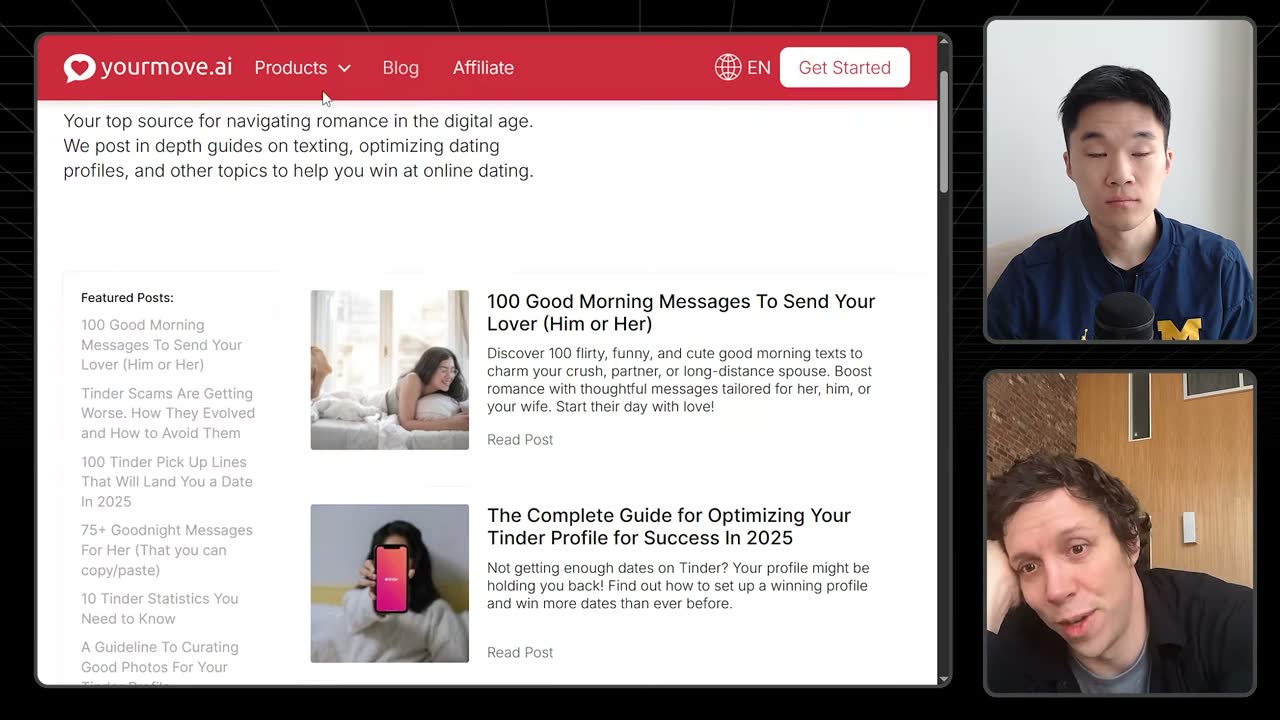
YourMove AI's blog lists SEO posts like '100 Good Morning Messages' and Tinder profile guides.
5Monetization and product mistakes
Charge from launch instead of waiting to monetize later. He waited 6 months to charge, following "get users, monetize later", until a mentor asked why he wasn't charging.
The paywall is now soft for text and hard for AI photos because photo generation has high compute costs.
Validate the core flow before building a keyboard app. The first dev-built project, a keyboard extension suggesting texts inside dating apps, performed much worse than the plain core flow and ran over time and budget.
"It looked and felt like what we needed, but it was deeply broken on the inside." He calls hiring an agency for it a terrible time.
6Bootstrapping on a day job with contractors
A salary funded contractors and removed deadline pressure. He ran the business at a loss for his last year at Opendoor, paying contractors rather than doing everything himself, since his time was worth about $150 an hour and experts cost $50.
The cushion avoided the panic that makes full-time founders quit after 3 to 6 months. For five months he ran it on 20 to 30 hours a week.
Part-time Upwork contractors who also coach you speed up learning. At one point he had 10 to 12 contractors covering email, SEO, ads, design, Webflow and support, most working a couple of hours a week, plus a dev at 40 hours and a support person at about $5 an hour.
For new channels like Google Ads he hired people who did the work and trained him. His first dev was terrible; the second was good and helped him hire others.
Quit only when the business covers all expenses. His line was $20k revenue, about $10k monthly profit in New York, without burning savings or cutting staff. He hit $17k to $18k and planned to leave in December.
A layoff with severance came just as he was about to quit, which he calls "probably the happiest moment in the past couple of years."
Big-tech habits don't transfer to small-business marketing. Coming from data science with Python and ML but no sales or social skills, he had to learn marketing by doing it.
Marketing is a discovery process you can't hand to someone after the product is built. "I think the biggest failure point that I see is people trying to take lessons from big tech and apply it here."
Wall Street Journal article "Can You Flirt Better Than Artificial Intelligence?" covering the AI dating app, January 2023.

he had nothing.. until he built a stupid simple $30k/mo app with AI
Started in 2022 as a text box that gave three flirty replies to a pasted Hinge message, and grew to about $30k a month with roughly 80% margin. SEO blog posts drove nearly half of traffic, the paywall is soft for text and hard for AI photos, and it took 2.5 years to reach real money. He sold it 4 to 5 months before the interview, with revenue at $28k.
Friends asking to use a rough prototype signaled real demand. In 2022 Dmitri, a data science manager building a Slackbot on Da Vinci 2, spent a weekend getting early GPT to flirt and put it on a website. Friends immediately asked for access and wanted to share it.
The first version was a text box: paste a Hinge message, get three flirty replies. He had built many products before but says, "I've never felt that pull. It was always kind of the push." He reads strong unprompted demand as a sign a product can be monetized.
YourMove AI homepage pitching dating profile reviews, claiming 250,000+ daters and press from WSJ, NBC. The product grew by covering every step of online dating. YourMove AI expanded from text replies to writing profiles, picking photos and, about a year and a half before the interview, generating AI photos. It reached about $30k a month at roughly 80% margin.
He tried about 12 products, and texting, profiles and photos are the ones that survived. He started about a year before the "RizzGPT" wave but captured far less of the market because he couldn't yet build apps or market. Revenue peaked at $30k and was $28k when he sold the company, 4 to 5 months before the interview; no exit price is given.
Real money took 2.5 years, carried by steady traction signals. It took 6 months to start charging, 11 more months to reach about $1,000, then roughly a year each to $10k and $28k a month.
Slow but consistent user growth and users calling the tool transformative kept him going. Before this he spent about four years and three failed projects before earning his first dollar, and five years before leaving his job. He credits some luck: he was building on GPT-3 before ChatGPT existed.
Amazon page for MJ DeMarco's The Millionaire Fastlane, 4.7 stars from 13,446 reviews. Pick a painkiller problem so users need no convincing. Dating pain lasts until it is solved, so people pay and stay, and the landing page needs little explaining. A friend offered a $10,000 bounty to anyone who introduced him to his future wife.
Vitamin products like calendar tools, to-do apps or friend-making apps force you to convince people they need them; he names longevity as the exception. "It's much easier to make money on a product when you don't have to sell a person on why they need that product."
Look for problems that recent technology created. Dating apps became competitive enough that everyone must market themselves, which created demand for AI texting help.
Other examples he gives are screen time blockers, anti-AI-cheating tools and apps that check unfollowers.
Bootstrappers should choose small problems without network effects. He argues capital should match problem scale: small problems suit bootstrappers because competitors spend less and move slower. A couple of venture-backed competitors in his space went nowhere.
Products that fix problems created by bigger apps fit this, like a tweet helper rather than the next Twitter; building a dating app at home fails on both network effects and budget. His first failed project had a total addressable market under $1 million, so check market size before building.
Press brought few users but built the domain authority SEO needed. Coverage in Fox, CNBC, Wired, the Washington Post and the Wall Street Journal gave strong backlinks from the start. He then targeted low-competition, high-volume keywords with blog posts, which drove nearly half of all traffic.
A Fox Business appearance got fewer views than one decent Reddit post. He never paid for or hunted backlinks. "The PR itself didn't generate any money but allowed us a really good SEO strategy."
Each blog post carried an ad for the app. Articles answered queries like "what do I text my crush" with pieces like "100 good morning messages" or "10 best dating apps in 2025", each promoting the product.
Only one serious competitor ran an SEO strategy in the niche; the rest were content farms, odd personal sites and small matchmakers with less money to spend. He also ran experiments on blog pages, including pop-up ads.
Generic SEO content is losing value as AI answers questions. People now generate answers instead of clicking into random posts, and his own SEO traffic has declined.
He says he doesn't know whether this SEO strategy would still work and that many tactics popular five years ago no longer do. What works now is routing content to the right product and entering a field with weak rivals.
Niche Reddit communities beat flyers and early Google Ads. Subreddits about optimizing dating apps gave early attention, and those posts still bring some SEO traffic. Flyers in Washington Square Park and a little Google Ads did not work well.
Google and SEO capture demand; Meta and TikTok create it. Search reaches people who already have the problem, so the job is only to convert them, but volume caps it. Meta and TikTok offer more upside but require monetizing as well as any rival bidding on that user.
Auction pressure pushes many ads to be "a little bit scammy". Facebook ads need longer funnels with full onboarding sequences and paywalls.
Give each channel enough time to know it truly failed. SEO needs about 3 months of focused work before showing anything and 3 to 6 months to know it failed. A failure should reflect the channel, not poor execution.
UGC took "an insane amount of work" even with people managing it. "There's no real marketing channel that you can just spin up in two weeks and be done with it."
Route each channel's traffic to the product it suits. Google Ads worked for some products and not at all for others, so a single web funnel sent each blog post and ad to its matching product.
He framed growth as two levers: get eyeballs, then convert them into the most monetizable thing possible. Dating coaching was tested this way and dropped as too high maintenance.
YourMove AI's blog lists SEO posts like '100 Good Morning Messages' and Tinder profile guides. Charge from launch instead of waiting to monetize later. He waited 6 months to charge, following "get users, monetize later", until a mentor asked why he wasn't charging.
The paywall is now soft for text and hard for AI photos because photo generation has high compute costs.
Validate the core flow before building a keyboard app. The first dev-built project, a keyboard extension suggesting texts inside dating apps, performed much worse than the plain core flow and ran over time and budget.
"It looked and felt like what we needed, but it was deeply broken on the inside." He calls hiring an agency for it a terrible time.
A salary funded contractors and removed deadline pressure. He ran the business at a loss for his last year at Opendoor, paying contractors rather than doing everything himself, since his time was worth about $150 an hour and experts cost $50.
The cushion avoided the panic that makes full-time founders quit after 3 to 6 months. For five months he ran it on 20 to 30 hours a week.
Part-time Upwork contractors who also coach you speed up learning. At one point he had 10 to 12 contractors covering email, SEO, ads, design, Webflow and support, most working a couple of hours a week, plus a dev at 40 hours and a support person at about $5 an hour.
For new channels like Google Ads he hired people who did the work and trained him. His first dev was terrible; the second was good and helped him hire others.
Quit only when the business covers all expenses. His line was $20k revenue, about $10k monthly profit in New York, without burning savings or cutting staff. He hit $17k to $18k and planned to leave in December.
A layoff with severance came just as he was about to quit, which he calls "probably the happiest moment in the past couple of years."
Big-tech habits don't transfer to small-business marketing. Coming from data science with Python and ML but no sales or social skills, he had to learn marketing by doing it.
Marketing is a discovery process you can't hand to someone after the product is built. "I think the biggest failure point that I see is people trying to take lessons from big tech and apply it here."
Wall Street Journal article "Can You Flirt Better Than Artificial Intelligence?" covering the AI dating app, January 2023.
More in Social & Dating
 Social & Dating
A social network built around connecting people and sharing.



 58 sources · 128 tips
 Social & Dating
A photo and video sharing social app built around creators, Stories, Reels and feeds.
38 sources · 79 tips Social & Dating
TikTok
A short-form video app where creators post content and can earn through a revenue-sharing program.


 35 sources · 75 tips
 Social & Dating
A professional networking platform for jobs, hiring and career content.
15 sources · 55 tips Social & Dating
Tinder
A dating app with tiered subscriptions plus boosts, Super Likes and other in-app purchases.
11 sources · 47 tips Social & Dating
Snap
The company behind Snapchat, a camera-first messaging app popular with teens.
6 sources · 29 tips Social & Dating
Discord
A chat and voice platform for gaming friends and communities.
10 sources · 29 tips Social & Dating
Snapchat
A camera-first messaging and social app built around close friends, Stories and AR lenses.
10 sources · 23 tips