Sway AI
An AI app that analyzes dating profiles and gives feedback on photos and prompts.
Sway AI went from zero to $2M ARR in 6 months by charging about $15 for manual profile reviews before building the app, then growing an Instagram audience. Organic TikTok and Instagram reached $30-40K a month, and influencer-made ads drove the rest. Credit upsells added about 11% of revenue. Lesson: validate with paid manual service, default to annual, and build onboarding like a sales funnel.
- 1Post Instagram prompt tipsPre-order link in bio, before code
- 2Sell $15 manual reviewsFollowers DM profiles, real payments validate
- 3Launch with paying customersThousands paying by launch day
- 4Run TikTok slideshowsOrganic reached about $30-40K a month
- 5Run creator videos as adsScaled to $2M ARR
From Sway co-founder Daniel, podcast interview
What was said about Sway AI
1Selling profile reviews before the app existed
Sway built an Instagram audience and pre-order list before writing code. A co-founder started a new Instagram account posting "how I cook on Hinge" prompt tips that people could copy straight onto their profiles, with a pre-order link in the bio. A few posts did well within a couple of weeks.
The content aimed to be both actionable and funny, which Daniel says wins the algorithm fast. Several distribution ideas were tested and this one stuck. By launch Sway had thousands of paying customers: "we actually had distribution before we launched the product."
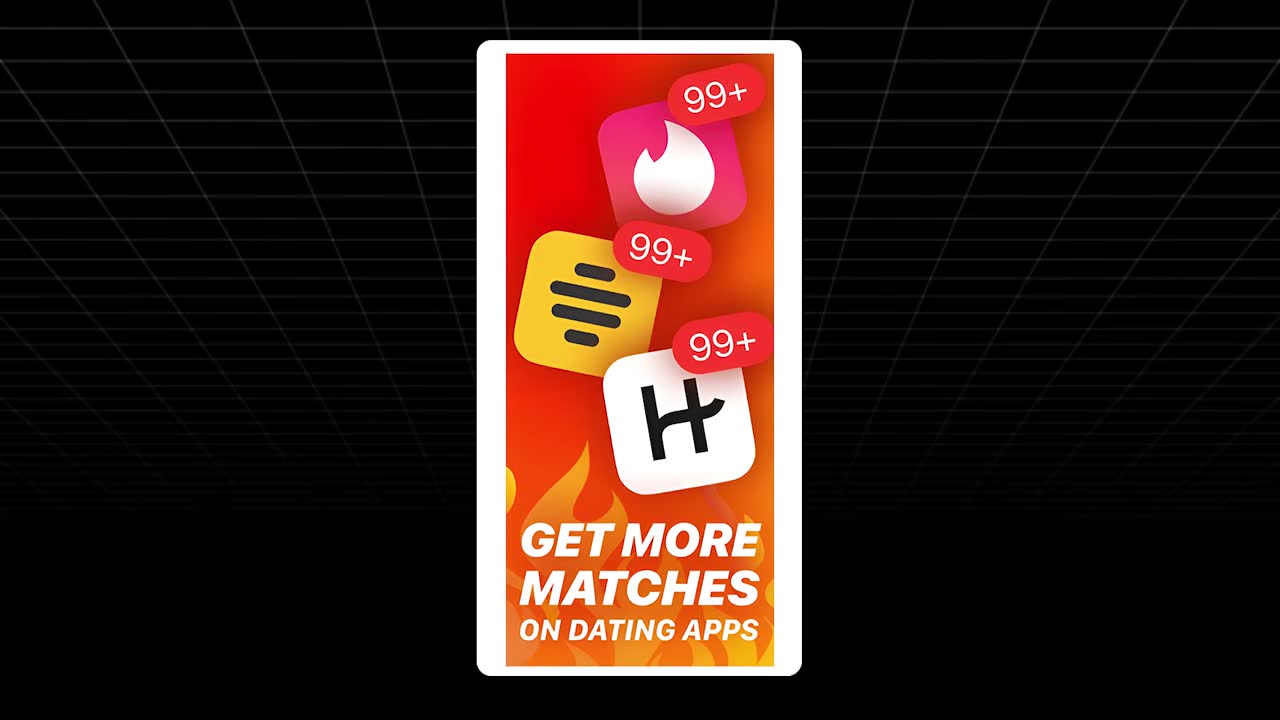
Promo graphic showing Tinder, Bumble and Hinge icons with 99+ badges: 'Get more matches on dating apps'. Charging $15 for manual reviews proved people would pay. In the first weeks, captions asked followers to DM screenshots of their profile and pay about $15 for feedback given by hand. Real payments validated the idea before any app was built.
The video itself was designed for virality and the caption carried the offer, rather than making dedicated sales videos. Daniel recommends this step to anyone testing an idea.
2The TikTok slideshow system that reached $30-40K a month
Borrowed viral text and templates made a month of posts in two hours. Slide text was taken from the most viral slideshows of a "men's improvement" account, and a spreadsheet auto-filled Figma backgrounds so each slide took seconds. One to two hours produced a month of content, and videos drew about 10K to 50K views each.
Canva served as a helper tool. It was Daniel's first month ever on TikTok, and every slide carried a plug for the app. Organic TikTok and Instagram together took Sway to about $30-40K a month.
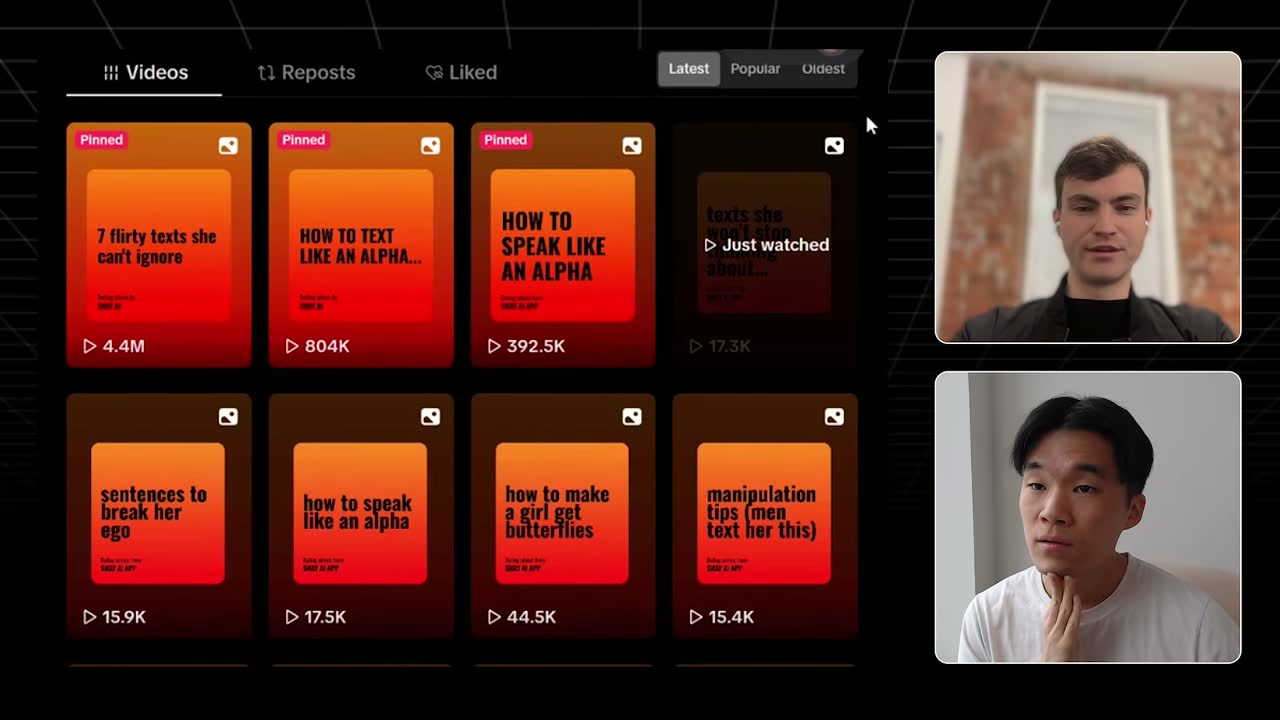
Sway AI's TikTok grid of branded slideshows, from 4.4M views on pinned posts to 15K–45K on the rest. Warm up a new account unbranded, then brand once views are reliable. Sway started with aesthetic carousels with no branding, testing a call to action on only the last slide or none at all. Once views were close to guaranteed, the whole feed switched to the orange brand theme.
Daniel believes a fully branded new account would not have gone viral at first. A heavily branded Christmas Day post, which he left unchecked for days, reached a couple million views (about 4 million per the tip) and earned $5-6K in one day, the biggest day to that point. Earlier posts with 600K views drew comments asking for the app but not huge downloads.
3Scaling with influencer ads, and why dating creators resist apps
Influencer videos run as ads to the creator's own audience scaled revenue. Organic posting capped growth, so Sway ran ads made from creator Defunct Sibling's videos on his own page, and repurposed his hard-selling organic promos as ads, which worked better. Ads took Sway from about $30-40K a month to $2M ARR, roughly four to five times the organic level.
Somewhat controversial ads that drew lots of comments performed well. At this stage the team had not yet learned to make videos specifically for ads. Daniel says growth became "a lot a lot easier" once ads began.
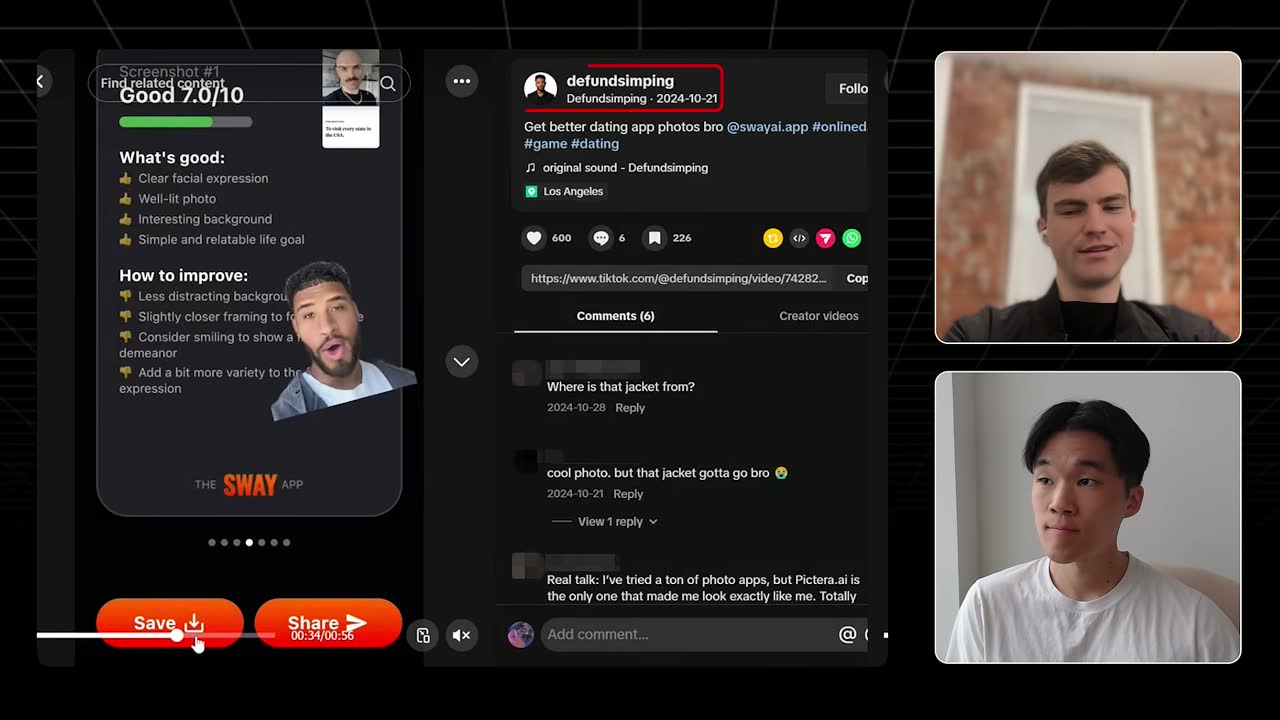
TikTok ad by influencer Defundsimping showing the Sway app rating a dating photo 7.0/10. Creators only promote apps that don't compete with what they sell. Dating coaches sell profile feedback themselves, so promoting an AI rater cannibalizes their business and few big dating influencers would work with Sway. Relying mostly on one creator left Sway short of ad creative when scaling.
By contrast, Cal AI tracks meals while fitness creators sell coaching, and there are many reasonably priced ones. Beauty creators get high-margin brand deals, which makes them costly. Quote: "we ran into like issues of not having enough creative."
4Onboarding and paywall built for high revenue per user
- 1Explain problem with videosUsers know what they're buying
- 2Ask quick multiple-choice questionsPersonalizes without slowing anyone down
- 3Show dream resultRepeated on the paywall
- 4Default to annual planCollects cash upfront to fund growth
- 5Upload profile after payingRating plus photo and prompt feedback
From Sway co-founder Daniel, podcast interview
Design onboarding as a sales funnel that raises intent to buy. Before the paywall, Sway clarifies why the user is there, labels the problem, shows the dream result other members get, personalizes with questions, and explains why the app is for them. The dream result shows again on the paywall, inside one guided path so the user never has to choose.
The first paywall showed the user's action plan and an eight-slide carousel of what the subscription includes. Daniel credits this flow for an LTV he says is higher than any other app he has seen. Sway was built by three people: Charles on iOS, Luis on marketing and operations, Daniel on design and product.
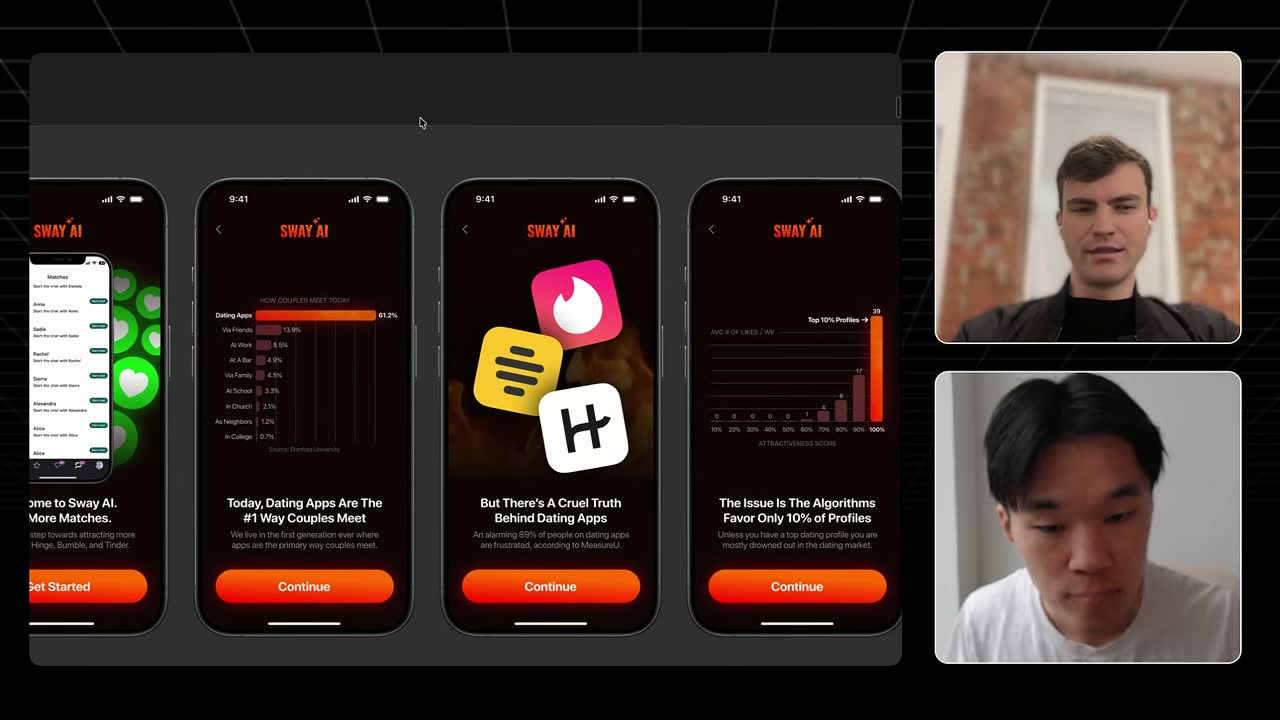
Sway AI onboarding screens: dating apps 61.2% of couples meet, algorithms favor top 10% profiles. Explain the app before asking questions, or users won't know what they're buying. Sway first jumped straight into onboarding questions, and users emailed asking what they were even subscribing for. Adding short videos on the problem and how the app solves it gave the questions context.
Each question is multiple choice and quick to answer so nobody slows down.
Sway put the aha moment after the paywall to avoid drop-off. A version that had users upload profile screenshots before the paywall risked them leaving to find screenshots and never returning. The simple onboarding requiring no effort, with the rating and feedback after payment, performed a lot better.
After paying, users upload screenshots and get a rating plus feedback on photos and prompts, similar to UMax. Prompt feedback was included because prompt tips were what went viral on Instagram. Daniel adds that a cheap lead-up to the aha moment before the paywall would be better if you can build one.
Defaulting to the annual plan collected cash upfront to fund growth. Sway's paywall defaults to annual, after Daniel noticed apps doing this had good LTV. A weekly plan was tried and produced much slower growth.
The intro claims a paywall change doubled revenue per user overnight, but this comes only from Daniel's account, with no revenue, churn or retention data shown.
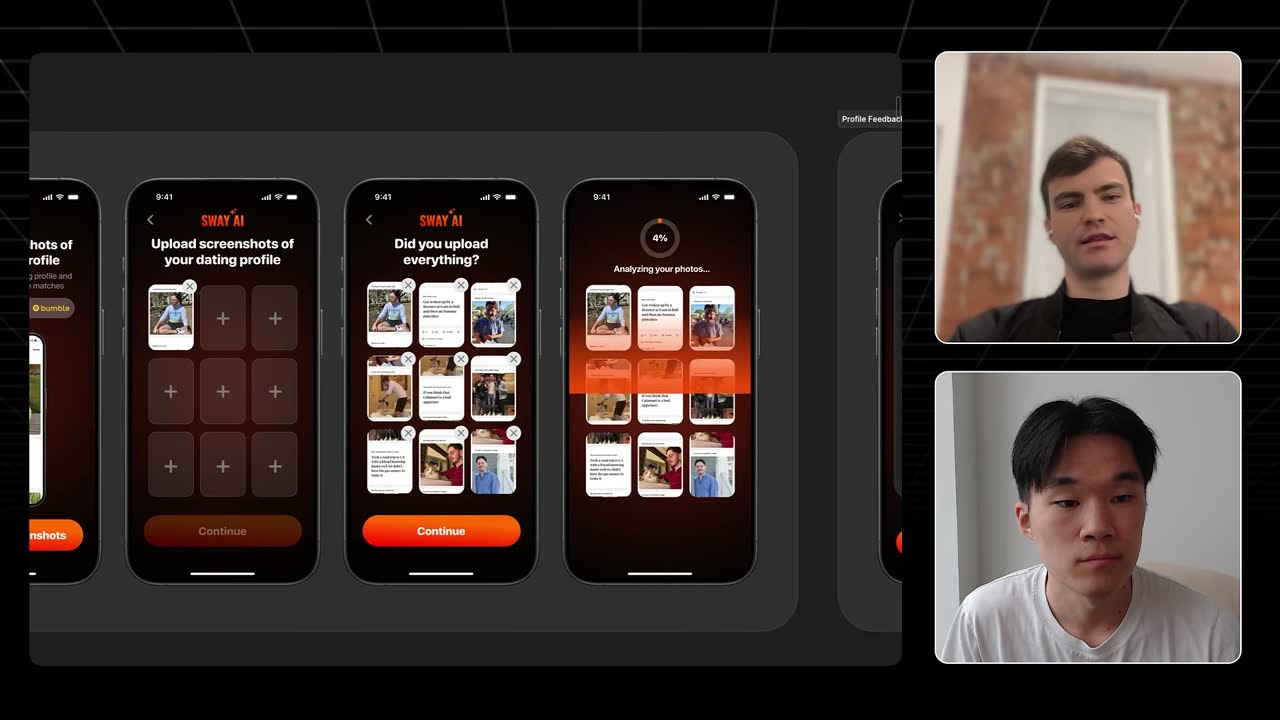
Sway AI onboarding: upload dating profile screenshots, confirm uploads, then a 4% photo analysis screen. Uncapped photo packs and credits capture whales on top of subscriptions. Sway sells AI photo packs at $14.99 and $49.99 (10 photos), and a credits upsell for users who run the flow repeatedly. Credits contribute about 11% of revenue, and photo packs are the biggest upsell.
Users ran the flow more often than the team expected, which created room for credits. Quote: "there's no cap to how much you can spend."
Private, sensitive feedback let Sway price high instead of chasing virality. Users rarely used share actions because people don't want to ask friends about their profile, so Sway optimized for monetization. This is the opposite of Cal AI, which keeps prices intentionally low.
It's not reported how much the ads cost or whether Sway's high prices limited its growth.
5Choosing the dating niche and judging new app ideas
Dating won because its users pay well and profile analysis was unclaimed. Daniel dropped an earlier AI financial advisor idea because personal finance apps are hard to monetize, while Tinder and Hinge showed dating users pay a lot. The idea came from the Hinge subreddit, where people publicly post profiles for feedback.
Posting publicly takes nerve, so a private app could reach more people. Sway mixes Riz GPT (what to say in chats) and Umax (appearance analysis), and Daniel argues a good profile matters more than texting. It launched in summer 2024 with two co-founders.
A good new app is novel, easy to demo, big-market and influencer-friendly. Daniel now picks apps that can be shown in a short video, like Cal AI's three screens (camera, loading, food detail), in markets big enough for a MyFitnessPal to exist, with affordable influencers. Influencers guarantee views and test an idea faster than hoping for a viral UGC post.
He runs the same playbook at Cal AI, which MyFitnessPal acquired. Quote: "If you can find a content niche that's very viral online and you can plug the app into it, I think those are also good ideas that you don't need an existing app to validate."

I speedran a new app from 0 to $2m/year in 6 months (here's how)
Went from zero to $2M ARR in 6 months by building an Instagram audience first and charging about $15 for manual reviews before any app existed. Organic TikTok and Instagram reached $30-40K a month, then influencer-made ads drove the rest, with an annual-default paywall, photo packs at $14.99 and $49.99, and credit upsells adding about 11% of revenue.
Sway built an Instagram audience and pre-order list before writing code. A co-founder started a new Instagram account posting "how I cook on Hinge" prompt tips that people could copy straight onto their profiles, with a pre-order link in the bio. A few posts did well within a couple of weeks.
The content aimed to be both actionable and funny, which Daniel says wins the algorithm fast. Several distribution ideas were tested and this one stuck. By launch Sway had thousands of paying customers: "we actually had distribution before we launched the product."
Promo graphic showing Tinder, Bumble and Hinge icons with 99+ badges: 'Get more matches on dating apps'. Charging $15 for manual reviews proved people would pay. In the first weeks, captions asked followers to DM screenshots of their profile and pay about $15 for feedback given by hand. Real payments validated the idea before any app was built.
The video itself was designed for virality and the caption carried the offer, rather than making dedicated sales videos. Daniel recommends this step to anyone testing an idea.
Borrowed viral text and templates made a month of posts in two hours. Slide text was taken from the most viral slideshows of a "men's improvement" account, and a spreadsheet auto-filled Figma backgrounds so each slide took seconds. One to two hours produced a month of content, and videos drew about 10K to 50K views each.
Canva served as a helper tool. It was Daniel's first month ever on TikTok, and every slide carried a plug for the app. Organic TikTok and Instagram together took Sway to about $30-40K a month.
Sway AI's TikTok grid of branded slideshows, from 4.4M views on pinned posts to 15K–45K on the rest. Warm up a new account unbranded, then brand once views are reliable. Sway started with aesthetic carousels with no branding, testing a call to action on only the last slide or none at all. Once views were close to guaranteed, the whole feed switched to the orange brand theme.
Daniel believes a fully branded new account would not have gone viral at first. A heavily branded Christmas Day post, which he left unchecked for days, reached a couple million views (about 4 million per the tip) and earned $5-6K in one day, the biggest day to that point. Earlier posts with 600K views drew comments asking for the app but not huge downloads.
Influencer videos run as ads to the creator's own audience scaled revenue. Organic posting capped growth, so Sway ran ads made from creator Defunct Sibling's videos on his own page, and repurposed his hard-selling organic promos as ads, which worked better. Ads took Sway from about $30-40K a month to $2M ARR, roughly four to five times the organic level.
Somewhat controversial ads that drew lots of comments performed well. At this stage the team had not yet learned to make videos specifically for ads. Daniel says growth became "a lot a lot easier" once ads began.
TikTok ad by influencer Defundsimping showing the Sway app rating a dating photo 7.0/10. Creators only promote apps that don't compete with what they sell. Dating coaches sell profile feedback themselves, so promoting an AI rater cannibalizes their business and few big dating influencers would work with Sway. Relying mostly on one creator left Sway short of ad creative when scaling.
By contrast, Cal AI tracks meals while fitness creators sell coaching, and there are many reasonably priced ones. Beauty creators get high-margin brand deals, which makes them costly. Quote: "we ran into like issues of not having enough creative."
Design onboarding as a sales funnel that raises intent to buy. Before the paywall, Sway clarifies why the user is there, labels the problem, shows the dream result other members get, personalizes with questions, and explains why the app is for them. The dream result shows again on the paywall, inside one guided path so the user never has to choose.
The first paywall showed the user's action plan and an eight-slide carousel of what the subscription includes. Daniel credits this flow for an LTV he says is higher than any other app he has seen. Sway was built by three people: Charles on iOS, Luis on marketing and operations, Daniel on design and product.
Sway AI onboarding screens: dating apps 61.2% of couples meet, algorithms favor top 10% profiles. Explain the app before asking questions, or users won't know what they're buying. Sway first jumped straight into onboarding questions, and users emailed asking what they were even subscribing for. Adding short videos on the problem and how the app solves it gave the questions context.
Each question is multiple choice and quick to answer so nobody slows down.
Sway put the aha moment after the paywall to avoid drop-off. A version that had users upload profile screenshots before the paywall risked them leaving to find screenshots and never returning. The simple onboarding requiring no effort, with the rating and feedback after payment, performed a lot better.
After paying, users upload screenshots and get a rating plus feedback on photos and prompts, similar to UMax. Prompt feedback was included because prompt tips were what went viral on Instagram. Daniel adds that a cheap lead-up to the aha moment before the paywall would be better if you can build one.
Defaulting to the annual plan collected cash upfront to fund growth. Sway's paywall defaults to annual, after Daniel noticed apps doing this had good LTV. A weekly plan was tried and produced much slower growth.
The intro claims a paywall change doubled revenue per user overnight, but this comes only from Daniel's account, with no revenue, churn or retention data shown.
Sway AI onboarding: upload dating profile screenshots, confirm uploads, then a 4% photo analysis screen. Uncapped photo packs and credits capture whales on top of subscriptions. Sway sells AI photo packs at $14.99 and $49.99 (10 photos), and a credits upsell for users who run the flow repeatedly. Credits contribute about 11% of revenue, and photo packs are the biggest upsell.
Users ran the flow more often than the team expected, which created room for credits. Quote: "there's no cap to how much you can spend."
Private, sensitive feedback let Sway price high instead of chasing virality. Users rarely used share actions because people don't want to ask friends about their profile, so Sway optimized for monetization. This is the opposite of Cal AI, which keeps prices intentionally low.
It's not reported how much the ads cost or whether Sway's high prices limited its growth.
Dating won because its users pay well and profile analysis was unclaimed. Daniel dropped an earlier AI financial advisor idea because personal finance apps are hard to monetize, while Tinder and Hinge showed dating users pay a lot. The idea came from the Hinge subreddit, where people publicly post profiles for feedback.
Posting publicly takes nerve, so a private app could reach more people. Sway mixes Riz GPT (what to say in chats) and Umax (appearance analysis), and Daniel argues a good profile matters more than texting. It launched in summer 2024 with two co-founders.
A good new app is novel, easy to demo, big-market and influencer-friendly. Daniel now picks apps that can be shown in a short video, like Cal AI's three screens (camera, loading, food detail), in markets big enough for a MyFitnessPal to exist, with affordable influencers. Influencers guarantee views and test an idea faster than hoping for a viral UGC post.
He runs the same playbook at Cal AI, which MyFitnessPal acquired. Quote: "If you can find a content niche that's very viral online and you can plug the app into it, I think those are also good ideas that you don't need an existing app to validate."
More in Social & Dating
 Social & Dating
A social network built around connecting people and sharing.



 58 sources · 128 tips
 Social & Dating
A photo and video sharing social app built around creators, Stories, Reels and feeds.
38 sources · 79 tips Social & Dating
TikTok
A short-form video app where creators post content and can earn through a revenue-sharing program.


 35 sources · 75 tips
 Social & Dating
A professional networking platform for jobs, hiring and career content.
15 sources · 55 tips Social & Dating
Tinder
A dating app with tiered subscriptions plus boosts, Super Likes and other in-app purchases.
11 sources · 47 tips Social & Dating
Snap
The company behind Snapchat, a camera-first messaging app popular with teens.
6 sources · 29 tips Social & Dating
Discord
A chat and voice platform for gaming friends and communities.
10 sources · 29 tips Social & Dating
Snapchat
A camera-first messaging and social app built around close friends, Stories and AR lenses.
10 sources · 23 tips