 Caddie
The bottom line
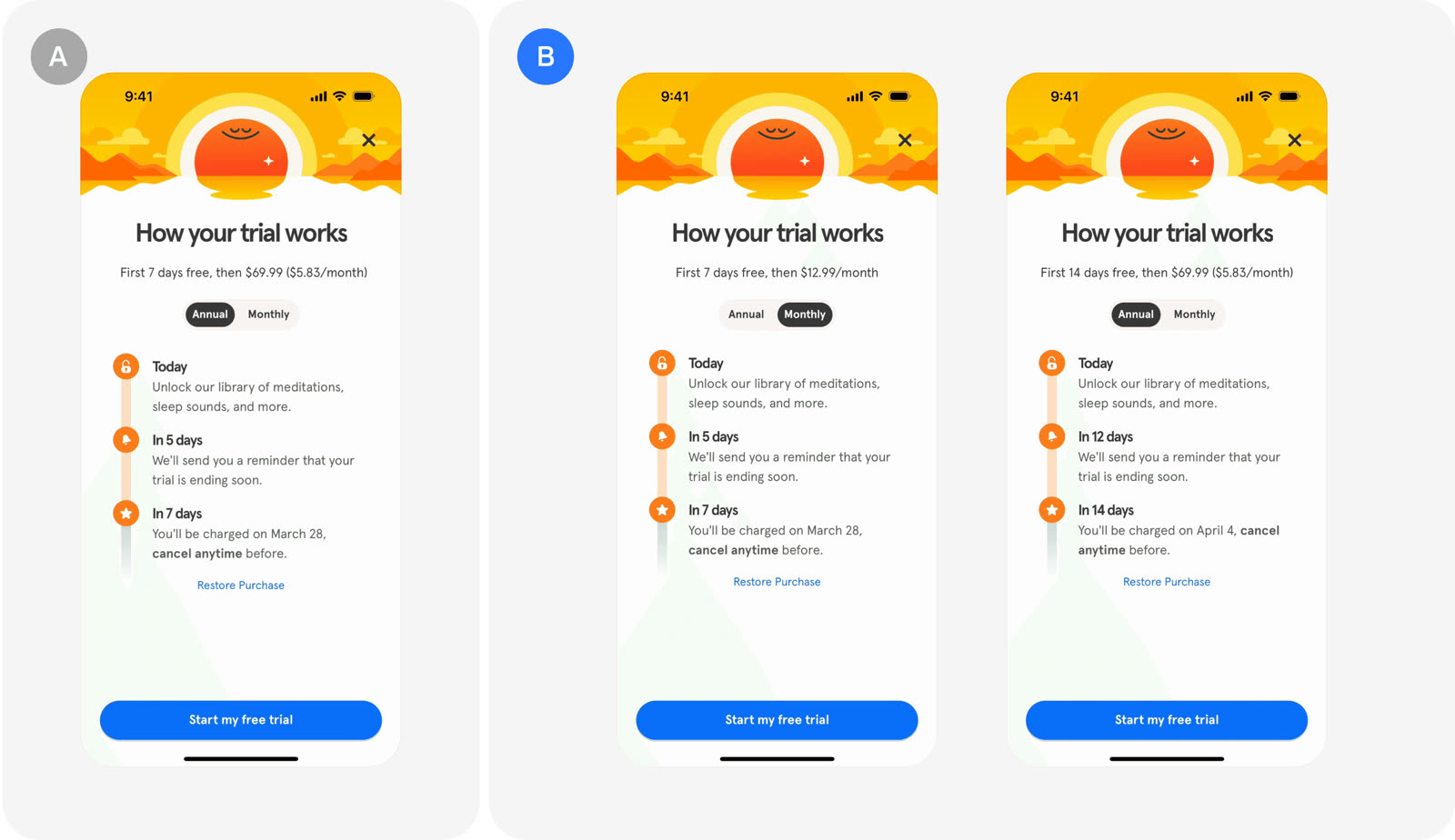
Headspace tied a 7-day free trial to its monthly plan and a 14-day trial to its annual plan, and conversions rose by double digits. The longer annual trial made that plan more appealing, even though revenue came in later.
Key takeaways
- Different trial lengths for each plan beat a single trial length. The final design matched 7 days to monthly and 14 days to annual.
- Headspace tested 7, 14 and 30 day trials before settling on the split.
- A longer trial on the annual plan makes it more attractive. It gives annual a visible perk over monthly.
- Conversions rose by double digits. This happened even though immediate revenue was delayed.
The test
| Monthly | Annual | |
|---|---|---|
| Free trial | 7 days | 14 days |
| Role of trial | Standard try-out | Visible perk over monthly |
| First payment | After day 7 | After day 14 |
Headspace searched for the trial length that would maximize conversions on its paywall.
- Three trial lengths were compared: 7, 14 and 30 days.
- The goal was to find the best duration for conversions.
- The final version set the trial length by subscription type.
- Monthly got a 7-day trial.
- Annual got a 14-day trial.
- Pairing the longer trial with annual was meant to make that option more appealing.
The result
The split trial raised conversions by double digits, at the cost of slower revenue.
- Conversions grew by a double-digit share.
- Immediate revenue was delayed because users start paying later.
In the growth library
Headspace, Paywall & free trial test. Headspace tested free trial lengths of 7, 14 and 30 days and landed on tying trial length to the plan: 7 days for monthly, 14 days for annual. The change produced a double-digit increase in conversions even though revenue arrived later.
Lessons that draw on this:
More from  abtest.design · The whole library, and ask it anything