Do Habit
A habit tracking app, formerly called Done, acquired as part of a bundle.
Do Habit (formerly Done) was bought in a bundle of five or six under-monetized apps, then fixed with better paywalls and subscriptions, paying back within 12 to 18 months. Heavy ad spend around New Year put it at number one in the US App Store on January 2 and 3 two years running, ahead of TikTok and Chrome. Lesson: fix monetization first, then time ad spend to the New Year window.
- Dead daySkip spending
- Test spend$5k to $10k a day
- Conversion jumps againQuality rises, spend follows
- Push hardest10x spend if early signals are good
- Number one free appAhead of TikTok and Chrome, two years running
From Ryan Thorpe interview
What was said about Do Habit
Buying an under-monetized app and fixing its paywall paid back fast. Ryan Thorpe's team bought Done, now Do Habit, as part of a bundle with five or six other apps. Because it was "quite undermonetized," better paywalls and in-app subscriptions lifted revenue, and the purchase paid for itself within 12 to 18 months.
Ryan reasoned that the same money spent on ads was less certain to come back, while owning the app kept its user base and tech, which left an exit option open. The team repeated the model across 30 to 35 apps from 2020 to 2025.
Calendar-timed ad spend around New Year took Do Habit to number one. After heavy spend in the New Year window, Done hit number one free app in the US App Store on January 2 and 3, two years in a row, ahead of TikTok and Google Chrome. About 75% of the yearly ad budget across the portfolio went into the first month of the year.
The playbook: December 25 is dead, December 26 to 28 is for testing at $5k to $10k a day, and conversion quality jumps again from December 28 to 30. Push hardest on the Sunday before people return to work, and Sunday to Tuesday plus the first days of each month convert best for self-improvement apps. "Saturday night into Sunday morning is where you just, you know, 10x the spend if your metrics are showing good good signals early."
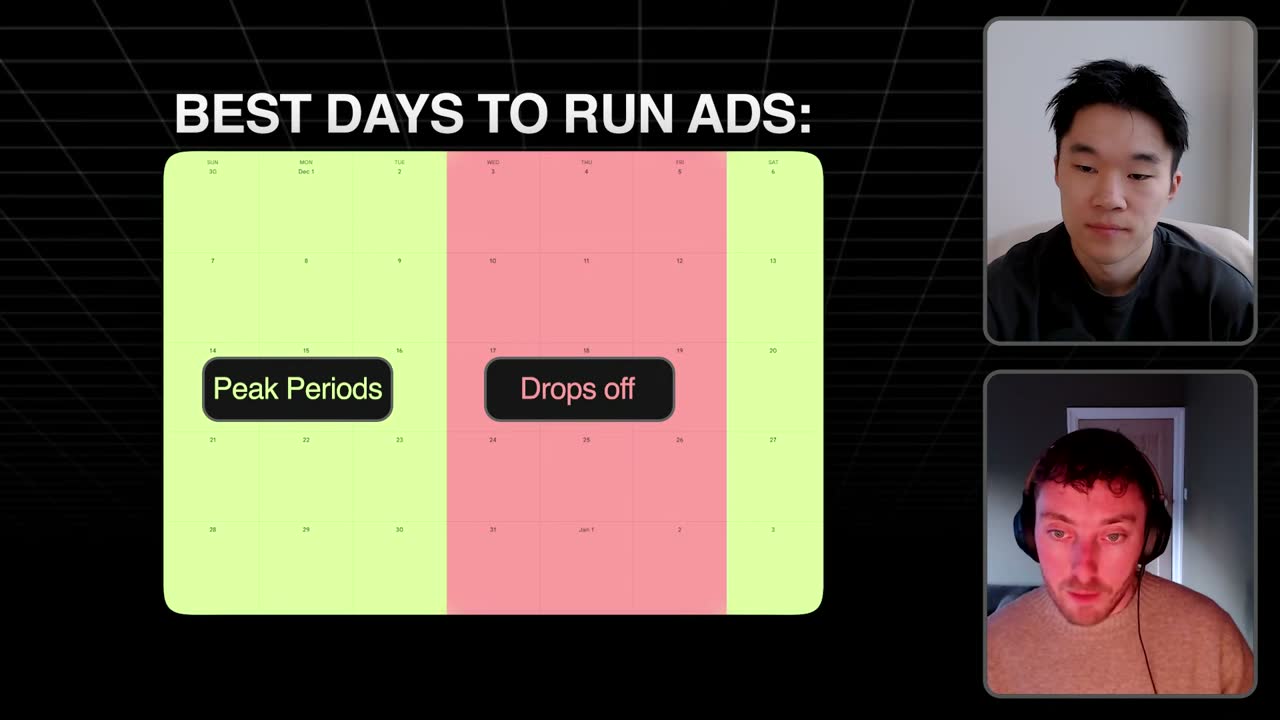
Calendar showing Sunday–Tuesday as peak ad days, with Wednesday–Friday dropping off. A brand account posting creator videos fed a tiered ad test ladder. The do.habits account posted an endless stream of same-style creator videos; any that gained traction were boosted with ads, then run as Spark Ads from the creator's own account. Each video got a $10 to $20 test, winners moved to $100 to $500 campaigns, and the top one or two evergreens took 90% of spend.
Videos came from about 250 regular in-house creators working to strict briefs, paid $30 to $40 a video rising to about $100 for reliable ones. The whole system was run by one founder, one media buyer and one head of content.

Meet The Guy Dominating The App Store
Bought with five or six other apps as an under-monetized bundle, then fixed with better paywalls and subscriptions, paying back within 12 to 18 months. It hit number one in the US App Store on January 2 and 3 two years in a row after heavy ad spend, ahead of TikTok and Chrome.
Buying an under-monetized app and fixing its paywall paid back fast. Ryan Thorpe's team bought Done, now Do Habit, as part of a bundle with five or six other apps. Because it was "quite undermonetized," better paywalls and in-app subscriptions lifted revenue, and the purchase paid for itself within 12 to 18 months.
Ryan reasoned that the same money spent on ads was less certain to come back, while owning the app kept its user base and tech, which left an exit option open. The team repeated the model across 30 to 35 apps from 2020 to 2025.
Calendar-timed ad spend around New Year took Do Habit to number one. After heavy spend in the New Year window, Done hit number one free app in the US App Store on January 2 and 3, two years in a row, ahead of TikTok and Google Chrome. About 75% of the yearly ad budget across the portfolio went into the first month of the year.
The playbook: December 25 is dead, December 26 to 28 is for testing at $5k to $10k a day, and conversion quality jumps again from December 28 to 30. Push hardest on the Sunday before people return to work, and Sunday to Tuesday plus the first days of each month convert best for self-improvement apps. "Saturday night into Sunday morning is where you just, you know, 10x the spend if your metrics are showing good good signals early."
Calendar showing Sunday–Tuesday as peak ad days, with Wednesday–Friday dropping off. A brand account posting creator videos fed a tiered ad test ladder. The do.habits account posted an endless stream of same-style creator videos; any that gained traction were boosted with ads, then run as Spark Ads from the creator's own account. Each video got a $10 to $20 test, winners moved to $100 to $500 campaigns, and the top one or two evergreens took 90% of spend.
Videos came from about 250 regular in-house creators working to strict briefs, paid $30 to $40 a video rising to about $100 for reliable ones. The whole system was run by one founder, one media buyer and one head of content.
More in Productivity
 Productivity
Notion
A connected workspace for docs, projects and AI agents, built around blocks.



 16 sources · 74 tips
 Productivity
Grammarly
A writing assistant that checks grammar, tone and clarity across apps and browsers.
 10 sources · 43 tips
 Productivity
Opal
A screen time app that helps people block distracting apps and reduce phone use.
3 sources · 36 tips Productivity
Dropbox
A cloud storage and file sharing service for individuals and teams.
 11 sources · 27 tips
 Productivity
Gamma
An AI tool for making presentations, documents and websites without fixed slides.
4 sources · 39 tips Productivity
Superhuman
A fast, keyboard-driven email app for high performers, now with AI features and team collaboration.
10 sources · 29 tips Productivity
Gmail
A free web-based email service from Google with searchable storage.
7 sources · 11 tips Productivity
Calendly
A scheduling tool that lets people book meetings by sharing a link to their availability.
5 sources · 22 tips