
Opal
A screen time app that helps people block distracting apps and reduce phone use.
Opal lifted trial sign-ups from downloads from 7% to 17% by showing users their projected lifetime phone time before the offer. After hitting $10M ARR with about 11 people, it went freemium: paid penetration fell from 20% to 9%, yet it passed 1M daily users from 10M+ downloads. Lesson: time asks to peak motivation, and trade conversion for organic growth and retention.
- $10M ARR, about 11 people
- Paid penetration about 20%
- User growth slowed
- Paid penetration fell to 9%
- Organic growth surged
- 1M+ daily users from 10M downloads
- Students now two thirds of users
Reach won; net revenue effect not shown
From Schlenker (Opal) on a podcast
What was said about Opal
1Going freemium after $10M ARR
Opal traded a hard paywall for reach once user growth stalled. Opal hit $10M ARR with about 11 people on a hard paywall, but user growth slowed. The team stopped focusing on revenue and asked what product could reach a billion users.
Schlenker argues that apps built around onboarding and a hard paywall are short-term arbitrage. He says freemium suits a billion-user goal, while a lifestyle business is a different aim.
Accept lower paid conversion when free users drive organic growth. After going truly freemium, paid penetration (paying subscribers as a share of monthly active users) fell from about 20% to 9%. Organic growth surged and Opal passed 1 million daily users from just over 10 million downloads.
Schlenker says the payback is tenfold in the long run and that revenue followed, but no figures are given, so the net revenue effect is not shown. "It's a short-term, you know, scary drop, but what happens in the long term is that payback is it pays back tenfold."
A free tier only pays off if free users would recommend it. Ask whether a non-paying user would recommend the app, and give away more if not. A free tier that feels like a capped trial loses the word-of-mouth that makes freemium work.
"If you want the freemium dynamic to really pay out, you need to make sure that the free users are recommending the app."
Opal tested one to four free blocks and settled on three. Opal caps the feature power users value most: blocks, meaning rules like social media blocked 9:00 to 10:00 on weekdays or Instagram opened only 10 times a day. Three free blocks give a full experience while power users still pay for more.
Each variant was judged on two measures together: LTV of installs and retention across free plus paid users, looking for a sweet spot where both rise. Schlenker calls finding it really hard. One block was "pretty restrictive."
Free access opened segments that would never pay upfront. The first segment was professionals who value saving time. Freemium brought in students, now about two thirds of daily users, who share the app with peers and parents.
Network effects run between friends, students and families: a teenager may recommend Opal to parents or the other way around. Students then pulled in schools as a third segment.
2Opal for schools
The schools product came from student demand, not a plan. Harvard-Westlake in Los Angeles emailed Opal after its students, asked how to handle a phone ban, named Opal, which they already used. Schlenker had only imagined working with colleges, never high schools.
It began with one school and is now scaling across many US high schools.
A "bell-to-bed" policy keeps students using Opal after class. On campus, banned apps are blocked while approved ones still work, such as texting parents, ChatGPT, a specific physics app or a calculator. After school, many students keep it for sleep schedules, focus timers and study.
Schools pay a per-student fee priced below alternatives, because the real value to Opal is distribution to families and communities.
3Retention as the moat, and streaks
Retention is the only lasting moat for a consumer app. Opal reports early retention on par with or better than Duolingo, Spotify and Strava, with over a million daily users from just over 10 million downloads.
No actual retention rates are given. "Retention really really is the only way to have like lasting value. It's the only kind of real moat."
A brand-designed streak was Opal's biggest win of the year. Opal built its own streak counting focus time, shown as an animated flame rather than an emoji, with Opal gems earned at milestones. Schlenker names it the biggest win of the last year for retention and growth.
He notes streaks fail in many apps; this one works because it fits the brand. It was not tested against an alternative.
4Brand and product soul
Teams create product soul that AI cannot copy. AI easily builds a function like a note app or calendar, but not the emotional pull that makes people connect with an app. Copycats can reproduce features, not taste, so the category leader keeps momentum.
Schlenker calls the one-person, AI-built billion-dollar company "a lie" and says a company is built in order: team, brand, retention, then AI. "You can't vibe code a brand."
Small magical moments are worth weeks of work. Opal built a tap-to-crack gemstone reveal for focus milestones. It is the most loved interaction in the app and people talk about it.
It took weeks against more urgent features and bug fixes and cannot be measured directly. Schlenker describes such details as ones that "feel unreasonably sophisticated."
Opal started from a manifesto and named itself after it. A written manifesto about attention-stealing technology came before any product. The name was chosen as the opposite of a phone: a calming gemstone versus glass and aluminum.
The gemstone theme runs through the app, its rewards and its marketing.
An unattributable billboard still had brand impact. Opal bought a New York billboard reading "Scrolling Kills." It had no impact on downloads or revenue, but a New York school head who saw it was more comfortable signing.
Searching the phrase now surfaces Opal. Schlenker calls it a half failure.
5The lifetime phone-time onboarding test
From Schlenker (Opal) on a podcast
Showing years of life lost to the phone lifted trial sign-ups. Opal projected how many years a user would spend on their phone over a lifetime and how many they could save, then asked for the trial. Over several iterations, trial sign-ups from downloads rose from 7% to 17%.
The projection creates a peak-motivation moment so the trial ask lands when commitment is strongest, similar to the commitment effect of gym memberships. The framing also drew users who were ready to engage after the trial started.
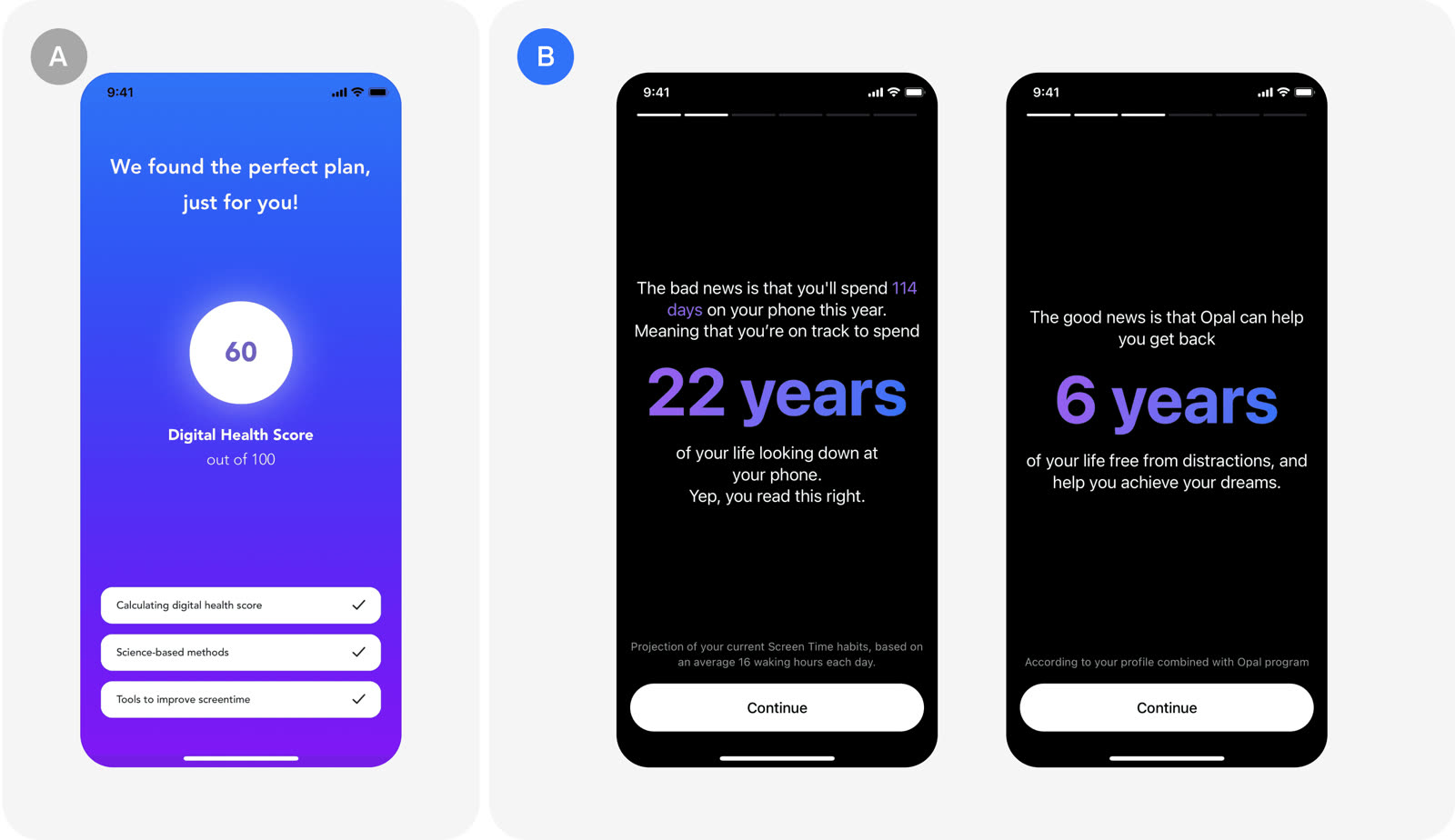
Version A and version B as Opal tested them.
6Organic videos and creator channels
Opal licensed a user's organic video and ran it as an ad. A user inspired by Opal posted a video that already looked like an Opal ad. Opal licensed it and ran it with only its logo attached; it has dozens of millions of views.
It still runs as a top paid creative a year or two later. "It is the organic video with the Opal logo attached. That's it."
Opal hired a user to run a brand-aligned creator channel. Opal spotted a user mentioning the app on TikTok and hired her to build Olivia Unplugged, an educational channel powered by Opal. It grew from zero to about 700,000 followers across platforms and millions of views in a few months.
Topics include making friends offline and building a bedtime routine, with Opal mentioned in videos and linked in bio. Many filmmakers and designers already use Opal, which helps recruit creators.
7AI and competition in screen time apps
Use AI only to deliver more of the app's core value. Every consumer app will add AI; the test is whether it is on the user's side. Fancy features draw early adopters, but lasting value comes from improving the core reason people use the app.
Server-side AI adds marginal cost, so the value created must exceed the cost to run it. "If your user wins, you win."
Copycats educate the market; the opportunity is non-users. Of 5 billion smartphone owners, only a few dozen million have used a screen time app, and about eight in ten people say they spend too much time on their phone. Many balk at an app that blocks apps.
Opal is building toward an app with no setup that coaches rather than restricts, which a prompt to copy Opal won't produce. Schlenker points to Duolingo, at over $1B a year, keeping its lead despite copies.

Driving motivation: Opal's A/B test
Raised trial sign-ups from downloads from 7% to 17% over several iterations by projecting how many years of life users would spend on their phone and how many they could save. The motivating moment worked like gym membership commitment and drew users ready to engage.
Showing years of life lost to the phone lifted trial sign-ups. Opal projected how many years a user would spend on their phone over a lifetime and how many they could save, then asked for the trial. Over several iterations, trial sign-ups from downloads rose from 7% to 17%.
The projection creates a peak-motivation moment so the trial ask lands when commitment is strongest, similar to the commitment effect of gym memberships. The framing also drew users who were ready to engage after the trial started.
Version A and version B as Opal tested them.

Why Opal Stopped Chasing Revenue to Build a Billion-User App – Kenneth Schlenker
Hit $10M ARR with about 11 people, then went freemium: paid penetration fell from 20% to 9% but organic growth surged, with over 1M daily users from 10M+ downloads. Students are two thirds of daily users, and a schools product grew from student demand; streaks were the biggest win of the year.
Opal traded a hard paywall for reach once user growth stalled. Opal hit $10M ARR with about 11 people on a hard paywall, but user growth slowed. The team stopped focusing on revenue and asked what product could reach a billion users.
Schlenker argues that apps built around onboarding and a hard paywall are short-term arbitrage. He says freemium suits a billion-user goal, while a lifestyle business is a different aim.
Accept lower paid conversion when free users drive organic growth. After going truly freemium, paid penetration (paying subscribers as a share of monthly active users) fell from about 20% to 9%. Organic growth surged and Opal passed 1 million daily users from just over 10 million downloads.
Schlenker says the payback is tenfold in the long run and that revenue followed, but no figures are given, so the net revenue effect is not shown. "It's a short-term, you know, scary drop, but what happens in the long term is that payback is it pays back tenfold."
A free tier only pays off if free users would recommend it. Ask whether a non-paying user would recommend the app, and give away more if not. A free tier that feels like a capped trial loses the word-of-mouth that makes freemium work.
"If you want the freemium dynamic to really pay out, you need to make sure that the free users are recommending the app."
Opal tested one to four free blocks and settled on three. Opal caps the feature power users value most: blocks, meaning rules like social media blocked 9:00 to 10:00 on weekdays or Instagram opened only 10 times a day. Three free blocks give a full experience while power users still pay for more.
Each variant was judged on two measures together: LTV of installs and retention across free plus paid users, looking for a sweet spot where both rise. Schlenker calls finding it really hard. One block was "pretty restrictive."
Free access opened segments that would never pay upfront. The first segment was professionals who value saving time. Freemium brought in students, now about two thirds of daily users, who share the app with peers and parents.
Network effects run between friends, students and families: a teenager may recommend Opal to parents or the other way around. Students then pulled in schools as a third segment.
The schools product came from student demand, not a plan. Harvard-Westlake in Los Angeles emailed Opal after its students, asked how to handle a phone ban, named Opal, which they already used. Schlenker had only imagined working with colleges, never high schools.
It began with one school and is now scaling across many US high schools.
A "bell-to-bed" policy keeps students using Opal after class. On campus, banned apps are blocked while approved ones still work, such as texting parents, ChatGPT, a specific physics app or a calculator. After school, many students keep it for sleep schedules, focus timers and study.
Schools pay a per-student fee priced below alternatives, because the real value to Opal is distribution to families and communities.
Retention is the only lasting moat for a consumer app. Opal reports early retention on par with or better than Duolingo, Spotify and Strava, with over a million daily users from just over 10 million downloads.
No actual retention rates are given. "Retention really really is the only way to have like lasting value. It's the only kind of real moat."
A brand-designed streak was Opal's biggest win of the year. Opal built its own streak counting focus time, shown as an animated flame rather than an emoji, with Opal gems earned at milestones. Schlenker names it the biggest win of the last year for retention and growth.
He notes streaks fail in many apps; this one works because it fits the brand. It was not tested against an alternative.
Teams create product soul that AI cannot copy. AI easily builds a function like a note app or calendar, but not the emotional pull that makes people connect with an app. Copycats can reproduce features, not taste, so the category leader keeps momentum.
Schlenker calls the one-person, AI-built billion-dollar company "a lie" and says a company is built in order: team, brand, retention, then AI. "You can't vibe code a brand."
Small magical moments are worth weeks of work. Opal built a tap-to-crack gemstone reveal for focus milestones. It is the most loved interaction in the app and people talk about it.
It took weeks against more urgent features and bug fixes and cannot be measured directly. Schlenker describes such details as ones that "feel unreasonably sophisticated."
Opal started from a manifesto and named itself after it. A written manifesto about attention-stealing technology came before any product. The name was chosen as the opposite of a phone: a calming gemstone versus glass and aluminum.
The gemstone theme runs through the app, its rewards and its marketing.
An unattributable billboard still had brand impact. Opal bought a New York billboard reading "Scrolling Kills." It had no impact on downloads or revenue, but a New York school head who saw it was more comfortable signing.
Searching the phrase now surfaces Opal. Schlenker calls it a half failure.
Opal licensed a user's organic video and ran it as an ad. A user inspired by Opal posted a video that already looked like an Opal ad. Opal licensed it and ran it with only its logo attached; it has dozens of millions of views.
It still runs as a top paid creative a year or two later. "It is the organic video with the Opal logo attached. That's it."
Opal hired a user to run a brand-aligned creator channel. Opal spotted a user mentioning the app on TikTok and hired her to build Olivia Unplugged, an educational channel powered by Opal. It grew from zero to about 700,000 followers across platforms and millions of views in a few months.
Topics include making friends offline and building a bedtime routine, with Opal mentioned in videos and linked in bio. Many filmmakers and designers already use Opal, which helps recruit creators.
Use AI only to deliver more of the app's core value. Every consumer app will add AI; the test is whether it is on the user's side. Fancy features draw early adopters, but lasting value comes from improving the core reason people use the app.
Server-side AI adds marginal cost, so the value created must exceed the cost to run it. "If your user wins, you win."
Copycats educate the market; the opportunity is non-users. Of 5 billion smartphone owners, only a few dozen million have used a screen time app, and about eight in ten people say they spend too much time on their phone. Many balk at an app that blocks apps.
Opal is building toward an app with no setup that coaches rather than restricts, which a prompt to copy Opal won't produce. Schlenker points to Duolingo, at over $1B a year, keeping its lead despite copies.

How Opal Reached $10M ARR with 11 Employees
Reached $10M ARR with 11 people by building on Apple's Screen Time API, using a hard paywall and paid ads tuned to day-8 ROAS. It then opened a free tier for students, now has 24 staff, and shipped Android, sleep and a schools product.
More in Productivity
 Productivity
Notion
A connected workspace for docs, projects and AI agents, built around blocks.

 16 sources · 74 tips
 Productivity
Grammarly
A writing assistant that checks grammar, tone and clarity across apps and browsers.
10 sources · 43 tips Productivity
Dropbox
A cloud storage and file sharing service for individuals and teams.
 11 sources · 27 tips
 Productivity
Gamma
An AI tool for making presentations, documents and websites without fixed slides.
4 sources · 39 tips Productivity
Superhuman
A fast, keyboard-driven email app for high performers, now with AI features and team collaboration.
10 sources · 29 tips Productivity
Gmail
A free web-based email service from Google with searchable storage.
7 sources · 11 tips Productivity
Calendly
A scheduling tool that lets people book meetings by sharing a link to their availability.
5 sources · 22 tips Productivity
Evernote
A note-taking app positioned as a personal second brain across devices.
 4 sources · 10 tips