 Caddie
The bottom line
Highlighting the free delivery offer for orders over £50 on Clarks product pages raised conversions by 2.6%. Many users did not know about the benefit, so making it visible helped more of them complete orders.
Key takeaways
- Showing the free delivery policy prominently increased conversions. The variation beat the original page.
- Conversions rose by 2.6%.
- Many users did not know about the free delivery threshold. Hidden benefits cannot influence buying decisions.
- The offer applied to orders over £50.
- The idea came from a large experiment database. Past test insights pointed to delivery information as a lever.
The test setup
Clarks moved free delivery where shoppers actually look
Clarks tested a product and delivery page that emphasized free delivery against the original version.
- The goal was to increase completed orders.
- The free delivery policy for orders over £50 was a benefit many users were unaware of.
- The category of the test is checkout and sales.
- The hypothesis was that prominent delivery information on product pages would change user behavior.
- The hypothesis drew on insights from a large experiment database.
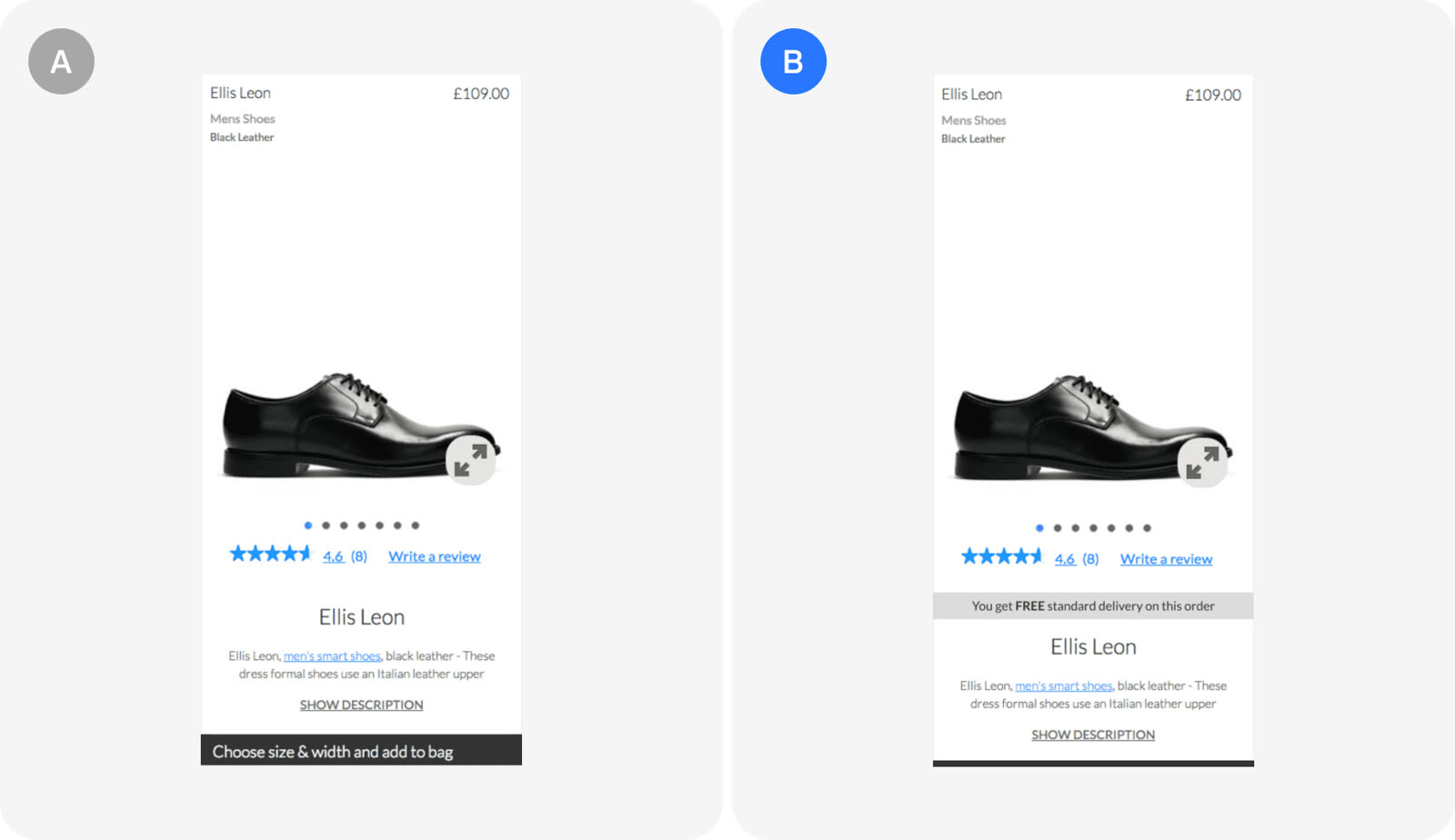
The result
Same offer, made visible, lifted conversions 2.6%
| Original | Variation | |
|---|---|---|
| Free delivery over £50 | Offered | Offered |
| Shown on product page | Not prominent | Prominent |
| Conversions | Baseline | +2.6% |
The variation that emphasized free delivery lifted conversions by 2.6%.
- The emphasized offer outperformed the original page.
- The measured impact was a 2.6% increase in conversions.
- The test was first written up at conversion.com as a Clarks case study.
In the growth library
Clarks, Checkout & sales test. Clarks showed that making a free delivery policy visible on product pages can lift completed orders. The test raised conversions by 2.6%.
Lessons that draw on this:
More from  abtest.design · The whole library, and ask it anything