 Caddie
The bottom line
Showing the amount of each individual investment, not just total portfolio value, led 12% more Stash users to keep Auto-Stash running 8 months later. Clearer insight into each investment helps keep users engaged with automatic saving.
Key takeaways
- Displaying individual investment amounts improved retention of Auto-Stash. Users saw clearer detail on each investment instead of only a total.
- 12% more users kept automatically saving 8 months later.
- The test targeted engagement with the Auto-Stash schedule. Keeping the feature active is what sustains regular saving.
- The comparison was individual investment amounts versus the total portfolio value alone.
The test
| Total value only | Each investment's amount | |
|---|---|---|
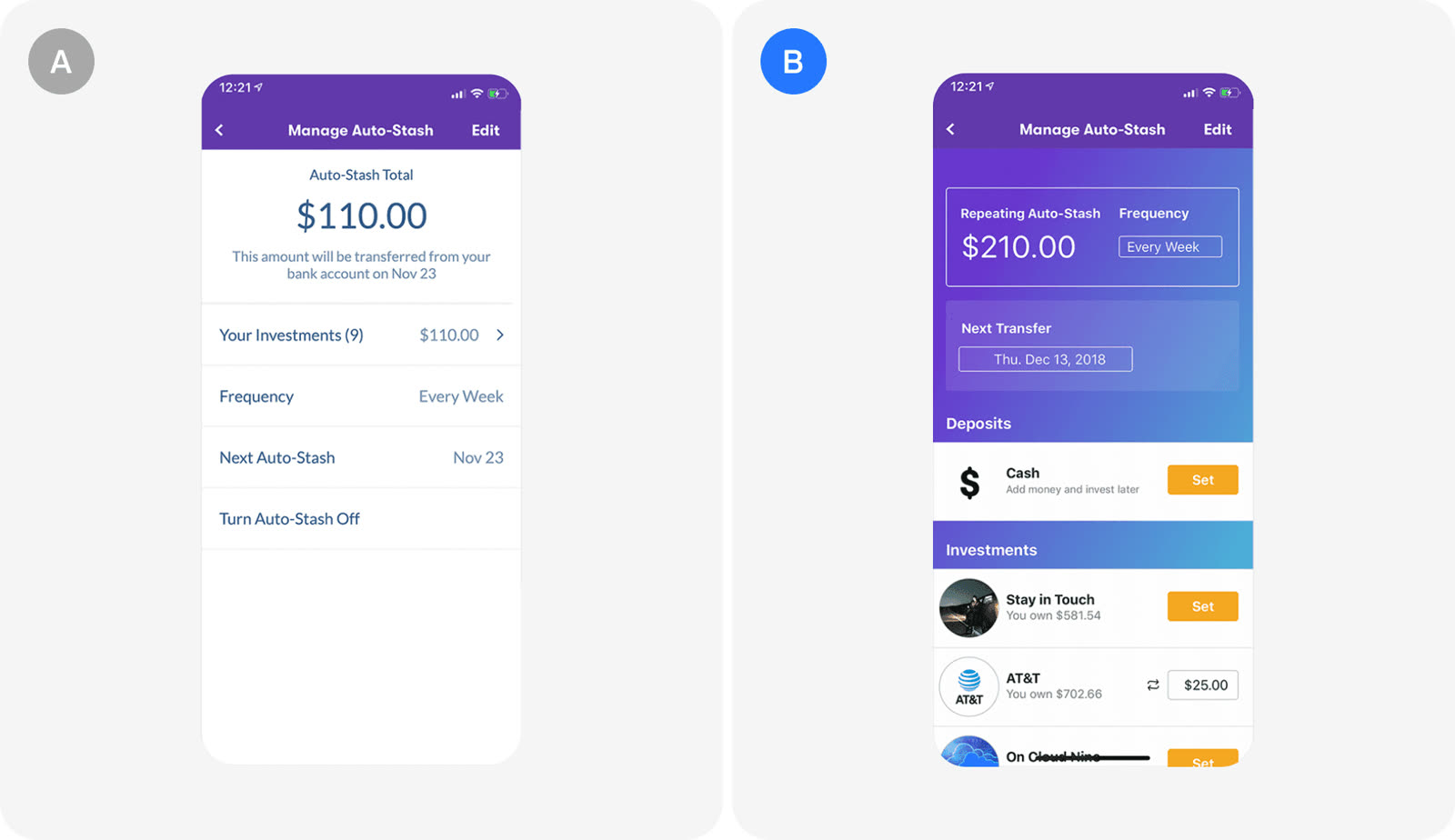
| What users see | One portfolio total | Amount per investment |
| Insight per investment | None | Clear |
| Auto-Stash still on at 8 months | Baseline | +12% more users |
Stash tested whether showing each investment's amount would keep users on their Auto-Stash schedule.
- The new design gave clearer insight into each investment.
- The alternative showed only the total portfolio value.
- The goal was to raise user engagement with the Auto-Stash schedule.
The result
The new display produced a lasting gain in users who kept automatic saving on.
- 12% more users kept automatically saving.
- The effect was still visible 8 months later.
- The test falls under the user engagement and retention category.
In the growth library
Stash, User engagement & retention test. Showing each investment's individual amount, not only the total portfolio value, helped users stay on Auto-Stash, the automatic saving feature. The change led to 12% more users still saving automatically 8 months later.
Lessons that draw on this:
More from  abtest.design · The whole library, and ask it anything