
Silicon Valley Product Group
Marty Cagan's book on building product teams, now in its second edition.
Inspired's first edition (2008) listed only value, usability and feasibility, buried viability, and barely covered product leadership. Many companies that read it set up teams and expected success. Cagan fixed viability in the second edition ten years later. Lesson: treat viability as a full risk, pair empowered teams with strong leadership and written strategy, and don't let process or frameworks replace thinking.
- Value risk
- Usability risk
- Feasibility risk
- Viability buried
- Value risk
- Usability risk
- Feasibility risk
- Viability a full risk
Viability became a full product risk
From Marty Cagan on Inspired, 1st vs 2nd edition
What was said about Silicon Valley Product Group
Inspired's first edition buried business viability; the second edition made it a full risk. The 2008 first edition listed only value, usability and feasibility as product risks, with viability buried. Cagan fixed this in the second edition ten years later and now says, "I completely understated the importance of business viability."
Viability means the business can afford to market, sell and service the solution, and that it is legal, compliant, private, safe and ethical. Cagan says his developer-tools career hid the gap, because viability is much simpler there than for most products, and especially than for AI products.
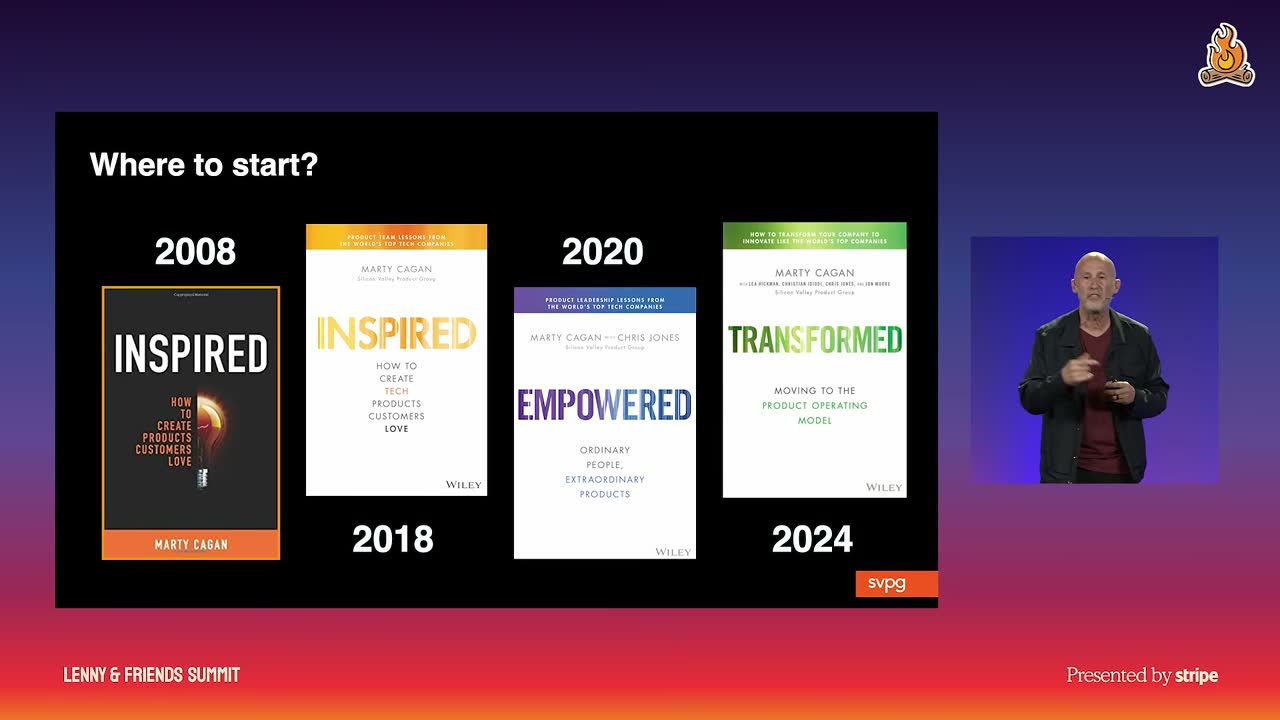
Marty Cagan's four books: Inspired (2008, 2018), Empowered (2020) and Transformed (2024), marking his timeline. Readers took Inspired as only needing empowered teams, not better leadership. The book barely covered product leadership, so many companies set up teams with a strong product manager and expected success. Cagan's correction: "you don't just need less management, you need better management."
At minimum, leaders must provide a product strategy, a prioritized list of problems to solve, to give teams context. He chose to focus on teams and discovery because he loves the craft. Some readers also took the product manager to be "CEO of the product", the opposite of the humility he intended.
Structuring Inspired as people, process and product fed the craving for process. Cagan regrets the book's three-part structure because it fed teams' appetite for process, frameworks and predictability as a substitute for thinking. He says he should have stressed thinking and product sense far more loudly.
"I did not appreciate the lengths that people would go to in order to avoid thinking." He now fears LLMs will become another alternative to thinking, as process already is in many companies.

Marty Cagan: Strong Opinions, loosely held
The 2008 first edition treated viability as buried and barely covered product leadership, and was structured as people, process and product. Cagan regrets both, and the second edition fixed viability ten years later.
Inspired's first edition buried business viability; the second edition made it a full risk. The 2008 first edition listed only value, usability and feasibility as product risks, with viability buried. Cagan fixed this in the second edition ten years later and now says, "I completely understated the importance of business viability."
Viability means the business can afford to market, sell and service the solution, and that it is legal, compliant, private, safe and ethical. Cagan says his developer-tools career hid the gap, because viability is much simpler there than for most products, and especially than for AI products.
Marty Cagan's four books: Inspired (2008, 2018), Empowered (2020) and Transformed (2024), marking his timeline. Readers took Inspired as only needing empowered teams, not better leadership. The book barely covered product leadership, so many companies set up teams with a strong product manager and expected success. Cagan's correction: "you don't just need less management, you need better management."
At minimum, leaders must provide a product strategy, a prioritized list of problems to solve, to give teams context. He chose to focus on teams and discovery because he loves the craft. Some readers also took the product manager to be "CEO of the product", the opposite of the humility he intended.
Structuring Inspired as people, process and product fed the craving for process. Cagan regrets the book's three-part structure because it fed teams' appetite for process, frameworks and predictability as a substitute for thinking. He says he should have stressed thinking and product sense far more loudly.
"I did not appreciate the lengths that people would go to in order to avoid thinking." He now fears LLMs will become another alternative to thinking, as process already is in many companies.
Product management theater | Marty Cagan (Silicon Valley Product Group)
Cagan's five-person firm wrote Transformed to reach more companies than it could coach one-on-one. His first visit to Walmart's headquarters inspired it, because companies in Arkansas and India deserve the same methods as Silicon Valley.
The nature of product | Marty Cagan, Silicon Valley Product Group
A five-person firm booked almost a year ahead, so it runs free sessions for independent coaches in London and New York. It only recommends practices used by several of the best product teams and calls the rest snake oil.
More in Business software
 Business software
Microsoft
A software company founded by Bill Gates and Paul Allen that made BASIC, MS-DOS and Windows.


 40 sources · 100 tips
 Business software
Figma
A collaborative design platform with design, whiteboarding, slides, dev handoff and AI prototyping tools.

 20 sources · 81 tips
 Business software
Shopify
A commerce platform that lets merchants build online stores and sell to customers.
 23 sources · 55 tips
 Business software
Atlassian
A software company behind Jira, Confluence, Trello and other team collaboration tools.
13 sources · 40 tips Business software
Slack
A workplace messaging platform for teams, acquired by Salesforce.
25 sources · 46 tips Business software
Airtable
A no-code platform for building collaborative business apps on a real-time database.
9 sources · 43 tips Business software
Miro
An online visual collaboration whiteboard for teams.
7 sources · 36 tips Business software
37signals
A small, independent, profitable software company behind Basecamp, HEY and Highrise, run remotely with about 60 people.
5 sources · 41 tips