DaBaby car game
A mobile racing game built around the DaBaby car-head meme.
A 14-year-old built a DaBaby car-head meme racing game overnight in Buildbox, and it drew about 2 million downloads and over $100k in a month from ads alone. Nine dev-log TikToks drove the first 300k to 400k downloads, then chart rankings took over (number two overall). The catch: roughly 10 cents per user versus 80 cents to $1 for well-monetized games. Speed wins distribution, but retention decides what it earns.
- 1Spot trending memeDaBaby car-head meme, caught early
- 2Build game overnightOne all-nighter in Buildbox
- 3Post dev-log TikToksNine videos brought 300k to 400k downloads
- 4Climb app chartsNumber two overall, number one racing
- 5Friends challenge friendsHigh-score competition passed it on
From Rafael Kramer on the DaBaby car game
What was said about DaBaby car game
1Turning the DaBaby car meme into a game overnight
Build a simple game around a meme the day it starts trending. At 14, Rafael Kramer saw the meme of DaBaby's head as a car and built a racing game in one all-nighter in Buildbox, a no-code builder. It got about 2 million downloads and over $100k in a month.
His reasoning: a trend is 2D, so you see it, laugh and scroll, but in a game you can be the DaBaby car yourself, and that makes people pass it on. Players were mostly middle and high schoolers on lunch breaks. He later hired Unity developers once money came in. "I would find something that pops off, find it early, make a game, put on the app store, and then make videos about it and hope they go viral."
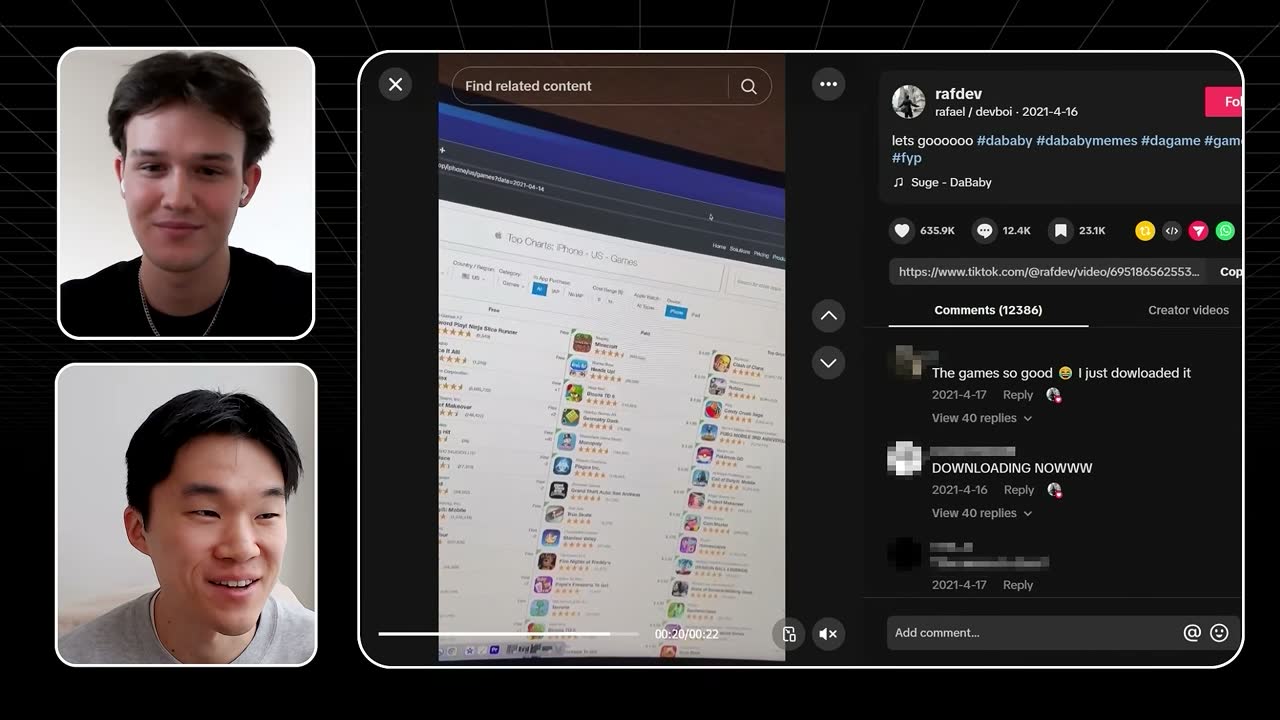
Rafael's April 2021 DaBaby game TikTok filming the App Store top charts, with 635.9K likes. Dev-log TikToks on a trending topic drove the first downloads. About nine day-by-day build videos, at 100k to a million views each, brought the first 300k to 400k downloads. The first TikTok, with about 4 million views, kickstarted it.
He A/B tested hooks and paid attention to which words and frames to use; beyond riding the trend, the only rule was not to be boring. Viewers suggested features in the comments and he added them, for example two new characters on day four of the dev log.
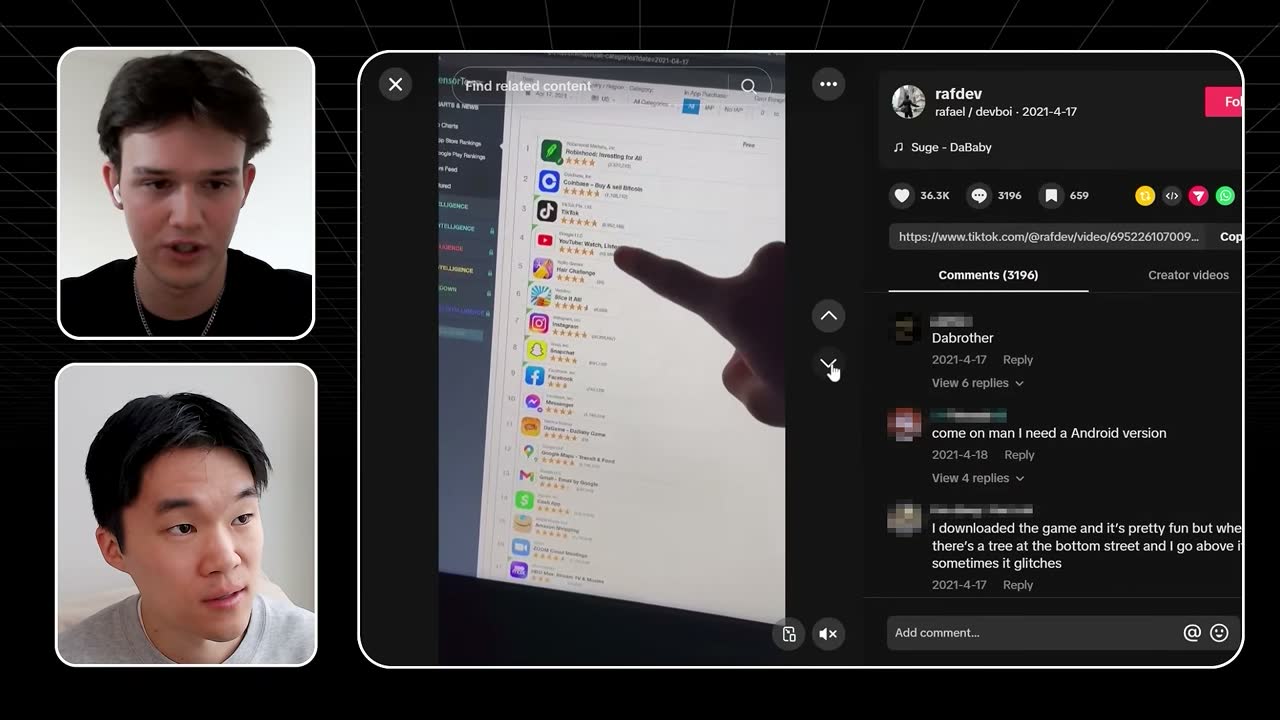
Rafael's April 2021 TikTok showing his DaBaby game on App Store top charts, 36.3K likes. Chart rankings and friend challenges took over after the first wave. Once TikTok delivered the first few hundred thousand downloads, the game reached number two overall on the App Store and number one in racing. Strangers clicked out of curiosity at seeing DaBaby's face on the charts.
Friends showed each other the game and competed on high scores. "The K factor you know had much more of a role than the actual Tik Toks."
2Ads-only monetization and the retention ceiling
Interstitial and rewarded ads alone produced the $100k month. Monetization ran on Google AdMob: an ad after every second death, plus a 30-second rewarded ad to revive and keep playing. There were no in-app purchases.
He says ad income starts to pay off at a few hundred to a few thousand players a day, and that better monetization could have earned much more. The $100k figure covers a single month, with no ongoing profit numbers given.
Distribution got the downloads, but poor retention capped the value. The game earned roughly 10 cents per user, against 80 cents to $1 for well-monetized mobile games. It was gimmicky, built to look good in a TikTok video rather than to keep players.
"We never really cracked retention." Kramer now describes himself as a marketer rather than a product person and says he has never had a product he is proud of long term.
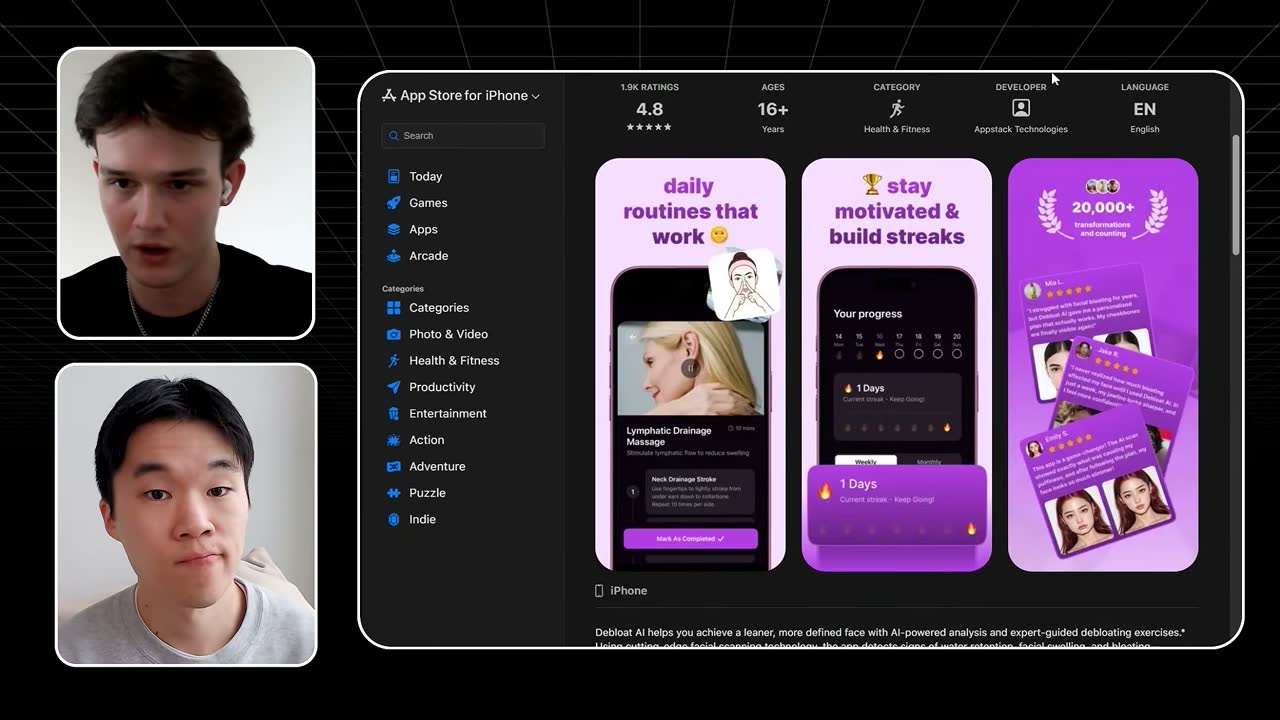
Debloat AI's App Store page: 4.8 rating from 1.9K reviews, a looksmaxxing app later sold.

this 14 yr old makes $100k/mo PROFIT building apps with ai (here's how)
Built overnight in Buildbox at age 14, it got about 2 million downloads and over $100k in a month, monetized only with ads. Nine dev-log TikToks drove the first 300k to 400k downloads, then it hit number two overall and number one in racing, at roughly 10 cents per user.
Build a simple game around a meme the day it starts trending. At 14, Rafael Kramer saw the meme of DaBaby's head as a car and built a racing game in one all-nighter in Buildbox, a no-code builder. It got about 2 million downloads and over $100k in a month.
His reasoning: a trend is 2D, so you see it, laugh and scroll, but in a game you can be the DaBaby car yourself, and that makes people pass it on. Players were mostly middle and high schoolers on lunch breaks. He later hired Unity developers once money came in. "I would find something that pops off, find it early, make a game, put on the app store, and then make videos about it and hope they go viral."
Rafael's April 2021 DaBaby game TikTok filming the App Store top charts, with 635.9K likes. Dev-log TikToks on a trending topic drove the first downloads. About nine day-by-day build videos, at 100k to a million views each, brought the first 300k to 400k downloads. The first TikTok, with about 4 million views, kickstarted it.
He A/B tested hooks and paid attention to which words and frames to use; beyond riding the trend, the only rule was not to be boring. Viewers suggested features in the comments and he added them, for example two new characters on day four of the dev log.
Rafael's April 2021 TikTok showing his DaBaby game on App Store top charts, 36.3K likes. Chart rankings and friend challenges took over after the first wave. Once TikTok delivered the first few hundred thousand downloads, the game reached number two overall on the App Store and number one in racing. Strangers clicked out of curiosity at seeing DaBaby's face on the charts.
Friends showed each other the game and competed on high scores. "The K factor you know had much more of a role than the actual Tik Toks."
Interstitial and rewarded ads alone produced the $100k month. Monetization ran on Google AdMob: an ad after every second death, plus a 30-second rewarded ad to revive and keep playing. There were no in-app purchases.
He says ad income starts to pay off at a few hundred to a few thousand players a day, and that better monetization could have earned much more. The $100k figure covers a single month, with no ongoing profit numbers given.
Distribution got the downloads, but poor retention capped the value. The game earned roughly 10 cents per user, against 80 cents to $1 for well-monetized mobile games. It was gimmicky, built to look good in a TikTok video rather than to keep players.
"We never really cracked retention." Kramer now describes himself as a marketer rather than a product person and says he has never had a product he is proud of long term.
Debloat AI's App Store page: 4.8 rating from 1.9K reviews, a looksmaxxing app later sold.
More in Games
Paintball Rush
A mobile paintball game used as the worked example of a feature pitch.
 7 sources · 14 tips
 Games
Chess.com
An online chess platform for playing, learning and reviewing games with engine analysis.


 6 sources · 29 tips
 Games
Color Switch
A mobile arcade game where players pass a ball through obstacles by matching its color.
6 sources · 19 tips Games
Crossy Road
An endless arcade hopper mixing Frogger and Flappy Bird with collectible voxel characters.
9 sources · 21 tips Games
Wordle
A news organization selling a bundled digital subscription of journalism, games, cooking, sports, audio and shopping.
2 sources · 19 tips Games
Zynga
A social games company behind FarmVille, CityVille, Words with Friends and Zynga Poker.
5 sources · 12 tips Games
Subway Surfers
An endless runner mobile game and the most downloaded mobile game ever.
2 sources · 11 tips Games
Black Box
A puzzle game of unconventional brain teasers that uses the device's features, sold as a paid app with in-app purchases.
1 source · 11 tips