0:00When you look at Morning Brew, The Hustle, [music] Axios, Politico, like all of these massive exits in the media space, and the one [music] commonality that they have is they're all newsletter first. Newsletters and owning your audience and owning your distribution as like a massive [music] advantage. And if you like Morning Brew and look up to them and that model, like we can do the same things, but better in one single platform. Some of the ways that Beehive has innovated and counterpositioned [music] itself to Substack is by offering this flat SAS fee with a 0% take rate. Why did you take that bet?
0:31>> I don't think by simply building the infrastructure [music] to pass money through the pipes of stripe to that is the value that we should be extracting at that layer. It's a stripe [music] connection that you can choose to say 0% or 10% or 50%. What is one profound way that you think AI will change [music] the content economy in the coming years? Yeah, I mean, >> welcome to Subversive, [music] a podcast dedicated to sharing stories from the best consumer subscription apps in the world. [music] We'll bring you lessons for how to grow your consumer subscription business, including insights and inflection [music] points that led to exponential growth from leaders at category defining companies and innovative startups.
1:13Let's get into the show. This episode is brought to you by RevenueCat. The world's best apps use RevenueCat to power their subscription infrastructure, manage customer data, and grow revenue across iOS, Android, and the web. From any developers launching their first apps to category leaders like OpenAI, Notion, and Ladder, scaling to millions of users, RevenueCat handles the complexity of monetization so you don't have to learn more at revenuecat.com/subversive.
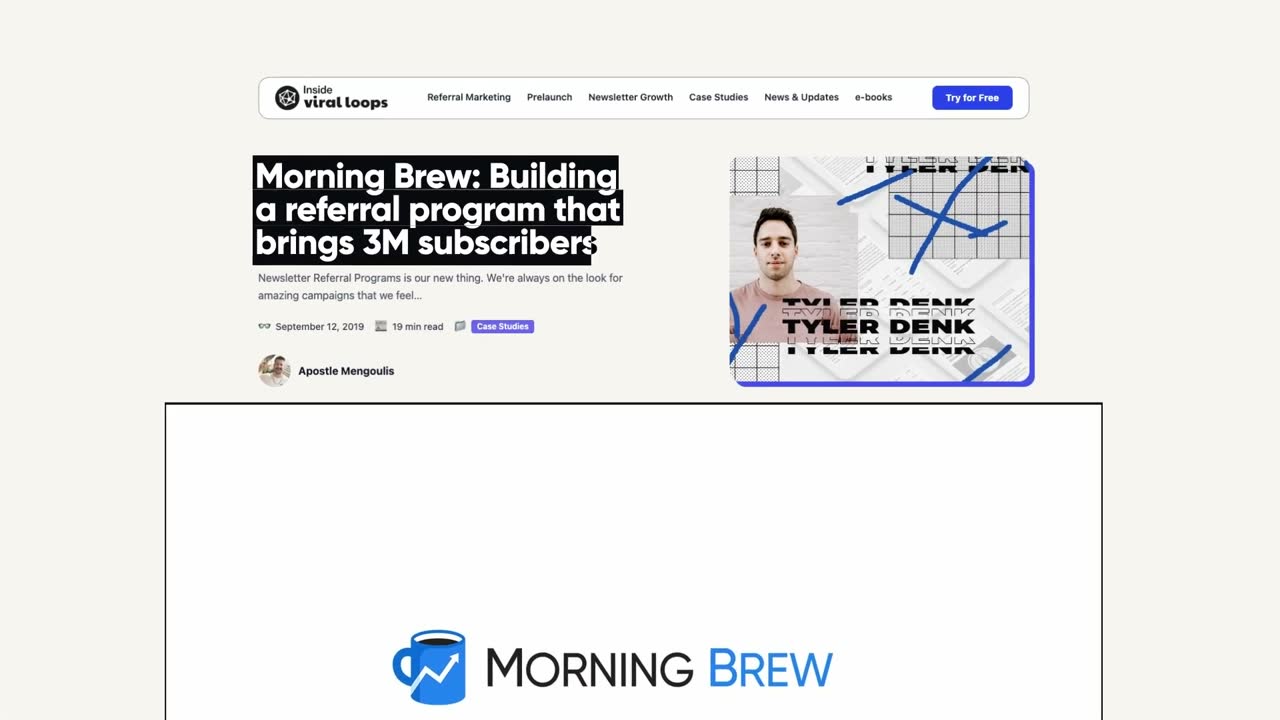
1:40My guest today is Tyler Denk, co-founder and CEO of Beehive, a newsletter and media platform used by over 130,000 publishers. Prior to Beehive, Tyler was employee number two at Morning Brew, where he built the referral program that helped scale that newsletter to 3 million subscribers and a $75 million acquisition. In this episode, I talked to Tyler about how he productized Morning Brew's growth engine as the basis for Beehive. About how Beehive grew from 0 to 20 million in ARR in just three and a half years with a zero take rate business model that brilliantly counterpositioned it versus Substack.
2:12and about how the company's recent product launch, including features like community co-pilot and its new visual editor, will help propel Beehive to $50 million in ARR by the end of 2026 and position it as the operating system for the content economy.
Tyler's first job building Morning Brew's referral program
2:292:29All right, welcome Tyler to the Subversive Podcast. Excited to talk about your startup Beehive today, which has been exploding over the last 5 years uh since you launched it in 2021. But before we get there, let's talk about the runup to founding Beehive and what sort of entrepreneurial path took you from your initial position at Morning Brew to starting this company. >> Yeah, for sure. So, I started a company in college called Venturetorm with two co-founders. One of the best and worst experiences of my life, I would say.
3:00Best because I think obviously like you know the Steve Jobs quote, you can only connect the dots looking backwards. like there's no way I'm here in this position talking to you if it weren't for trying and failing at that startup in college. We had to build the platform from scratch. I taught myself how to code in college. We had no budget as broke college students and it really taught us the grit of how do you get we I think we achieved like 10 15,000 users. How do you do that with no budget in college building your company for the first time? And we did a bunch of things like very cringe writing on like Kora and Medium articles that you can still actually find on my Medium profile and doing like contentbased marketing. We would travel to different universities.
3:39So half of our it was a two-sided marketplace which is maybe our first mistake as unseasoned entrepreneurs [clears throat] trying to build a two-sided marketplace. But half of that marketplace was college developers and student developers. So we would sponsor university hackathons at Harvard and Michigan and and Waterlue and Toronto and we would actually spend our weekends driving up to University of Toronto sleeping on the auditorium floor and brought our laptops and try to get these student developers to sign up for our platform. I know you hear a lot from different founders like the grit required and the discipline when you have no budget and you're not raising a $50 million round and how creative you have to be with those constraints to actually find success. And so I I attribute a lot of both like my success at Morning Brew and at Beehive to that early experience. Uh but to fast forward, I I did that. It didn't work
4:32out. I I forewent all sort of like internships in college because I thought that I was building a billion-dollar business and internships were below me. So I never had any working experience. I graduated, moved back home into my parents' basement, had $5 to my name because I never generated a dollar of income during my college career. had $120,000 of student debt and was really had nothing to show for it outside of the fact that I taught myself how to code back before AI would do the coding for you. Fortunately, Austin Reef, who is one of the co-founders of Morning Brew, he and I had grown up together in Baltimore, and he was talking about this newsletter that he created and how they had such high retention and people were super engaged with it. I just thought that I was building a billion-dollar software business. I thought newsletters were kind of lame and like, why is that super interesting? But I needed the
5:21money and he gave me an opportunity for $3,000 to build a referral program. I had no idea what I was doing. I lied and said I could figure it out. I wouldn't give up because I had $5 in my bank account and $3,000 would change my life at that time and eventually figured it out. >> And he's like, "Dude, we have so many things we wanted to build. We don't have any engineers on our team. Like, why don't you just keep working with us and build things over the summer?" never meant for that to be a full-time job at Morning Brew, but ultimately got to the point where he wanted me to join full-time. And it was either that or a job at Deote as a technology consultant.
5:59And the best piece of advice I think I've ever gotten from a friend was you could be one of 50,000 people with that exact same title and role at Deote or you could be the only person in the world building Morning Brew and doing that. And that like was the only thing I ever needed to hear of like wanting to bet on myself even though I had $120,000 of student debt even though I was in way over my head and they expected so much from me and I was a self-taught software developer who never took a computer science program class. But I think that was the fun and the challenge of it and what attracted me to that opportunity.
How Tyler productized Morning Brew's growth engine
6:296:29So let's trace that critical bet that you made on yourself deciding to join Morning Brew and initially build their referral program to the moment you founded Beehive. in between. When did you realize that the growth engine that you had built at Morning Brew could actually be productized and turned into an entire company? >> Yeah, I didn't even know what product was when I first joined Morning Brew. I again self-taught software developer.
6:51There were problems to be solved and me as like a problem solver would look around at the business and see one of the first things we built or I built there was our writers were copy and pasting the their stories into an HTML template every single night. It would take 3 hours and then we would copy and paste that HTML template into Mailchimp. And me being a problem solver, like no one told me to do this, but it was, okay, that makes no sense. And if we ever wanted to hire a second writer, no one's ever going to spend 3 hours of their day copy and pasting. So, let me build a content management system to do that process for us where you can basically create the newsletter in this customuilt software and it will sync to Mailchimp and then our other ESPs and send it for us. And I was too dumb and naive to understand like what it meant to build a content management system, but just naive enough to think like I
7:41there's nothing stopping me from starting to build this software. Again, today with AI, it'd be so easy to vibe code one of these things and like it would change all of this, but back then it was like a 3-month journey of Austin and Alex trusting me that if I'm going to come up from this 3 months and it will actually yield results that's good for the business. And it did. We we shipped a content management system. It changed our ability to actually create these beautiful newsletters and we scaled an entire content team to build and launch a bunch of these newsletters.
8:08Then I looked around and our sales and partnership team were running all of like Morning Brew makes money from ads and at some point we had three different advertisers per newsletter and then we had four or five different newsletter verticals. So any given week we would be dealing with 50 or 60 different advertisers and they were managing that in a Google sheet. And we'd realized the night before at 10 p.m. we didn't have the assets, we didn't have the image, we didn't have the URL. And so I was like, there's got to be a better way to do this. Me and my now co-founder at Beehive, but then was the first engineer I hired at Morning Brew built this system to manage all of our inventory.
8:43And so you fast forward a little bit and when you look around, we built a custom website. We built a custom CMS. We built this custom ad platform. And back in those days, our users were our co-workers and these were like internal morning brew employees. But the other like the impetus that we got for like what this potential could be was we would send a newsletter to 3 million people every morning. And dozens if not hundreds every single week would respond being like, "Hey, I run a newsletter for my business in in Ottawa and like we our newsletters don't look anything like yours. We and you guys are growing so much faster than us. like what data are you looking at? How do you format the newsletter? How are you monetizing the newsletter? And all of these questions would get forwarded to me from our team.
9:26And it was like I know the answer to everything cuz I I built all of this. I know exactly like the data pipeline that we built. I know exactly the internal tools. And so that was really the impetus of like seeing hundreds of people a week come to us as like the subject matter experts in this newsletter and me being that subject matter expert that had built an in and built that infrastructure to make that all possible. I mean, I pitched it to to Alex at Morning Brew. I was like, "Hey, I think we could actually productize this internal tech that we've built."
9:54And you already have the distribution because we're sending a newsletter to three to four million people. So, we have the distribution engine. We have the case study of like, look, it works. We're making $25 million a year off of what we had built internally. Um, what I didn't know at the time that I pitched it is that they were already talking about M&A and it's a quite a curveball to go from media business with a massive successful newsletter to a SAS business who's selling their software. So, I don't discredit them for knocking my idea. Um, but that obviously became what Beehive is today.
10:23>> Yeah. So, let's talk a little bit more about that. I mean, good thing for you that they didn't accept that proposal because it meant you got to go off and start your own company. And so, for
What beehiiv is today and how it has evolved over time
10:3110:31those who don't already know, tell us a little bit more about what Beehive is now and how it's evolved since you originally launched it 5 years ago. >> It's funny because that's always the most difficult question for me to answer is because we're evolving so quickly and we're doing so much. Like I used to answer that as like we are a newsletter platform. It's very straightforward. If you have a newsletter, we should be able to serve you better than anyone else.
10:52But then we launched we acquired a website builder and we we you can host your website on the platform. A few months ago, we launched the ability to sell digital products so you can sell templates, guides, coaching, um just other ways to monetize as a publisher or a content creator. Three months ago, we launched podcast hosting. So we have thousands of people hosting their podcasts and distributing it through our platform. And so you can see this evolution of what started as anyone who's been listening thus far in this podcast like the morning brew story. It was morning brew in a box. It was bundling website and newsletter and being able to do everything to scale a successful morning brewesque newsletter all under one roof. And there was a lot of value in that. And this was at the time where you know media has had its troubles over the past decade. But when you look at Morning Brew, The Hustle,
11:41Axios, Politico, like all of these massive exits in the media space, and the one commonality that they have is they're all newsletter first. And so in a time where newsletter first media companies were crushing it, Morning Brew had just got acquired. Substack came three or four years before us, but a venturebacked startup focusing on newsletters. And then you have these independents like Ben Thompson of Strateery building a $5 million plus revenue business as a solo content creator.
12:08you start to see like newsletters and owning your audience and owning your distribution as like a massive advantage and something that like the tailwinds of that were very much in our favor. So I say all of that because that's where we started. It was we are the best newsletter platform. If you like morning brew and looked up to them and that model like we can do the same things but better in one single platform. And over the past four years, we've evolved to whether we say like the operating system for the content economy or the platform for anyone with an audience. If you have an expertise or an audience and you want to be able to grow and monetize that, we are the best platform to do that.
12:46>> Well, I think it's a great segue into the first topic I really wanted to cover with you today, and that's how you got your initial product market fit as a as a new company with Beehive. So, in the
How beehiiv acquired its first 1,000 publishers
12:5612:56early days, your positioning was built by the Morning Brew Growth team, and it sounds like you already had this credibility as somebody who had helped to scale Morning Brew to a very large and successful newsletter in its own right. Um, why did that work, and how did it get you to your first thousand publishers on the Beehive platform? >> Yeah, we benefited from Morning Brew being a success story that our ICP was familiar with. or ICP were people who had a newsletter and everyone at the time wanted to build Morning Brew for X, Morning Brew for crypto, Morning Brew for real estate, Morning Brew for AI.
13:27And so we had that credibility and in the early days it's a lot of storytelling, right? Like our product today, I think, is the most mature and expansive product in the ecosystem, but it didn't start out that way. And what if if you wait till it's perfect, you're too late. We launched with like the shittiest version that you could possibly imagine out of the fear and anxiety that someone would get there first, which I actually think a lot of founders and people struggle with because what I do not fear is negative feedback. Just the other day on X and LinkedIn, I posted any Beehive user, what's the worst part of our product?
14:01And I got 250 comments of people just tearing us apart, which like some people on my team got stressed out about and like why would you ask for all of that uh the all of the the insults and everything else? For me, it's like our roadmap for the next six months of what we can do better. So when I asked that question six months from now, ideally it's not the same answers, but it's something totally different. Um, so credibility is everything. And so for for us, it was just early days like we didn't have the most polished product.
14:27We didn't have any half the functionality that any of our competitors had. But what we had was the expertise and knowhow that me and my two co-founders were part of the early morning brew team and built Morning Brew into a massively successful entity. and exit and you could basically tap into that expertise and use the same tools that Morning Brew did for your newsletter at a time where everyone wanted to be Morning Brew for X. There's not much more of a reason besides like we didn't have much else to hang our hat on. Um it it worked in the early days and bought us trust. Um I I'd say the next thing that we did and something that we still do to this day and like what I think we're best known for is product velocity. And so I think it's the self-awareness of we never thought we were the when we launched because we knew that we had 5% of the functionality of all of our competitors.
15:16But what we did know is that we had the playbook that worked at Morning Brew which no one else had. So we had like a road map already in our head >> and we also had the self-awareness and willingness to listen to customers and hear what they wanted and what they didn't like about the competitors. And so every single week we would try to launch at least one major feature and we were a team of four founding engineers. Um and our first two hires were engineers and they're all full stack.
15:44And so the product velocity of knowing one what worked for Morning Brew, two what our customers wanted, three what our competitors did wrong and being able to build this marketing flywheel where every single week we had an announcement of a new feature does a few different things. one existing users who are probably losing their patience with how immature our platform was. It shows them like hey we see you we heard your feedback and we launched this so please don't leave to people who are not yet users it says this is what we just launched and if this is something of interest to you that your platform doesn't offer like we do and you should come over and then three it creates the narrative that if we do this every single week ideally either as a user or a potential user you might think they only have five of the 10 things that I want but with this velocity and pace I think they'll get those other five
16:34sooner than any of these other competitor comptors and that's the horse that I want to bet on. >> Yeah. I mean, there were a lot of important lessons in there. So, I want to try to unpack the most important points I heard. The first one is build for your own need. I think that's something many people have said before, but you're living it in real time. And because you built the same tools within Morning Brew that you're now building for the entire content economy at Beehive, you already had a built-in product roadmap. You understood your customers deeply. And so, that was a huge advantage for you. Second is timing is everything. I mean, I I don't think you could have timed it any better coming out of the pandemic with the content economy exploding as fast as it was with the experience that you built at morning. You were just very well positioned. But then third, and this is very important, you weren't afraid of
17:13negative feedback and you were very willing to prioritize speed and product velocity above everything else, which allowed you to capitalize on your timing. And that has led to this rapid iteration that even though your initial MVP may not have been very high quality, you've you've iterated your way increasingly toward being the leader in the space along with Substack. And so
How beehiiv scaled from $3M to $20M+ in ARR
17:3117:31let's talk a little bit more about this growth phase. From 2023 to mid 2025, you guys grew from 3 million to 20 million in ARR. What were some of the most important growth loops and channels that helped you achieve such rapid growth? >> Quite a few. uh founder-ledd marketing actually works to this day incredibly well, but in the early days and like I I say this is like I think when people hear that they're like, "Hey, I only have 2,000 followers on X." Like I was never a content creator. I still don't really call myself a content creator. At the time when we were in 2021, 2022, maybe sub 5,000 followers on these platforms. So it wasn't like I had the added benefit of distribution. I worked for that distribution by being very consistent and continuing to share the stories of what we're building and why it matters.
18:15Founder-led marketing has unlocked so much for us as a business for a few different reasons. early days. It was just my genuine excitement of look at what we just launched and me just wanting to share that and like I feel like that excitement is contagious and people are attracted to seeing this founder building and shipping and following a passion and like the pro progression from very immature platform to something that is valuable to other people and seeing that in real time I think is really interesting. I launched a newsletter called Big Desk Energy which is the behindthescenes stories, narratives, strategies of how we're building the company. super raw, very unfiltered. I share wins, I share losses, I share when we've had to lay off people, like all of the terrible and great things of starting a company. And I think that level of transparency is fairly rare for other founders, whether
19:02they think they have competitive secrets they don't want others to know or they are on this venture flywheel where they know they have a future round and they don't want investors to think that they're fallible at all and that there's everything is perfectly fine. That's not the case at any of these companies. But like what that level of transparency has done is we have this audience of people who trust me and the vision I have for the company and that one either attracts people to want to try the software because they know the person behind it and can align with my values and vision or buy a lot of patients when we do make mistakes that they're like I actually feel like I have this parasocial relationship with the founder. I know he cares deeply about this company and the product and even though I kind of want to churn because it whatever mistake kind of pissed me off like I'm willing to give him a second chance and the
19:49company a second chance. So founder le marketing has been great both across social and for my newsletter. >> We have a lot of like productled growth built into the product. So the classic what is it the hotmail example that everyone talks about in like the late 1990s something similar like in the footer of all of our emails unless you pay to remove it we have built with behive um and then we also have that in the footer of websites and so we benefit from [snorts] our users have distribution and a large audience when liquidity and his execum newsletter moved his 100,000 subscribers over to our platform that's a 100,000 people that they opened their inbox the next day and saw that email that they've been subscribed to for years look better, have like a new referral program. Uh there's something different about it and when they scroll to the bottom they see that it's sent with Beehive and so like
20:39that is growth in itself and there's that obviously compounds over time. The product velocity and shipping every week like we built an entire go to market motion out of that. We have a we like hype it up the night before the day that we launch a new feature. We have like these animated videos that explain what the features are and like why it matters. We post them across all of our social channels. We have a newsletter.
21:03It's called the product update that goes out that goes out to 450,000 people, all of our current users explaining exactly what just launched and why it matters to them. We have like an employee activation mechanism like both like in our Slack channels and elsewhere where like they're also engaging in real time with all of this content. So, we've built this flywheel. Um, and then we post like in our internal Slack community and elsewhere, but every time we launch a feature, which we try to do every week, there's just a it's a marketing moment that we can continue to compound over and over again. And we've built that playbook up to be pretty robust.
21:35>> Yeah. So, it sounds like you're doing a lot of the standard best practices for proumer SAS tools like having the watermark that if if somebody's not paying to remove it, it provides free distribution. Allah Hotmail in the '9s or more recently companies like Grammarly or GMA have used this effectively. But what's really separated you from a lot of other companies that run a lot of these same playbooks is the founder marketing and the building in public. And I would imagine that for your product and target customer in particular that really resonates because these are all creators in their own right. They're building in public in their own way whether that's a podcast or a newsletter or a website. And so seeing you do it makes you feel very authentic to what they're trying to build themselves and very trustworthy as as a founder who's building tools for them to be successful in their own
Why building in public has been so powerful for beehiiiv
22:2022:19business. I imagine there are some trade-offs to being so transparent. Like you share all of your investor updates, you share revenue numbers publicly that a lot of other founders guard closely. What are some of the trade-offs and why do you think ultimately the benefits have outweighed the risks? >> I I honestly think the biggest trade-off is time. Like I take pride in the work that I do. And so the newsletter takes five hours to write every week. And like five hours is a lot of time. It's my my entire weekends. It doesn't take away from beehive time. It every hour in theory is beehive time. I suppose it takes away from the time like I could be on a beach on on Saturday afternoon like actually enjoying um but instead I'm writing a newsletter in my room and in my room for the sixth consecutive day of the week. That's probably the biggest trade-off is just like the opportunity cost, the time. Um I I I've been pretty
23:04transparent with our roadmap and our ambitions and everything else. Like have we tipped off our competitors of what we're building well in advance so they can copy us? Like yes, all of our competitors have copied us at one time or another. But I think that we can out execute and that's always been the bet that we've had. It's like I when when all of the competitors who have been in the industry for 5 10 15 years longer than us look at us and start copying what we're doing like I kind of feel like we are in the driver's seat even if they are larger than us today. And I feel like the innovation, the the ability to operate, the leadership team, like the direction that we move, I just don't think other companies can match that. And that's always been my bet. So I don't feel any sort of competitive pressure in terms of like tipping our hat in that way. On the revenue side of things, like it adds a lot of pressure,
23:51right? Like that's why I love [clears throat] sending investor updates every month is all of our investors, all of our friends, our family, and I have all of the investors that passed on us um kind of and I hold a grudge against them on this list as well. And knowing that I have to send this investor update motivates me so much to make sure that we never have a down month and we never have had a down month. And so it's like a competit a healthy competitive pressure to continue to perform. And so I think I thrive under that pressure.
24:20Like I enjoy the challenge of being able to do that. And what that's unlocked is like we raised our series A in less than a week because all of our wouldbe investors or people who are interested were able to follow the real unfiltered journey through my newsletter and through our investor updates where they didn't need to do a ton of diligence because they know exactly how I think and they know exactly the revenue numbers and all of the other uh KPIs at the business. Um, we've also attracted tons of talented employees who started off as maybe accidentally signing up for this newsletter that their friend recommended to seeing the vision of what we're building, just getting to know me via the newsletter and just aligning with the level of transparency cuz like that extends beyond just the newsletter and on social, but I share with the entire company our board decks, our cash balance, our revenue, our cost like I
25:10think that's the only way to run a company in my perspective. I think if you hire smart people, you want to arm them with as much information as possible so they can continue to do their job to the best of their ability. And so yeah, I think just like that transparency shines all the way through. Um, to answer your question, yeah, the biggest trade-off is just time. >> Yeah. Yeah. Although it's funny you say that because look, I can certainly imagine how much time it takes to write a great newsletter and I I do my own quarterly updates for my business, obviously on a much smaller scale, but it takes real work and it takes courage to a degree because you're putting everything out there, the good, the bad, and the ugly. But it's funny because on the one hand, it takes a lot of extra time in the short term, but then you talked about how you raised your series A in less than a week. So I can't
25:50imagine how many days or weeks or months you saved yourself in in the long run by providing those updates along the way. And then also just builds a ton of trust. And there's there's really no replacement for trust when you're building a business as large and important as Beehive. So let's talk a
Why beehiiv built its platform on a 0% take rate model
26:0526:05little bit more about some of the ways that Beehive has innovated and counterpositioned itself relative to competitors and Substack in particular. And one of the most important ways you've done that is by offering this flat SAS fee with a 0% take rate. Why did you take that bet in the early days and and how has it continued to serve Beehive well as you've scaled? >> Yeah, I think there's probably three ways to look at that. One is maybe just like well the obvious counterpositioning right like there was I don't know if I consider them the market leader especially at that time but they were the venturebacked upstart who their business model was what I consider like a predatory take rate which is what a lot of the creator economy companies have and I think if you are going to be so vulnerable to put your content out there and build an audience and you can actually convert people from free to
26:52paid to generate a business around that to take that earning it just doesn't seem like like I I don't philosophically align with that and I feel like there's this counterpositioning from like a business perspective on the actual like implementation and like just knowing as like an engineer what it takes to facilitate that. It's a stripe connection that you can choose to say 0% or 10%. Or 50%. And and I don't think by simply building the infrastructure to pass money through the pipes of Stripe to that that is the value that we should be extracting at that layer. I think we built an incredible platform that warrants paying $49,79 $159 a month depending on like your size and like I feel good charging for someone who logs into our platform daily and is using all the different features that our team of 40 engineers have built with the expertise of everything we had learned at Morning Brew. but simply passing
27:46dollars from point A to point B via Stripe and taking a fee out of that. I feel like that's not the value extraction or like where we deserve to be taking revenue. And then three is just like out and this kind of like dovetales I guess with just the the counterpositioning point, but looking on Twitter and X and like what are the complaints of like the different platforms in the ecosystem? Like the number one complaint of Substack at the time and still to this day is like I'm growing out of this. I'm I'm paying them $10,000 $15,000 a year in fees when Beehive I could pay $200 a month and like that's 80% cheaper with more functionality. And so I just think there's something around understanding what the users are complaining about.
28:27There's the philosophical thing and then they they are the market leader now. And so just kind of playing the counterposition game I think is pretty important for us. >> Well, what's ironic about that is when you charge that high of a take rate, one it's sort of the Jeff Bezos quote of your margin is my opportunity. But two, you're creating this perverse incentive where I imagine for upstart publishers and writers, okay, 10% take rate, not a big deal. I might not even be making any money yet. But as you become a large publisher, it's a very meaningful amount of money. And so you're actually incentivizing the largest and most prominent publishers to switch platforms. And so you recently talked
Why publishers are switching from Substack to beehiiv
28:5828:59about how one in seven new beehive writers are now coming from Substack, including some larger brands like Time and Newsweek. So what does it take to get a large publisher like that to switch and what are the primary things driving that decision for them? Yeah, on the Substack front like I I love the term graduation effect that you graduate out of that platform in one of two ways. One is the fees. So again, if starting out is amazing. It's like, wait, I want to do this as a passion project and you're telling me I can start for free, $0, no subscription, like take 10% of nothing is totally fine. Take 10% of $100, it's totally fine. Um, but you eventually get grow to a point where you graduate out of that. The second part of the graduation is like I think we're just fundamentally going in two different directions. I think they're building a social platform and there's there's a lot of simplicity to the
29:43platform which is good for getting started. Going back from the morning brew day is like we're building enterprise level software and bringing it to consumers. So like more of like a proumer play. The reason why we can get a news week or a time is because they were looking at us at morning brew being like what are these capabilities you have and like how have you able to scale this newsletter and style it and build it and monetize and that's the type of software and capabilities that we've built into this platform. So, it's like a really interesting place to be in because like if if if we do get complaints, even though I think we are incredibly affordable across the board, it's like we are really quote unquote democratizing access to very enterprise level software. The the big ESPs charge starting at $100,000 a year for the type of software and capabilities that we've normalized and made it available in a
30:31plan for $79. And so relaying that value prop I think is always like an uphill battle and like challenging. And so there's two sides to it. For the Times and Newsweeks of the world, they're like, "Wait, you offer everything our current platform does plus 15 other things at 40% the cost." And it's like a no-brainer value to be able to move over, let alone the fact that most of these like legacy ESP platforms are the only thing that they've shipped in years are pricing updates. And we're shipping dozens of updates every single week. And so it's [clears throat] just like a pretty clear divergence there. Um on like the lower longtail end of the market, >> it is getting people the the one thing Substack has done which makes it interesting is like they've normalized not paying for software. And I don't know if that's a forever strategy and what their burn looks like and everything else, but it is interesting
31:20having a market where 99% of the platforms charge a subscription price and one has entered as a free option. and what that does to the market dynamics, which is pretty interesting to navigate. >> Yeah. Well, and it also sounds like it relates to their longerterm strategy of becoming more of a social network and building a really large community. But ultimately, if the best publishers are going to end up graduating to behive, then that does give you a real long-term revenue advantage. This episode is brought to you by Paddle. Today's fastest growing apps are multi-channel.
31:51More teams are using web checkout to improve margins, control pricing, and build stronger customer relationships. But external payments bring new complexity from tax and compliance to fraud, disputes, billing support, and entitlement logic. That's why Paddle launched the 2026 web monetization playbook. As the merchant of record for apps including RUA, GoodNotes, Codeway, and HubX, Paddle handles the complexity so you can focus on growth. Download the playbook at paddle.com/subversive.
How beehiiv is building an ad network on top of its platform
32:1832:18In addition to subscriptions, Beehive has layered on ads and this marketplace for recommendations recently and my understanding is that now accounts for about a third of the company's revenue and it's the fastest growing part of your business. So, how do those two additional revenue line items complement the core subscriptions product? What's funny is like my core insight when I wanted to launch Behive was we can build the largest ad network for newsletters.
32:41It wasn't let's build the best software platform. It was how do we like I I see the zero marginal cost of a Google or Meta incredible business models like two of some of the most successful companies ever created. I saw up close and personal that morning brew had you know when I when I left I think we had about 40 employees 25 of them were on the brand partnerships and sales team and then I saw the rise of substack which was hey we don't believe in ads the proper way to make money on the internet is via subscription and I know there's a finite limit to one how many subscriptions will consumers pay for for newsletters and two how differentiated does your content have to be as a content creator to warrant charging 10 $1,20 a month and like it's really hard to be able to get build a subscription business as a content creator, but I saw Morning Brew scale $25 million revenue business all via ads. And so the
33:34disconnect was we had 25 people doing that. Your average content creator who's a soloreneur writing about sports or politics or whatever doesn't have a 25 person team. And if you're incredible about writing about sports and you have 50,000 people looking forward to your newsletter every day, that doesn't mean you also want to speak to AG1 and New Balance and build and do ad sales. So the disconnect there was there's a business model that's tried and tested on the internet, which is ads that works really well, and I'd argue like Instagram ads are incredible and like a value ad to the platform despite it being an advertisement. But a lot of these content creators have no capabilities to actually be able to monetize their content with those ads.
34:15So the ad network was always the northstar. It was can we build it similar to what YouTube did for video content creators. Like they they built an entire industry where you can create videos and make millions of dollars a year without ever talking to a brand ever just through the YouTube platform. Could we do that for newsletters? And then you work backwards. Like the only way you could do that is by having enough supply where advertisers would want to invest in and put their brand dollars into this ad network. And the only way to get supply is by building a platform so great that they would move off of all of these existing platforms and move over to PI because we offer a better solution. And the holy grail is like it's a very symbiotic relationship where the software kicks ass. People love using it. It's bestin-class. The ad network has the most targeted best ads that you could possibly ask for to help
35:04you monetize your content. And the northstar that we always look at is like how many of our users are generating more revenue than what they're paying us, right? If you pay us $1,000 a year, but you're making $10,000 off the ad network, like that's a great trade for you. And like that's where churn goes like to zero. Like why would you ever turn off of that platform? And so that's always kind of been the holy grail on how we look at that. And I actually think someone told me recently which is like totally I I always used to say that we're building Facebook ad manager for newsletters. I thought that was such that was like what I had in our C deck and my C deck was we want to compete with Meta and Google. I thought that was the most ambitious thing ever. He was like you're actually thinking way too small. You should be the Facebook ad manager for creators. like whether now that we host their website and their
35:49podcasts, like any surface area of these niche content creators that they're generating this content, like you should be able to monetize that. And as a brand, whether you're Nike or Netflix or Roku or HubSpot, which are all advertisers on our ad network, being able to get in front of these super engaged niche audiences across all of the mediums from newsletter to podcast is so valuable and like where else can you do that? So, that's like the the big like multi-billion dollar vision that I've actually been saying from the beginning. Just no one believes you when you're making $10,000 a month in revenue that this is a multi-billion dollar opportunity, but I think we're starting to grow into that a bit and people are starting to see the vision.
36:27And yeah, I'm very excited about it. >> Well, to me that goes back to the original point around build for your own need because you you sort of saw the
Expanding beehiiv to websites, podcasts, and communities
36:3436:35future of the content economy when you were building these tools within Morning Brew. And so even though not everyone necessarily could connect the dots the way you could, you were able to foresee some of this coming to the market. And this relates to the last topic which is how you're evolving from a newsletter tool into more of an entire operating system for the content economy. So you alluded to this before, but in the last two years you acquired titam you use that to launch your own AI website builder. You also built podcast hosting and a number of other features. So what's this thesis behind expanding beyond newsletters to this much broader platform? I I think even my thesis back when we launched Beehive was even just focusing on newsletter, the value prop that I would tell the seed investors was the content ecosystem used to look like you host your website and blog on WordPress and then you copy and paste
37:23content over to Mailchimp to send your newsletter. And if you wanted ads, you use like live intent or some banner ads that you drop in or like Google display. And if you wanted a subscription product, you have to set up Stripe or you have to do some user authentication. if you wanted a referral program, it was like entirely different piece of software. And coming from this ecosystem where I built this at morning, like that's what I inherited at Morning Brew and I consolidated it into like one welloiled machine. And the difference between trying to piece together six pieces of software that aren't supposed to work together, but you know that you can somewhat get them together, the combination that most content creators aren't technical and don't want to combine them, and even large publishers aren't like a hotbed for tech talent.
38:02And so just trying to make that work or having one solution where all of your data is in sync. Um there's no silos. You can benefit from like economies of scale. You understand like someone who visits your website and then opens your newsletter and then buys a product and they're all the same person because you can connect them without having to pipe it into like a data lake and do all this data analysis. And so like the consolidation thing I saw up close and personal and like I brought that to life at Morning Brew. And then as we launched newsletters and then we had like a very rudimentary website builder, everyone would like the website's kind of like your front page of your content on the internet and we never had enough features or customization. So people kept asking for more which is what led us to acquiring Typeream. But then once you had the website they were like well now that I'm driving traffic I also want
38:48to sell something like I want people to be able to buy a guide or a template or I want them to log in and be able to chat with other members in my community. And so there was always like you give an inch and they want a mile. Like it just kept being like as we expanded what we offered there was more surface area of what users expected. And going all the way back to the product velocity and the level of transparency. So one of these investors said something to me once. He was like you didn't build a product you built an engine that people expect things from you and you can actually deliver them. And through that lens, it was like, yes, I could put my podcast over here and my community over here, but like one either they're not moving at the same velocity and pace at which you are >> and I actually am logging into Beehive every morning and I love using your software. So yes, I have my website on
39:34you and your newsletter. Can you also bring my podcast? Can you also bring my community? And so I think it just comes from the thesis around consolidation. I think that's what users want. I think there's a lot of benefits to not living in silos. And then I also just think there's like a product velocity and affinity for what we have built and users wanting more of what we have built. >> Yeah. I mean, as we're talking about this, you're selling me on the product because we've worked together informally for over a year now. I've done a little bit of growth advising for Beehive, but when we first started working together, you were more of a pure play newsletter platform. And over the last couple years, you've added the podcast, you've added the website builder. These are all things that I do with my business. And so I'm I'm thinking in the moment that I need to check out Beehive myself and and
40:16potentially give it another shot for building my own business. We're building our website right now for elemental growth. That's something we could post on. >> What I would say is like one of the hardest parts about that is it is so hard to be known for anything like there's so much competition. There's so much noise on the internet and we've actually have carved out like we are the newsletter platform and like it's really hard to do that. When you ask chat GPT like I want to launch a newsletter, what platform should I use? like it's either us and Substack is like the one and two always >> and it's really hard to earn that space and that mind share and so I am also very cognizant of like being the everything platform it's like a lot harder to describe it's like oh they do podcast but they also do newsletters they also you can host your website and you can sell on there too it's like harder to communicate and so like that's
40:58like one of the things that I'm internally struggling with of like yes we do a lot more than newsletter we kind of use the word newsletter plus like we are newsletter platform plus anything else you would need to build around that we offer and I think that's actually the better positioning than we are the creator platform for anyone with an audience cuz like you hear that and like granted that's not super polished but it's like what the hell does that mean and like what can you actually do for me? Um but yeah it's like part of the challenge of like growing up and trying to launch all these things as well.
41:25>> Yeah. Yeah, like you said, I mean, it's hard to be known e even as the best in the business when it comes to a particular point solution, let alone an entire platform. But the best tech companies start with a world-class point solution and then that earns them the right to expand into a broader platform. Google did this with search and now there are million products that Google has created. That's an extreme example, but there are plenty of other companies that have followed that same playbook.
Inside beehiiv's recent and largest ever product launch
41:4741:46And I think this gets us to one of the biggest questions I wanted to ask you about today, which is you announced last week in your summer release the biggest product launch in Beehive's entire history. There were a number of new features included community co-pilot, the new visual editor. So let's talk a little more about each one of those and how that really gives you the right to be the operating system for the content economy. I mean, even just building on what I was just talking about in the thesis around consolidation and even something I was talking about earlier around being willing to get user feedback and take the criticism and understand like we aren't tied to a specific road map. Our our road map's totally determined by our users. And when we were call it before our winter release event last year, I would hype up, hey, we're going to launch something massive like what do you guys want? Like
42:31what do you think it is? And the overwhelming response was community. um by by a long shot and like ever since that it's like very been it's been very much planted in my mind of like that is clearly like the next evolution of what we need to offer. I view newsletters and podcasts are great for like top offunnel distribution. It's like a oneto- many channel where like I send my newsletter to 130,000 people. They read it. They get information from me but it's me to them and like yes they can respond. So it's a little birectional podcast less so but it is like one to many where I think you get benefits of building this audience of like like-minded people is like the many to many where [clears throat] people want to connect with other people who have the same interests and I know like my first million as a podcast they'll like do these IRL meetups sometimes across like different cities and like they don't
43:20actually even go like Sam and Sean don't even go to these meetups it's just people who love the podcast they obviously have a shared affinity for business and startups and tech and the bet is if I listen to my first million three times a week and I meet other people who listen to it, they [clears throat] probably have so many commonalities and like what what an amazing thing for Shawn and Sam to be able to like foster these relationships within their community without them actually having to do anything. It's just bringing people together. And so I think under that same thesis, people want community. Um, we already host your website and your newsletter. Like it we already own the distribution and to go a layer deeper and host like an actual community of like your audience. It is one an amazing value ad to those people and two to the content creator, it's like a revenue stream. I I I spent an
44:09hour this morning going over like I'm going to launch my Big Desk Energy community and I like can't sleep thinking about like I'm so excited because like I've done the hard part of aggregating an incredible audience and giving them content every single week and I have so many interesting people in this network where if I can get them into a single community where they can engage with each other, it'll be founders, operators, investors and people who want to grow their business but also connect with different investors and understand from people who have been there and done that. like it's just such an interesting lever and so yeah I'm like very excited about the launch and introduction of community uh the other two the visual editor like it it's we kind of went back to our roots it's the most important part of the platform is like [clears throat] >> 20% of users use automations 10% have a
44:52podcast but like 100% use the editor to create content and it's just the most important part of the app and so we rebuilt like a wizzywig editor that I genuinely think is the greatest writing experience on the internet. It's so intuitive. It's it's like there's AI involved in it, but there's also styling and design and customization. So, we rebuilt that. And then co-pilot is just everywhere across the app having full context of what you're doing and being able to ask it for best practices for insights. I I think one of the core thesis I have around AI and the creator economy is I was on this panel and this lady said she spends two days creating content and 5 days doing admin work to support her content. And like to me totally backwards. It should be 5 days creating content and doing what she actually loves and two days doing the admin work. And that's where I think AI kind of fits into this ecosystem is like
45:47how do you do the analyst work, the outreach for sponsorships, the the manual tasks that you don't really want to be doing. And because it has all of the context of your business and who you are and your content, like I think we're in a perfect position to provide that type of experience. And so the co-pilot's first iteration of being able to do that in the app. Uh pretty excited about that as well. >> Yeah. Well, again, as a small business owner, I spend plenty of my time, more than I would like, on admin tasks. And so that's I'm sure that's appealing to anybody who is putting their own content out into the world. And then the community thing is really compelling cuz right now and I know a lot of other content creators who do this. I have my own community of consumer subscription app builders and and growth experts and I just host it in a Slack group which is kind of the hacky solution to be able to
46:31compile a set of professionals into one place. But it's not built for that use case, right? That's not why Slack was built. And so, uh, it it definitely seems like a much more natural and seamless way of stitching together community you've already built through your newsletter and your podcast. So,
How beehiiv's expanded platform can unlock more growth
46:4446:44really excited to see the momentum from this most recent launch. How does this expanded product offering that you all are building position you to grow faster and and what new growth loops or channels might it unlock for you beyond what you're already doing today? one that we're like just starting to tap into and so getting out ahead of ourselves because we're not doing this to the best of our ability yet. But something I'm very bullish on is like we're slacking so much on user education and like playbooks. We have so many successful content creators who have built have literally quit their jobs and gone full-time off the backs of like our platform, whether it's from a newsletter and podcast and everything else. And as we go deeper and wider on what you can do on the platform, like the permutations of what's possible have increased so much, like where people can actually generate like $10,000 day one
47:31of like launching a community cuz they had a 50,000 person newsletter list. They're subject matter experts in something and they can charge $150 a month or a quarter or whatever it is to join this community. And people are actively looking for more human interactions and relationships. So I think like looking forward like what I think all of these additional products help us do is like the ecosystem play unlocks so many more possibilities for successful case studies and being able to tell those stories and highlight our users and create the playbooks and educate more people that everyone who's having success on our platform at one point had no audience and no revenue and we're able to use the tools that we've provided to build and create passive income or their main income stream. And so I just think that's very exciting and it's it's yes, you can do that with newsletters, but you can do a lot more
48:19when everything is kind of tied together in this very multiaceted platform. >> Yeah. Well, I definitely think that thesis is sound. I'm I'm somebody who came up in the Reforge community. Reforge was one of the first online platforms for product growth and marketing professionals founded by Brian Balffor who was an old mentor of mine dating back 15 years. And so I learned from other growth advisors like Elena Vera and Yuri Timman, Adam Fishman, uh Casey Winters, and uh because I was part of the Reforge community, I saw the businesses that those growth advisers were able to build and decided I wanted to go do something like that myself. And so I think this thesis you have that if you're in a community around my first million or what whatever the podcast or newsletter might be and you see other successful content creators doing it, there's a good chance that some percentage of those people are going to
49:02decide to go do it themselves. And if the people inspiring them have their businesses built on Beehive, then chances are they're going to turn to Beehive to to build their own businesses. So I think it's a really really compelling channel. Uh and I think it has all sorts of exponential upside for you. Um so to close out here
Tyler's vision for what beehiiv can become by 2030
49:1849:19before we get to our lightning round, you're projecting 50 million in revenue this year and because you're so transparent about your revenue numbers, that's all out in the open. Uh and you you say you're on a path to profitability as early as 2027. What's your vision for what Beehive can become by 2030? I'll probably piggy back the ad network. Like I I think I've always said that content creators only care about two things. They want to grow faster and they want to make more money. And and I I think they care about impact and relationships and everything there. But like that all comes through I think like what pays the bills to allow them to continue to create that impact. And so I see a world in 2030 where I I'll actually flip it to like the advertiser perspective. Say I am uh Nike as the advertiser. And yes, we invest in TV and radio and meta and Google, but I I tweeted this earlier today. I think the
50:07f I think the creator economy is the future of media. And I think we're already seeing this with legacy media players. And we're seeing the growth of all these independent content creators. And where people are actually consuming information today is coming through social, which is mostly led by these different content creators. And so if I'm Nike and I want to sp and I want to find more people to to buy whatever the latest pair of shoes are, like who are the content creators in the health and wellness space and how do I actually get in front of 10,000 of these people? And you can either send some like intern to go to 10,000 different content creators and DM them on Instagram and YouTube or is Beehive the destination where you can say I have a million-doll budget this year. I want to sponsor content creators in these categories with men and women in their 20s and 30s. With this household income, we have a full ad
50:54platform and you can actually hit these very engaged niche audiences across website, newsletter, and podcast. And maybe podcast works super well and we can ramp that up and you can go slow down on newsletter. But having those different capabilities, I think those surface areas of quality content and engaged audiences are going to be more valuable than ever in the future with AI. And I think us being home to 50,000 plus of like the top content creators and growing quickly like I think that is like the flywheel because if we can solve that problem for Nike and Netflix and Roku as like we become the destination where they want to allocate dollars those dollars trickle down to content creators who are now having success who can now go full-time who can now spend more of their time investing in content who then bring more people into their orbit whether it's in a community or newsletter which then
51:46inspires those people who were consumers to then launch their own newsletters and communities. And so there's like a massive flywheel there, but I think it starts with being able to build sustainable business models where they can actually succeed. And I think a lot of that starts with like solving the ad network and making that massively profitable. >> Well, and it seems to me, and I'm certainly not an expert when it comes to the media industry, but it seems like there are two big tailwinds you're writing. One is there are just more and more people creating content for a living. And part of that is with AI and with companies increasingly turning to technology and displacing human workers, they have no choice. Like you have to find alternative ways to make a living and people are finding that they can monetize their passions if they're good enough at what they do. So that's one piece which is growing the creator side
52:26of the marketplace. But then the other is the vertical integration of because you have built your own platform of people creating all this content, you can disintermediate the advertising companies in the middle and just bring the publishers directly to the content creators which is more efficient for
52:40everyone. So it's a really compelling vision and I I'm certainly excited to watch you guys play it out over the next 5 years. Um let's get to our lightning round. I always ask the the same question first and that is what's the best part about working at Beehive and what's one thing you would change or given that you're the CEO what's one thing you're actively trying to change at the company >> the best part would probably be the people right like >> something I try to remind myself a lot like I'm very goal oriented I'm very excited for I'm trying to enjoy the journey more and part of enjoying the journey is like actually being with really smart motivated people who motivate you and inspire you I think the the quality and talent bar at the company is so high and it's incredibly inspiring to be around these people which I think dovetales with the second part of the question which is like what
53:24would I change like we're an entirely remote company we have a once a year offsite where we get together for a week and work in person and have fun and go out I'd love to be around people more I I I'm [clears throat] such a big believer in remote work and I wouldn't trade it for the world and I'm not suggesting that I'm like a return to office but even like a quarterly meetup of some sorts like I just think being around these people, it's like contagious to spend more time with them.
53:50Um, so kind of two sides of the same coin. >> Yeah, I completely agree with you and I I'm somebody who spent a few years during the pandemic working remotely when I was at Quizlet, which happened to coincide with my two daughters being at a certain age where I needed to spend more time at home anyways to help out as a dad. Um, and so that had huge benefits for me as an employee. But now as a founder, it's like I I want to spend more time with my team because I love working with them. That's the best part of the job. And we're actually building our entire team locally in Colorado, which is definitely a contrarian approach, but it's something that I think increasingly can be a competitive advantage because there are certain people who miss the camaraderie that they experience at work and that that's less common than it used to be. Sort of related to this, so you said you spent recent winters working from Medí,
54:30Colombia. What does that look like? And and and what is Median like as a place? And how have you made that work as a founder CEO? >> I love Median. Uh it's just a beautiful city. I I what 3 years ago I there was a point where my usual dayto-day is sitting in my room 7 days a week for 12 hours a day just working by myself. Um which I wouldn't trade for the world in the sense that I am right now in the stage of my life where I want output and results and this is how I can maximize that.
55:00>> But we're [clears throat] also a remote company and being taking advantage of the fact that I can work from anywhere. I spent a month living in Mexico City. Fell in love with just like Latin America, the lifestyle, the food, the people and I had previously been to Medí in Colombia and I was like, I'd love to make that my next stop of this like let's go out and work and live remote >> and it was amazing. I just fell in love with the city. I met so many incredible people. I met locals. I met expats.
55:26There's like a big founder community there. The I'm very impacted by the weather. Like I that's why I got out of New York. Like I hate the cold and I hate the rain. So in LA when it's sunny pretty much 95% of the time um it's pretty great. Medí is they call it the eternal spring. It's like 75 to 80 degrees year round and usually sunny. >> And so as a place where the cost of living is lower. I have a private chef. I have a maid. Like stuff I can't afford in LA. But I have the luxury. It's like the perfect founder life for me. I have everything taken care of. Everything's very affordable. I have a nice apartment. The weather is amazing. And so even though I am inside 12 hours a day working, when I step outside, I know it's going to be beautiful and I have a chef and other people around me to take care of me so I can focus on what I need to do, which is work. Um, so I've made it work. I've met great people and I
56:14enjoy I kind of live like a dual lifestyle. So it's it's fun. >> Well, my equivalent of that, my wife and I both own our own small businesses and so we try to take an international trip every summer for two to three weeks with our daughters just to show them a different part of the world. And we're going to have to add Colombia to the list. I've always wanted to go there and it sounds beautiful from the way you're describing it. Um, what's the most creative or surprising newsletter you've ever seen launched on Beehive?
56:35>> But I I was looking this up the other week actually for a different purpose, but there's I was looking for what I find really inspiring of what we've been able to empower is niche content creators that like what's the long tale? Like everyone's like Morning Brew is massive. It's general business news and like there's politics, there's sports, but like who's like the long tale of content creators that it's just bizarre how successful they could be on a platform like ours >> and and do in using Claude and going through and like trying to find these niche use cases. There's one that stuck out. It's called One Ahead. It is a 10,000 person newsletter for working magicians. So people want to be a magician. They have a few hundred paid subscriptions. I think they're making more than $75,000 a year just on subscriptions. Like that's all I can really see from my angle.
57:24>> But like that it just goes in the face of like going for scale. Like you could go for scale and be the scam and Morning Brew get millions of readers or you can find 10,000 people in a very interesting niche like those who want to be magicians and build a business that's nearly six figures just on the surface. I'm sure they're doing other things around like events and ads and and other ways to monetize. That just kind of blew my mind. And like I think that's like the bullcase of when I was raising the seed round people like how how big could this be? Like how many people could possibly have a newsletter cuz in their mind they subscribe to five of the major newsletters and don't think outside the box of how many interesting hobbies and interests and people there are in the world and this is just the one that like blows in the face of all of that of like this is this is what I think the creator
58:08economy is all about and proud that we build a platform that supports that. Yeah, I completely agree and I think it's increasingly where things are headed with AI, there's riches and niches for the for the creators, but then also as consumers of that content, it's just great to be living in an era when no matter what weird things you're interested in, you can find someone online who's talking about it. Uh, a couple more here and I can definitely relate to this one. So, you famously built your life around very strict routines. I'm somebody who's very similar. Like, I'm up at the same time every day. I go on my run. I meditate. I have I have very similar routines with my wife and with my family. Um, and that seems to have really worked for you. So, what what are some of your most important routines and why are they so important?
58:43>> Probably can't pick a favorite, but the two are like the get mornings and nights for me because honestly everything in between is just working. >> So, by process of elimination, like I wake up at 5:30 every morning, I stretch for 15 minutes. I meditate for 15 minutes. I like don't touch my phone for the first hour when I wake up. Especially being on the west coast, a lot of our team's on the east coast and waking up at 5:30 before the sun's up and opening Slack to like problems and like downtime and like outages like your body like the human brain is not meant to see that much negativity and stress within 5 minutes of waking up. And after doing like torturing myself for years of opening Slack when I'm still in bed and just seeing like just getting my to-do list of all the stressful things I was going to have to deal with that day before I even got out before the sun's even up. Like that was not healthy. Um,
59:30so I don't touch my phone for the first hour and like that's like my time to just have like truly organic thoughts about what I want to prioritize, what's exciting to me, what's important to me while I stretch, while I meditate, while I brush my teeth. So mornings are like a ritual for me and like I treat those like very sacred. And then nighttime, very guilty of like working way too late and I don't always abide by this, but as much as I possibly can trying to rap by like 9:00 p.m. and I do like a Spanish lesson, I try to read for 30 minutes and I also don't touch my phone for like the last like 30 to like 45 minutes before bed. Just realizing like I'm a big health and wellness person and and sleep is just like above everything else just the most important thing. And so being able to calm your body to actually get 7 to 8 hours of good sleep, like as much as I talk about I work 14 hours a day
1:00:20and I'm so locked into what I do, and that is true. Like I still try everything I can to get seven plus hours of sleep. Yeah, it's so critical and it's the foundation for everything else. I bought an Aura ring 3 years ago and it was pretty transformational in terms of tracking my sleep and and guarding that time. And those morning and evening routines are the key to making sure that you have good sleep, hygiene, and health. Last question and you can probably guess what I'm going to ask you. What is one profound way that you think AI will change the content economy in the coming years?
1:00:46>> The obvious answer is like you can see the proliferation of like slop and so I actually think you know it's I think it's always good to zigg when others zag and like kind of like bet against like where the pendulum is going. I think there's going to be such a massive premium on human generated content and human connections like >> the community thing we're building the the eventually like doing more events wanting to hear and see and read content that was like genuinely written by a human that you resonate with and want to follow like I think that is going to be more important than ever. And so where a lot of founders and people are betting on like what are the like the lowest hanging fruit to AI automate certain things I actually think we're so well positioned to be the frontr runner of a company that is investing in human creativity and once the creator economy and like the creator being the front and
1:01:40center of our business and really like the media ecosystem. Um so I think AI is going to change a lot. I think it'll make people want more from humans and I think we're very well positioned to serve them. >> Well, what an inspiring note to end on. I certainly hope you're right both as a creator and a consumer of content. Uh it's been such a pleasure having you on the podcast today. Any parting words you want to leave the audience with before we wrap?
1:02:03>> No, outside of subscribe to my newsletter, Big Desk Energy. Um I think we we talked about it a bit in the pod, but that's definitely where I think you'll get to know me the best. And if you are a founder or interested in growth, like I think you'll learn quite a few things about what we do well and also all of the mistakes that we made and things you should probably avoid doing. >> Subscribe to the newsletter and join the community since you just launched that on Beehive. Uh well, thanks Tyler. This has been great. I appreciate having you on.
1:02:27>> Yeah, I appreciate it. Thank you. >> Thanks again to Revenue Cat for sponsoring this episode. If you're building a subscription app, you can use RevenueCat to deploy native pays, run continuous AB tests, automate win back campaigns, and unlock more revenue. I work with dozens of subscription apps and most of them are already using RevenueCat as their single source of truth to power their businesses. Learn more at revenuecat.com/subversive.
 Caddie
 Subversive · The whole library, and ask it anything